

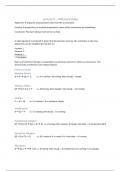
Lecture 9 – Inference Rules
Argument: A sequence of propositions that end with a conclusion.
Premise: A proposition, or multiple propositions, upon which conclusions are established.
Conclusion: The claim whose truth we try to show.
A valid argument is produced if, given that the premises are true, the conclusion is also true.
Arguments can be simplified and written as:
Premise 1
Premise 2…
Premise n
∴ Conclusion
Rules are functions that take in propositions as premises and return others as conclusions. This
lecture looks at inference rules (shown below).
Inference Rules
Modulus Ponens
[P • (P → Q)] => Q i.e. it is raining • (if raining, then cloudy) ∴ cloudy
Modulus Tollens
[(P → Q) • Q’] => P’ i.e. (if raining, then cloudy) • not cloudy ∴ not raining
Addition
P => (P + Q) i.e. it is raining ∴ it is raining or cloudy
Simplification
(P • Q) => P i.e. it is raining and cloudy ∴ it is raining
Hypothetical Syllogism
[(P → Q) • (Q → R)] => (P → R) i.e. if raining, then cloudy • if cloudy, then dark ∴ if raining then dark
Disjunctive Syllogism
[(P + Q) • P’] => Q i.e. (it is rainy or it is sunny) • it is not rainy ∴ it is sunny
Absorption
(P → Q) => P → (P • Q) i.e. if raining, then cloudy ∴ if raining then, (it is raining • it is cloudy)
Argument: A sequence of propositions that end with a conclusion.
Premise: A proposition, or multiple propositions, upon which conclusions are established.
Conclusion: The claim whose truth we try to show.
A valid argument is produced if, given that the premises are true, the conclusion is also true.
Arguments can be simplified and written as:
Premise 1
Premise 2…
Premise n
∴ Conclusion
Rules are functions that take in propositions as premises and return others as conclusions. This
lecture looks at inference rules (shown below).
Inference Rules
Modulus Ponens
[P • (P → Q)] => Q i.e. it is raining • (if raining, then cloudy) ∴ cloudy
Modulus Tollens
[(P → Q) • Q’] => P’ i.e. (if raining, then cloudy) • not cloudy ∴ not raining
Addition
P => (P + Q) i.e. it is raining ∴ it is raining or cloudy
Simplification
(P • Q) => P i.e. it is raining and cloudy ∴ it is raining
Hypothetical Syllogism
[(P → Q) • (Q → R)] => (P → R) i.e. if raining, then cloudy • if cloudy, then dark ∴ if raining then dark
Disjunctive Syllogism
[(P + Q) • P’] => Q i.e. (it is rainy or it is sunny) • it is not rainy ∴ it is sunny
Absorption
(P → Q) => P → (P • Q) i.e. if raining, then cloudy ∴ if raining then, (it is raining • it is cloudy)


