

Psych202 - Foundations of Cognitive Neuroscience
Lecture 4 - Short-Term/Working memory and the prefrontal cortex
Long-Term Memory (LTM):
● stored information that needs not be presently accessed or even consciously accessible; has
virtually unlimited capacity
Short-Term Memory (STM):
● memory for information currently “in mind”; limited capacity - retrieve one by one
Working Memory (WM)
● STM emphasises ‘limited’ maintenance of the current information
● WM emphasises that this information is being manipulated - additional brain resources
● In a nutshell, WM actively manipulates information within an STM store to support high cognitive
functions (e.g., comprehension, reading etc.)
● If you lose LTM like H.M. you can still ‘live in the present’.
● If your WM fails, you will lose the ability to carry out many activities of daily living, let alone
successfully execution of complex behaviour - can’t process memories
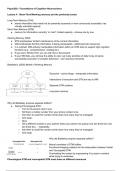
Baddeley’s (2000) Model of Working Memory
Executive - active things - manipulate information
Interactions of executive and STM are key to WM
Separate STM systems
Long term memory
Why did Baddeley propose separate buffers?
● Testing Phonological STM:
○ Turn to the person next to you:
○ Tell them a mobile number from your phone contact once
○ Ask them to recall the number (write down how many they’ve managed)
○ And swap.
○ Next,
○ Tell a different number to your partner while your partner are saying ‘one two three four one
two three four…’ repeatedly.
○ Ask them to recall the number (write down how many they’ve managed)
○ And swap.
Why did Baddeley propose separate buffers?
Neural correlates of STM buffers
Functional Imaging evidence for the dissociation between Verbal
and Visuospatial STM
Overloading the system by suppressing it by sayinv numbers
while trying to remember
Phonological STM and visuospatial STM must draw on different resources
, Different types of short-term memory
Stimuli for a short period of time and then a delay - finally have to
report the stimuli
Different parts of the brain are active - different neural correlates
Testing Phonological STM storage: Verbal Digit Span test
In this case, the span was 5
Most people can do 7±2
Capacity does vary - articulary suppressor limits the capacity further
Rehearsal is Required to Maintain: Phonological Short-Term Memory
Articulatory Suppression:
Silently (or not) mouthing words while performing some other task
Phonological STM has two components that
form a loop:
- Phonological store
- Rehearsal (refreshes the buffer) - Articulatory Suppression removes the ability to
rehearse
Neural Correlates of the Phonological Loop
● Phonological Loop:
○ phonological store
○ rehearsal mechanism
● Paulesu et al. (1993) PET study while participants
performed tasks engaging:
○ Remembering letters (store + rehearsal)
○ Rhyme Judgments (rehearsal only)
● Phonological store and rehearsal are separate components
Testing Visuospatial Short-Term Memory
‘Corsi Blocks’ tasks
● Study phase - Arrays of blocks - coloured cubes
● Delay - hold the information in their mind
● Test phase
● Recognition: Was this object present?
● Change Detection: Is the array the same?
● Cued Recall: What object was at this location?
Can accurately maintain up to 5 blocks in an array (Della Sala et al., 1999) - visuospatial sketchpad
Models of Visuospatial STM
● How to explain the STM limit?
● Slot model
Lecture 4 - Short-Term/Working memory and the prefrontal cortex
Long-Term Memory (LTM):
● stored information that needs not be presently accessed or even consciously accessible; has
virtually unlimited capacity
Short-Term Memory (STM):
● memory for information currently “in mind”; limited capacity - retrieve one by one
Working Memory (WM)
● STM emphasises ‘limited’ maintenance of the current information
● WM emphasises that this information is being manipulated - additional brain resources
● In a nutshell, WM actively manipulates information within an STM store to support high cognitive
functions (e.g., comprehension, reading etc.)
● If you lose LTM like H.M. you can still ‘live in the present’.
● If your WM fails, you will lose the ability to carry out many activities of daily living, let alone
successfully execution of complex behaviour - can’t process memories
Baddeley’s (2000) Model of Working Memory
Executive - active things - manipulate information
Interactions of executive and STM are key to WM
Separate STM systems
Long term memory
Why did Baddeley propose separate buffers?
● Testing Phonological STM:
○ Turn to the person next to you:
○ Tell them a mobile number from your phone contact once
○ Ask them to recall the number (write down how many they’ve managed)
○ And swap.
○ Next,
○ Tell a different number to your partner while your partner are saying ‘one two three four one
two three four…’ repeatedly.
○ Ask them to recall the number (write down how many they’ve managed)
○ And swap.
Why did Baddeley propose separate buffers?
Neural correlates of STM buffers
Functional Imaging evidence for the dissociation between Verbal
and Visuospatial STM
Overloading the system by suppressing it by sayinv numbers
while trying to remember
Phonological STM and visuospatial STM must draw on different resources
, Different types of short-term memory
Stimuli for a short period of time and then a delay - finally have to
report the stimuli
Different parts of the brain are active - different neural correlates
Testing Phonological STM storage: Verbal Digit Span test
In this case, the span was 5
Most people can do 7±2
Capacity does vary - articulary suppressor limits the capacity further
Rehearsal is Required to Maintain: Phonological Short-Term Memory
Articulatory Suppression:
Silently (or not) mouthing words while performing some other task
Phonological STM has two components that
form a loop:
- Phonological store
- Rehearsal (refreshes the buffer) - Articulatory Suppression removes the ability to
rehearse
Neural Correlates of the Phonological Loop
● Phonological Loop:
○ phonological store
○ rehearsal mechanism
● Paulesu et al. (1993) PET study while participants
performed tasks engaging:
○ Remembering letters (store + rehearsal)
○ Rhyme Judgments (rehearsal only)
● Phonological store and rehearsal are separate components
Testing Visuospatial Short-Term Memory
‘Corsi Blocks’ tasks
● Study phase - Arrays of blocks - coloured cubes
● Delay - hold the information in their mind
● Test phase
● Recognition: Was this object present?
● Change Detection: Is the array the same?
● Cued Recall: What object was at this location?
Can accurately maintain up to 5 blocks in an array (Della Sala et al., 1999) - visuospatial sketchpad
Models of Visuospatial STM
● How to explain the STM limit?
● Slot model


