Psych202 - Foundations of cognitive neuroscience
Lecture 13 - Neural basis of reading
Background: Origins of Writing
● Early writing based on pictorial representation, but late writing becomes
symbolic when representing word sounds
● Ancient languages often used graphic scripts where the symbol represented a
whole meaning or word and not just one letter
Background: The Writing System
● Alphabetic vs. Logographic
● Transparent vs. Opaque orthography
● For example: Japan has two writing systems
○ Kana: Alphabetic - represents sounds and letters
○ Kanji - Logographic - Each character visually looks like what it
represents - they represent a whole word
Reading aloud - Mapping print to sound
● In English, letter clusters are not always pronounced the same
● For example: “corpse, corps, horse and worse” - all have ‘or’ in the words but they are pronounced
very differently
● The same letter combination can sound different depending on the word
● How does the brain figure out what to say when looking at the same letters?
Reading is different from speech perception
● The Cohort Model of Speech Perception
○ Signal is decoded sequentially
○ Speech signal unfolds in time
○ We are forced to recognise one phoneme at a time until a word is
recognised
○ Only code one phoneme at a time
○ Filtering out other possible words until you reach the optimal phonemes to the point you can
decipher and recognise the word
Reading takes snapshots of letters
● All in one go
● We can recognise written words very rapidly and accurately, in a series of fixations (averaging
~200ms) and saccades, with some words skipped altogether
● Eye tracker films pupil movements in reading - eye fixation over text
● In reading your eye jumps from word to word (it is not a smooth movement)
● Jumping = Saccade = Rapid, conjugate, eye movement that shifts the centre of gaze from one part
of the visual field to another
Slpeling Isn’t As Ipmorantt As You Thnik
● Normal readers can read this surprisingly well:
○ I cdnuolt blveiee taht I cluod aulaclty uesdnatnrd waht I was rdanieg. The phaonmneal pweor
of the hmuan mnid. Aoccdrnig to a rscheearch at Cmabrigde Uinervtisy, it deosn't mttaer in
waht oredr the ltteers in a wrod are, the olny iprmoatnt tihng is taht the frist and lsat ltteer be
, in the rghit pclae. The rset can be a taotl mses and you can sitll raed it wouthit a porbelm.
Tihs is bcuseae the huamn mnid deos not raed ervey lteter by istlef, but the wrod as a wlohe.
Amzanig huh? Yaeh and I awlyas thought slpeling was ipmorantt.
● If you do not have dyslexia than reading the above passage is easy to read and spelling isnt
important
● If you have dyslexia than spelling is important an reading the passage is nearly impossible
Word superiority effect
● A few unexpected observations:
○ Visual processing time is not strongly affected by length, suggesting letters are not analysed
one by one:
○ PSYCHOLOGY vs. SKY
○ We are not trying to identify each letter at a time - psychology does not take 11 units of time
due to having 11 letters - psychology and sky will have similar reading times
● Letters identification is affected by whether it makes up a word or not
● Letter identification has top-down influences from word knowledge
○ The brain stores some sort of ‘word forms’
○ When word form is lost, you develop ‘word blindness’
Word Blindness
● Neuropsychological case:
○ Monsieur C developed ‘Word Blindness’ - incapable of understanding
written words
○ Autopsy by neurologist Joseph Dejerine shows stroke damage to the
left ventral occipito-temporal cortex (vOTC)
○ Connection between visual and language area was damaged
○ Dejerine thought this was a connection that carried visual information
forward to language areas of the brain
○ Others think this could be a ‘mental dictionary’ that stores the word
forms
Pure Alexia (Word Blindness)
● Word Blindness is also called Pure alexia
○ Defined by the presence of a letter length effect in reading aloud,
which normal readers do not show for most words
○ e.g., Reading times for PSYCHOLOGY (11 letters) is about 267%
longer than SKY (3 letters) in people with pure alexia
○ They analyse one letter at a time, rather than recognise a word form
holistically. (Word form knowledge is lost)
The confirmation of the Visual Word Form Area (VWFA)
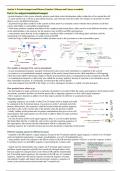
● Patients with left vOTC damage (dubbed the Visual Word Form Area) shows the word length effect
(pink, yellow), compared to visual cortex-lesioned patients without vOTC damage (green, blue)
● VWFA is likely more than a mere visual connection
Lecture 13 - Neural basis of reading
Background: Origins of Writing
● Early writing based on pictorial representation, but late writing becomes
symbolic when representing word sounds
● Ancient languages often used graphic scripts where the symbol represented a
whole meaning or word and not just one letter
Background: The Writing System
● Alphabetic vs. Logographic
● Transparent vs. Opaque orthography
● For example: Japan has two writing systems
○ Kana: Alphabetic - represents sounds and letters
○ Kanji - Logographic - Each character visually looks like what it
represents - they represent a whole word
Reading aloud - Mapping print to sound
● In English, letter clusters are not always pronounced the same
● For example: “corpse, corps, horse and worse” - all have ‘or’ in the words but they are pronounced
very differently
● The same letter combination can sound different depending on the word
● How does the brain figure out what to say when looking at the same letters?
Reading is different from speech perception
● The Cohort Model of Speech Perception
○ Signal is decoded sequentially
○ Speech signal unfolds in time
○ We are forced to recognise one phoneme at a time until a word is
recognised
○ Only code one phoneme at a time
○ Filtering out other possible words until you reach the optimal phonemes to the point you can
decipher and recognise the word
Reading takes snapshots of letters
● All in one go
● We can recognise written words very rapidly and accurately, in a series of fixations (averaging
~200ms) and saccades, with some words skipped altogether
● Eye tracker films pupil movements in reading - eye fixation over text
● In reading your eye jumps from word to word (it is not a smooth movement)
● Jumping = Saccade = Rapid, conjugate, eye movement that shifts the centre of gaze from one part
of the visual field to another
Slpeling Isn’t As Ipmorantt As You Thnik
● Normal readers can read this surprisingly well:
○ I cdnuolt blveiee taht I cluod aulaclty uesdnatnrd waht I was rdanieg. The phaonmneal pweor
of the hmuan mnid. Aoccdrnig to a rscheearch at Cmabrigde Uinervtisy, it deosn't mttaer in
waht oredr the ltteers in a wrod are, the olny iprmoatnt tihng is taht the frist and lsat ltteer be
, in the rghit pclae. The rset can be a taotl mses and you can sitll raed it wouthit a porbelm.
Tihs is bcuseae the huamn mnid deos not raed ervey lteter by istlef, but the wrod as a wlohe.
Amzanig huh? Yaeh and I awlyas thought slpeling was ipmorantt.
● If you do not have dyslexia than reading the above passage is easy to read and spelling isnt
important
● If you have dyslexia than spelling is important an reading the passage is nearly impossible
Word superiority effect
● A few unexpected observations:
○ Visual processing time is not strongly affected by length, suggesting letters are not analysed
one by one:
○ PSYCHOLOGY vs. SKY
○ We are not trying to identify each letter at a time - psychology does not take 11 units of time
due to having 11 letters - psychology and sky will have similar reading times
● Letters identification is affected by whether it makes up a word or not
● Letter identification has top-down influences from word knowledge
○ The brain stores some sort of ‘word forms’
○ When word form is lost, you develop ‘word blindness’
Word Blindness
● Neuropsychological case:
○ Monsieur C developed ‘Word Blindness’ - incapable of understanding
written words
○ Autopsy by neurologist Joseph Dejerine shows stroke damage to the
left ventral occipito-temporal cortex (vOTC)
○ Connection between visual and language area was damaged
○ Dejerine thought this was a connection that carried visual information
forward to language areas of the brain
○ Others think this could be a ‘mental dictionary’ that stores the word
forms
Pure Alexia (Word Blindness)
● Word Blindness is also called Pure alexia
○ Defined by the presence of a letter length effect in reading aloud,
which normal readers do not show for most words
○ e.g., Reading times for PSYCHOLOGY (11 letters) is about 267%
longer than SKY (3 letters) in people with pure alexia
○ They analyse one letter at a time, rather than recognise a word form
holistically. (Word form knowledge is lost)
The confirmation of the Visual Word Form Area (VWFA)
● Patients with left vOTC damage (dubbed the Visual Word Form Area) shows the word length effect
(pink, yellow), compared to visual cortex-lesioned patients without vOTC damage (green, blue)
● VWFA is likely more than a mere visual connection