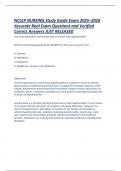
NCLEX NURSING Study Guide Exam 2025–2026
Accurate Real Exam Questions and Verified
Correct Answers JUST RELEASED
The nurse administers oral levothyroxine to a client with hypothyroidism.
Which of the following would be the PRIORITY for the nurse to monitor for?
A. Diarrhea
B. Palpitations
C. Diaphoresis
D. Weight loss - answer>>>B. Palpitations
Explanation:
Thyroid replacement is used to treat hypothyroidism a condition in which the thyroid
gland produces insufficient thyroid hormones to support the metabolic functions of the
n=body. Autoimmune disease (Hashimoto thyroiditis), surgical removal, destruction, by
irradiation, cancer, medications (amiodarone), and a poorly functioning thyroid gland are
all causes of hypothyroidism
Levothyroxine is a synthetic thyroid hormone use to treat hypothyroidism. It is an isomer
of thyroxine (T4) that stimulates T4 receptors in the body, effectively "replacing" the
client's thyroid hormone. Side effects of overdose can be serious and resemble an
extreme hyperthyroid state. symptoms indicating possible cardiac toxicity (e.g., chest
pain, hypertension tachycardia), should be reported immediately to the healthcare
provider. Palpitations are a sign of toxicity that can indicate arrhythmias, including atrial
fibrillation.
,Takeaway: Serious cardiovascular side effects of levothyroxine monitored for and report
include:
Palpitations
Chest pain
Hypertension
Tachycardia
The nurse is caring for a 76-year old female client who was recently prescribed
hydrochlorothiazide.
Which client finding would be MOST concerning?
A. Increased triglyceride levels
B. Nausea, headache, and lethargy
C. Client has been urinating frequently at night
D. Rash on sun-exposed skin of the face and arms - answer>>>B. Nausea, headache, and
lethargy
Explanation:
Nausea, headache, and lethargy are symptoms of hyponatremia hyponatremia is a side
effect of thiazide diuretics (e.g., hydrochlorothiazide) that occurs when too much sodium
is lost in the urine. Thiazide diuretics treat edema or hypertension by blocking the
reabsorption of sodium and chloride in the distal convoluted tubules. These symptoms
are most concerning, as hyponatremia can progress to confusion or seizures if the
electrolyte disturbance is not corrected.
Takeaway:
,Side effects of thiazide diuretics include hyponatremia, increasedtriglyceride levels, and
photosensitivity.
Nausea, headache, and lethargy are symptoms of hyponatremia that require follow-up.
The nurse has taught a client with anemia who is receiving ferrous sulfate.
Which of the following statements by the client would indicate a correct
UNDERSTANDING of the teaching?
A. " I should take this medication in between mealtimes."
B. " If I have black stools, I will notify my health care provider."
C. " O can take an antacid with this medication if it gives me heartburn."
D. " The liquid medication should be taken undiluted in a medicine cup." - answer>>>A. "
I should take this medication in between mealtimes."
Explanation:
The common side effect of ferrous sulfate include nausea, heartburn, bloating,
constipation, and diarrhea. These effects are typically dose-dependent and diminish over
time. Antacids should NOT be taken with ferrous sulfate to mitigate these symptoms as
co-administration with calcium decreases iron adsorption.
Liquid ferrous sulfate preparations can cause permanent teeth staining. To prevent this
the dose should be diluted and taken through a straw.
Additionally the client should be educated to rinse their mouth after taking the dose.
Takeaway Ferrous sulfate teaching includes:
, Take on an empty stomach to maximize absorption.
Avoid taking with calcium.
Common side effects (e.g., gastrointestinal upset, black or greenish-colored stools)
Liquid iron preparations should be diluted and taken through a straw.
The nurse is caring for a client with pneumonia who spikes a fever and has a drop in
blood pressure to 88/58.
Which order should the nurse implement FIRST?
A. Administer IV fluids bolus
B. Administer IV antibiotics
C. Draw 2 sets of blood cultures
D. Initiate IV norepinephrine infusion - answer>>>A. Administer IV fluids bolus
Explanation:
Septic shock occurs when inflammatory mediators (e.g., cytokines) are released in
response to infection, inducing widespread vasodilation and increased capillary
permeability. Priority treatment includes aggressive fluid resuscitation to improve
intravascular fluid volume and tissue perfusion. Recommendations include the rapid
administration of a 30 mL/kg bolus of crystalloid IV fluids (e.g., 30 mL x 100 kg = 3000 mL)
Takeaway:
Accurate Real Exam Questions and Verified
Correct Answers JUST RELEASED
The nurse administers oral levothyroxine to a client with hypothyroidism.
Which of the following would be the PRIORITY for the nurse to monitor for?
A. Diarrhea
B. Palpitations
C. Diaphoresis
D. Weight loss - answer>>>B. Palpitations
Explanation:
Thyroid replacement is used to treat hypothyroidism a condition in which the thyroid
gland produces insufficient thyroid hormones to support the metabolic functions of the
n=body. Autoimmune disease (Hashimoto thyroiditis), surgical removal, destruction, by
irradiation, cancer, medications (amiodarone), and a poorly functioning thyroid gland are
all causes of hypothyroidism
Levothyroxine is a synthetic thyroid hormone use to treat hypothyroidism. It is an isomer
of thyroxine (T4) that stimulates T4 receptors in the body, effectively "replacing" the
client's thyroid hormone. Side effects of overdose can be serious and resemble an
extreme hyperthyroid state. symptoms indicating possible cardiac toxicity (e.g., chest
pain, hypertension tachycardia), should be reported immediately to the healthcare
provider. Palpitations are a sign of toxicity that can indicate arrhythmias, including atrial
fibrillation.
,Takeaway: Serious cardiovascular side effects of levothyroxine monitored for and report
include:
Palpitations
Chest pain
Hypertension
Tachycardia
The nurse is caring for a 76-year old female client who was recently prescribed
hydrochlorothiazide.
Which client finding would be MOST concerning?
A. Increased triglyceride levels
B. Nausea, headache, and lethargy
C. Client has been urinating frequently at night
D. Rash on sun-exposed skin of the face and arms - answer>>>B. Nausea, headache, and
lethargy
Explanation:
Nausea, headache, and lethargy are symptoms of hyponatremia hyponatremia is a side
effect of thiazide diuretics (e.g., hydrochlorothiazide) that occurs when too much sodium
is lost in the urine. Thiazide diuretics treat edema or hypertension by blocking the
reabsorption of sodium and chloride in the distal convoluted tubules. These symptoms
are most concerning, as hyponatremia can progress to confusion or seizures if the
electrolyte disturbance is not corrected.
Takeaway:
,Side effects of thiazide diuretics include hyponatremia, increasedtriglyceride levels, and
photosensitivity.
Nausea, headache, and lethargy are symptoms of hyponatremia that require follow-up.
The nurse has taught a client with anemia who is receiving ferrous sulfate.
Which of the following statements by the client would indicate a correct
UNDERSTANDING of the teaching?
A. " I should take this medication in between mealtimes."
B. " If I have black stools, I will notify my health care provider."
C. " O can take an antacid with this medication if it gives me heartburn."
D. " The liquid medication should be taken undiluted in a medicine cup." - answer>>>A. "
I should take this medication in between mealtimes."
Explanation:
The common side effect of ferrous sulfate include nausea, heartburn, bloating,
constipation, and diarrhea. These effects are typically dose-dependent and diminish over
time. Antacids should NOT be taken with ferrous sulfate to mitigate these symptoms as
co-administration with calcium decreases iron adsorption.
Liquid ferrous sulfate preparations can cause permanent teeth staining. To prevent this
the dose should be diluted and taken through a straw.
Additionally the client should be educated to rinse their mouth after taking the dose.
Takeaway Ferrous sulfate teaching includes:
, Take on an empty stomach to maximize absorption.
Avoid taking with calcium.
Common side effects (e.g., gastrointestinal upset, black or greenish-colored stools)
Liquid iron preparations should be diluted and taken through a straw.
The nurse is caring for a client with pneumonia who spikes a fever and has a drop in
blood pressure to 88/58.
Which order should the nurse implement FIRST?
A. Administer IV fluids bolus
B. Administer IV antibiotics
C. Draw 2 sets of blood cultures
D. Initiate IV norepinephrine infusion - answer>>>A. Administer IV fluids bolus
Explanation:
Septic shock occurs when inflammatory mediators (e.g., cytokines) are released in
response to infection, inducing widespread vasodilation and increased capillary
permeability. Priority treatment includes aggressive fluid resuscitation to improve
intravascular fluid volume and tissue perfusion. Recommendations include the rapid
administration of a 30 mL/kg bolus of crystalloid IV fluids (e.g., 30 mL x 100 kg = 3000 mL)
Takeaway: