3.1.3 Modes of Transmission
Goals:
● Describe how infectious diseases can be transmitted.
● Explain ways to stop the spread of infectious diseases.
● Summarize how our bodies can fight infection.
● Use models and simulations to find trends in data.
Video Instructions for Part 1
Please go to 3.1.3 Modes of Transmission
As an introduction to 3.1.3, please watch the clip from Contagion.
Please read Contagion
Please read The Chain of Infection
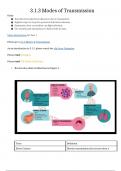
1. Review the chain of infection in Figure 1
Term Definition
Direct Contact Disease transmission that occurs when a
This study source was downloaded by 1143875 from cliffsnotes.com on 08-10-2025 19:06:41 GMT -05:00
https://www.cliffsnotes.com//study-notes/3431114
, susceptible host touches an infected individual
or is exposed to their body fluids.
Indirect Contact Disease transmission that occurs when a
susceptible host inhales infected particles
touches an infected object or is bitten by an
infected insect.
2. Analyze a chain of infection
Draw the chain of infection. Add to your chain as described below and respond to the following questions.
a. The bacterium, E. coli, can cause food poisoning. To the chain of infection, you drew, add
notes to show how E. coli can spread from a reservoir (such as contaminated beef) to a
susceptible host. Is this type of transmission direct or indirect?
1) Bacteria
2) Anyone
3) Gastrointestinal tract
4) Indirect contact
5) Urogenital tract
6) Contaminated beef
b. What may make a host more or less susceptible to an infectious disease?
i. Are the hospital patients more susceptible to disease given their conditions, or
less susceptible to disease given their presence in a hospital? Explain.
The environment they are in, the integrity of their immune system, their hygiene, etc. can make a person
more or less susceptible to an infectious disease. Hospital patients usually have compromised immune
systems, and can be exposed to infection while in surgery very easily if not taken care of properly, and the
patient can come into contact with other patients who have diseases.
3. Either individually or with a partner/group of 3, access the GNMH Hospital Map. There is a GNMH
map on Google Classroom on a Jamboard
4. Using the app, revisit Messages and Patient Details to access the patient locations for each of the 11
infected patients. (You may also access the map within the app.)
5. On the GNMH map (on the Jamboard on Google Classroom), plot the locations each patient visited.
PLTW LABORATORY NOTEBOOK
Either individually or with a partner/group of 3, look for and record any trends or patterns you
observe related to the locations of the 11 patients affected by this outbreak.
A lot of them were in the ER or OR then went to recovery and then the step-down unit.
This study source was downloaded by 1143875 from cliffsnotes.com on 08-10-2025 19:06:41 GMT -05:00
https://www.cliffsnotes.com//study-notes/3431114
Goals:
● Describe how infectious diseases can be transmitted.
● Explain ways to stop the spread of infectious diseases.
● Summarize how our bodies can fight infection.
● Use models and simulations to find trends in data.
Video Instructions for Part 1
Please go to 3.1.3 Modes of Transmission
As an introduction to 3.1.3, please watch the clip from Contagion.
Please read Contagion
Please read The Chain of Infection
1. Review the chain of infection in Figure 1
Term Definition
Direct Contact Disease transmission that occurs when a
This study source was downloaded by 1143875 from cliffsnotes.com on 08-10-2025 19:06:41 GMT -05:00
https://www.cliffsnotes.com//study-notes/3431114
, susceptible host touches an infected individual
or is exposed to their body fluids.
Indirect Contact Disease transmission that occurs when a
susceptible host inhales infected particles
touches an infected object or is bitten by an
infected insect.
2. Analyze a chain of infection
Draw the chain of infection. Add to your chain as described below and respond to the following questions.
a. The bacterium, E. coli, can cause food poisoning. To the chain of infection, you drew, add
notes to show how E. coli can spread from a reservoir (such as contaminated beef) to a
susceptible host. Is this type of transmission direct or indirect?
1) Bacteria
2) Anyone
3) Gastrointestinal tract
4) Indirect contact
5) Urogenital tract
6) Contaminated beef
b. What may make a host more or less susceptible to an infectious disease?
i. Are the hospital patients more susceptible to disease given their conditions, or
less susceptible to disease given their presence in a hospital? Explain.
The environment they are in, the integrity of their immune system, their hygiene, etc. can make a person
more or less susceptible to an infectious disease. Hospital patients usually have compromised immune
systems, and can be exposed to infection while in surgery very easily if not taken care of properly, and the
patient can come into contact with other patients who have diseases.
3. Either individually or with a partner/group of 3, access the GNMH Hospital Map. There is a GNMH
map on Google Classroom on a Jamboard
4. Using the app, revisit Messages and Patient Details to access the patient locations for each of the 11
infected patients. (You may also access the map within the app.)
5. On the GNMH map (on the Jamboard on Google Classroom), plot the locations each patient visited.
PLTW LABORATORY NOTEBOOK
Either individually or with a partner/group of 3, look for and record any trends or patterns you
observe related to the locations of the 11 patients affected by this outbreak.
A lot of them were in the ER or OR then went to recovery and then the step-down unit.
This study source was downloaded by 1143875 from cliffsnotes.com on 08-10-2025 19:06:41 GMT -05:00
https://www.cliffsnotes.com//study-notes/3431114