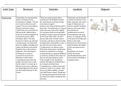
Joint Type Structure Function Location Diagram
Fixed Joints Fixed joints are connected by They are constructed to allow Fixed joints can be found in
dense connective tissue movement and flexibility (except numerous locations in the
consisting of collagen. They do for skull bones) and they provide body, however, the main 3
not move and have no joint mechanical support. types of fixed joints are
cavity. They are connected by Sutures are a type of fibrous joint in found in specific locations:
fibrous connective tissue. the skull. The skull bones of a foetus Sutures are found within
Skull bones are connected via will move over each other slightly the skull bones.
fibrous joints called sutures. to compress skull size during birth, Syndesmoses are joints
Sutures are bound together by making it easier to pass through the found between two long
connective tissues called birth canal. After birth, the skull bones. An example of this
sharpey’s fibres. The skull bones will return to their natural is the joint of the tibia and
bones of a foetus are unfused. structure and fuse to become fixed, fibula in the ankle.
Syndesmoses are fixed joints making them immovable in order to Movement in these joints is
that are slightly moveable and protect the brain from impact. determined by the length
allow two bones to be joined Syndesmoses’ are fibrous joints of the connective tissue
together by an interosseous that have interosseous membranes fibres.
ligament. This interosseous which are important in creating Gomphoses are found
membrane is a type of compartments to separate different within the mouth,
connective tissue found structures, distribute the impact of specifically between tooth
between certain bones. forces and separating the joints. roots and the mandible or
A gomphosis joint lines the The strength of the membrane maxillary bones.
upper and lower jaw in each allows absorption and distribution
tooth socket. It is made up of on impacts of either bone.
fibrous tissue and a collection A gomphosis is a fibrous joint and
of tough ligaments that attach anchors a tooth to its socket. They
to the socket and base of the have very little mobility, so teeth
tooth. are held firmly in place. Gomphosis
is developed along with adult teeth
to make sure they’re anchored into
the jaw.
Fixed Joints Fixed joints are connected by They are constructed to allow Fixed joints can be found in
dense connective tissue movement and flexibility (except numerous locations in the
consisting of collagen. They do for skull bones) and they provide body, however, the main 3
not move and have no joint mechanical support. types of fixed joints are
cavity. They are connected by Sutures are a type of fibrous joint in found in specific locations:
fibrous connective tissue. the skull. The skull bones of a foetus Sutures are found within
Skull bones are connected via will move over each other slightly the skull bones.
fibrous joints called sutures. to compress skull size during birth, Syndesmoses are joints
Sutures are bound together by making it easier to pass through the found between two long
connective tissues called birth canal. After birth, the skull bones. An example of this
sharpey’s fibres. The skull bones will return to their natural is the joint of the tibia and
bones of a foetus are unfused. structure and fuse to become fixed, fibula in the ankle.
Syndesmoses are fixed joints making them immovable in order to Movement in these joints is
that are slightly moveable and protect the brain from impact. determined by the length
allow two bones to be joined Syndesmoses’ are fibrous joints of the connective tissue
together by an interosseous that have interosseous membranes fibres.
ligament. This interosseous which are important in creating Gomphoses are found
membrane is a type of compartments to separate different within the mouth,
connective tissue found structures, distribute the impact of specifically between tooth
between certain bones. forces and separating the joints. roots and the mandible or
A gomphosis joint lines the The strength of the membrane maxillary bones.
upper and lower jaw in each allows absorption and distribution
tooth socket. It is made up of on impacts of either bone.
fibrous tissue and a collection A gomphosis is a fibrous joint and
of tough ligaments that attach anchors a tooth to its socket. They
to the socket and base of the have very little mobility, so teeth
tooth. are held firmly in place. Gomphosis
is developed along with adult teeth
to make sure they’re anchored into
the jaw.