
CHAPTER 51 Characteristics of Countries at different levels of development
Population growth and structure
Measurement and causes of changes in birth rate, death rate, infant mortality and net
migration
Birth and death rates are two key factors in population growth. They are both measured
per thousand of the population per year. As countries develop, health and education
services improve leading to lower birth and death rates. Also important is the infant
mortality rate which is again improved health care will lead to a decline.
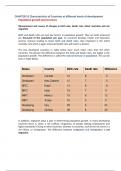
The two developed countries in Table below have much lower rates than the other
countries. The greater the difference between the birth and death rates, the higher is the
population growth. This difference is called the natural increase in population. This can be
seen in Table below.
In addition, migration plays a part in determining population growth. In many developing
countries there is, often, a net outflow, emigration, of people seeking employment and
higher standards of living in other countries, whereas in countries, such as the UK, there is a
net inflow, or immigration. The difference between emigration and immigration is net
migration.
, Causes of changes in population:
As countries develop, the growth in their populations tends to decline. While their death
rate decreases, their birth rate falls at a greater rate. Better health care, education,
sanitation, housing and nutrition contribute to people living longer. A decline in infant
mortality, increased cost of bringing up children and increase in women’s participation in
the labor force usually result in a decline in the birth rate.
Some countries with a high income per head and high development experience a natural
rate of decrease in population. A number of these still experience a rise in population
because they attract net immigration. People may want to move to the country to gain
higher income and to enjoy a higher living standard.
The higher birth rate of countries with low development results in a relatively low average
age of population. This creates a high proportion of dependent, non-productive members
of the population.
Population growth and structure
Measurement and causes of changes in birth rate, death rate, infant mortality and net
migration
Birth and death rates are two key factors in population growth. They are both measured
per thousand of the population per year. As countries develop, health and education
services improve leading to lower birth and death rates. Also important is the infant
mortality rate which is again improved health care will lead to a decline.
The two developed countries in Table below have much lower rates than the other
countries. The greater the difference between the birth and death rates, the higher is the
population growth. This difference is called the natural increase in population. This can be
seen in Table below.
In addition, migration plays a part in determining population growth. In many developing
countries there is, often, a net outflow, emigration, of people seeking employment and
higher standards of living in other countries, whereas in countries, such as the UK, there is a
net inflow, or immigration. The difference between emigration and immigration is net
migration.
, Causes of changes in population:
As countries develop, the growth in their populations tends to decline. While their death
rate decreases, their birth rate falls at a greater rate. Better health care, education,
sanitation, housing and nutrition contribute to people living longer. A decline in infant
mortality, increased cost of bringing up children and increase in women’s participation in
the labor force usually result in a decline in the birth rate.
Some countries with a high income per head and high development experience a natural
rate of decrease in population. A number of these still experience a rise in population
because they attract net immigration. People may want to move to the country to gain
higher income and to enjoy a higher living standard.
The higher birth rate of countries with low development results in a relatively low average
age of population. This creates a high proportion of dependent, non-productive members
of the population.


