'BATTLE OF THE FORMS'
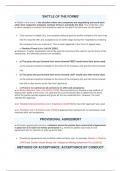
⇒ 'Battle of the forms' is the situation where two companies are negotiating and send each
other their respective company contract forms to conclude the deal. The contention, then,
is which company's contract form should be used for the deal if the terms are not the same?
• If the contract is simple (e.g. one company selling a good to another company) the court may
find the required offer and acceptance at an earlier stage during their negotiations (meaning
the company forms are irrelevant). This is what happened in the Court of Appeal case
of Hertford Foods Ltd v Lidl UK [2001].
⇒ However, if earlier negotiations cannot be used (to circumvent the need to use the forms of the
companies), the following solutions are available:
• a) The party who put forward their terms forward FIRST would have their terms used:
so the contract would be finalised on the terms of the company who put their terms forward
first.
• b) The party who put forward their terms forward LAST would have their terms used:
so the contract would be finalised on the terms of the company who put their terms forward
last (this is also known as the 'last shot’ approach).
• c) There is no contract at all as there is no offer and acceptance.
⇒ In Butler Machine Tool v Ex-Cell-O [1979], Denning tried to put forward a new method of
dealing with 'battle of the forms'. He said that the court should be able to determine the terms
which the parties actually agreed and ignore all the non-essential term. However, the court
rejected this approach.
⇒ In Tekdata Interconnections Ltd v Amphenol Ltd [2010] the 'last shot' approach was used.
⇒ In Trentham Ltd v Archital Luxfer [1993] it appeared that contracts do not necessarily need
matching offer and acceptance.
PROVISIONAL AGREEMENT
⇒ Provision agreements concern a situation where the parties have some kind of agreement
in place but it is said it is merely provisional e.g. where the parties have had an oral
agreement with an intention to write up terms later.
• Provisional agreements can constitute valid contracts: see, for example, Branca v Cobarro
[1947] and Golden Ocean Group Ltd v Salgaocar Mining Industries Pvt Ltd [2012].
METHODS OF ACCEPTANCE: ACCEPTANCE BY CONDUCT
, ⇒ With unilateral contracts acceptance is always done by conduct: see, for example, Carlill v
Carbolic Smoke Ball Co [1893].
⇒ With Bilateral contracts sometimes conduct can amount to acceptance too e.g. in a shop no
words may be spoken but a transaction can be done.
⇒ Even where the contract is more complex it may be possible for conduct to amount to
acceptance: see, for example, Brogden v Metropolitan Railway (1877).
⇒ Acceptance should be made in the manner prescribed by the offer: see, for
example, Haughland Tankers AS v RMK Marine [2005].
METHODS OF ACCEPTANCE: ACCEPTANCE BY SILENCE
⇒ Again, see the case of Brogden v Metropolitan Railway (1877): this case shows that the
reasonable person must be able to tell there was some intention to accept where there is
acceptance by silence.
⇒ In some cases acceptance by silence is possible e.g. in unilateral contracts to the world, like
in Carlill v Carbolic Smoke Ball Co [1893], acceptance is made through performance of the
contract.
⇒ In bilateral contracts, almost always it will be the case that silence cannot amount to
acceptance
• See the case of Felthouse v Bindley (1862) .
• Robert Goff J in The Leonidas D [1985]: "We have all been bought up to believe it to be
axiomatic that acceptance of an offer cannot be inferred from silence, save in the most
exceptional of circumstances."
• In Vitol SA v Norelf Ltd [1996] it was suggested this "exceptional circumstance" would be
where the silence was a "clear and unequivocal" acceptance.
ACCEPTANCE BY POST
⇒ The general rule is that acceptance is complete as soon as you post the letter i.e. if you
are made an offer and said acceptance must be made by post, your acceptance is complete
when your letter is put in the letterbox.
• See, for example, Adams v Lindsell (1818).
⇒ Limitations to the postal rule:
• The postal rule only applies to acceptance.
• The postal rule only applies when it is reasonable for acceptance to be sent by post.
⇒ 'Battle of the forms' is the situation where two companies are negotiating and send each
other their respective company contract forms to conclude the deal. The contention, then,
is which company's contract form should be used for the deal if the terms are not the same?
• If the contract is simple (e.g. one company selling a good to another company) the court may
find the required offer and acceptance at an earlier stage during their negotiations (meaning
the company forms are irrelevant). This is what happened in the Court of Appeal case
of Hertford Foods Ltd v Lidl UK [2001].
⇒ However, if earlier negotiations cannot be used (to circumvent the need to use the forms of the
companies), the following solutions are available:
• a) The party who put forward their terms forward FIRST would have their terms used:
so the contract would be finalised on the terms of the company who put their terms forward
first.
• b) The party who put forward their terms forward LAST would have their terms used:
so the contract would be finalised on the terms of the company who put their terms forward
last (this is also known as the 'last shot’ approach).
• c) There is no contract at all as there is no offer and acceptance.
⇒ In Butler Machine Tool v Ex-Cell-O [1979], Denning tried to put forward a new method of
dealing with 'battle of the forms'. He said that the court should be able to determine the terms
which the parties actually agreed and ignore all the non-essential term. However, the court
rejected this approach.
⇒ In Tekdata Interconnections Ltd v Amphenol Ltd [2010] the 'last shot' approach was used.
⇒ In Trentham Ltd v Archital Luxfer [1993] it appeared that contracts do not necessarily need
matching offer and acceptance.
PROVISIONAL AGREEMENT
⇒ Provision agreements concern a situation where the parties have some kind of agreement
in place but it is said it is merely provisional e.g. where the parties have had an oral
agreement with an intention to write up terms later.
• Provisional agreements can constitute valid contracts: see, for example, Branca v Cobarro
[1947] and Golden Ocean Group Ltd v Salgaocar Mining Industries Pvt Ltd [2012].
METHODS OF ACCEPTANCE: ACCEPTANCE BY CONDUCT
, ⇒ With unilateral contracts acceptance is always done by conduct: see, for example, Carlill v
Carbolic Smoke Ball Co [1893].
⇒ With Bilateral contracts sometimes conduct can amount to acceptance too e.g. in a shop no
words may be spoken but a transaction can be done.
⇒ Even where the contract is more complex it may be possible for conduct to amount to
acceptance: see, for example, Brogden v Metropolitan Railway (1877).
⇒ Acceptance should be made in the manner prescribed by the offer: see, for
example, Haughland Tankers AS v RMK Marine [2005].
METHODS OF ACCEPTANCE: ACCEPTANCE BY SILENCE
⇒ Again, see the case of Brogden v Metropolitan Railway (1877): this case shows that the
reasonable person must be able to tell there was some intention to accept where there is
acceptance by silence.
⇒ In some cases acceptance by silence is possible e.g. in unilateral contracts to the world, like
in Carlill v Carbolic Smoke Ball Co [1893], acceptance is made through performance of the
contract.
⇒ In bilateral contracts, almost always it will be the case that silence cannot amount to
acceptance
• See the case of Felthouse v Bindley (1862) .
• Robert Goff J in The Leonidas D [1985]: "We have all been bought up to believe it to be
axiomatic that acceptance of an offer cannot be inferred from silence, save in the most
exceptional of circumstances."
• In Vitol SA v Norelf Ltd [1996] it was suggested this "exceptional circumstance" would be
where the silence was a "clear and unequivocal" acceptance.
ACCEPTANCE BY POST
⇒ The general rule is that acceptance is complete as soon as you post the letter i.e. if you
are made an offer and said acceptance must be made by post, your acceptance is complete
when your letter is put in the letterbox.
• See, for example, Adams v Lindsell (1818).
⇒ Limitations to the postal rule:
• The postal rule only applies to acceptance.
• The postal rule only applies when it is reasonable for acceptance to be sent by post.