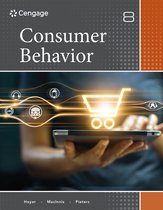
SOLUTION MANUAL FOR
Consumer Behavior 8th Edition Wayne D. Hoyer, Deborah J.
MacInnis, Rik Pieters
Chapter 1: Understanding Consumer Behavior
TABLE OF CONTENTS
Purpose and Perspective of the Chapter ............................... 2
List of Student Downloads ............................................ 3
Chapter Objectives ................................................... 3
Complete List of Chapter Activities and Assessments .................. 3
Key Terms ............................................................ 4
What's New in This Chapter ........................................... 5
Chapter Outline ...................................................... 6
End-Of-Chapter Questions for Review and Discussion .................. 15
Additional Discussion Questions ..................................... 18
Additional Activities and Assignments ............................... 19
1
1
, Instructor Manual: Chapter 1: Understanding Consumer Behavior
PURPOSE AND PERSPECTIVE OF THE CHAPTER
The purpose of this chapter is to explore the fundamentals of consumer
behavior. Consumer behavior involves understanding the set of
decisions (what, whether, why, when, how, where, how much, and how
often) that an individual or group of consumers makes over time about
the acquisition, use, or disposition of goods, services, ideas, or
other offerings. The psychological core exerts considerable influence
on consumer behavior. A consumer‘s motivation, ability, and
opportunity affect their decisions and influence what a person is
exposed to, what they pay attention to, and what they perceive and
comprehend. These factors also affect how consumers categorize and
interpret information, how they form and retrieve memories, and how
they form and change attitudes. Each aspect of the psychological core
has a bearing on the consumer decision-making process, which involves
(1) problem recognition, (2) information search, (3) judgments and
decision making, and (4) evaluating satisfaction with the decision.
Consumer behavior is affected by the consumer‘s culture and by the
typical or expected behaviors, norms, and ideas of a particular group.
Consumers belong to a number of groups, share their cultural values
and beliefs, and use their symbols to communicate group membership.
Household and social class influences are involved in consumer
behavior, as are each individual‘s values, personality, and
lifestyles. Consumer behavior can be symbolic and express an
individual‘s identity. It is also indicative of how quickly an
offering spreads throughout a market. Further, ethics and social
responsibility play a role in consumer behavior.
Marketers study consumer behavior to gain insights that will lead to
more effective marketing strategies and tactics. Ethicists and
advocacy groups are keenly interested in consumer behavior, as are
public policy makers and regulators who want to protect consumers from
unsafe or inappropriate offerings. Consumers and society can both
benefit as marketers learn to make products more user-friendly and to
show concern for the environment. Finally, studying consumer behavior
helps marketers understand how to segment markets and how to decide
which to target, how to position an offering, and which marketing-mix
strategies will be most effective.
Chapter Appendix
This chapter‘s Appendix focuses on consumer behavior research and its
special implications for marketers. Students will learn about various
research methods, types of data, and ethical issues related to
consumer research. With this background, they will be able to
understand how consumer research helps marketers develop more
effective strategies and tactics for reaching and satisfying
customers.
2
2
, Instructor Manual: Chapter 1: Understanding Consumer Behavior
LIST OF STUDENT DOWNLOADS
Students should download the following items from the Student
Companion Center to complete the activities and assignments related to
this chapter:
Downloadable Student PowerPoints
CHAPTER OBJECTIVES
The following objectives are addressed in this chapter:
1-1 Explain the components that make up the definition of consumer
behavior.
1-2 Identify the four domains of consumer behavior that affect
acquisition, usage, and disposition decisions.
1-3 Discuss the benefits of studying consumer behavior.
1-4 Explain how companies apply consumer behavior concepts when
making marketing decisions.
COMPLETE LIST OF CHAPTER ACTIVITIES AND ASSESSMENTS
The following table organizes activities and assessments by objective,
so that you can see how all this content relates to objectives and
make decisions about which content you would like to emphasize in your
class based on your objectives. For additional guidance, refer to the
Teaching Online Guide.
Chapter Activity/Assessment Source (i.e., PPT Duration
Objective slide, Workbook)
N/A Icebreaker PowerPoint Slide 3 5–10 mins.
1-1 Group Activity PowerPoint Slide 15 15-25 mins.
1-2 Polling Activity PowerPoint Slide 23 5–10 mins.
1-4 Discussion Activity PowerPoint Slide 31 10-15 mins.
1-1 – 1-4 Knowledge Check PowerPoint Slide 39 5 mins.
Activity
1-1 – 1-4 Learn It: Concept MindTap Learning Path 35–45 mins.
Check Quiz: Chapter 01 Chapter 1 Folder
Understanding Consumer
Behavior
1-1 – 1-4 Apply It: Assignment: MindTap Learning Path 35–45 mins.
Chapter 01 Chapter 1 Folder
Understanding Consumer
Behavior
1-1 – 1-4 Apply It: Case MindTap Learning Path 35–45 mins.
2
3
, Instructor Manual: Chapter 1: Understanding Consumer Behavior
Activity: Chapter 01 Chapter 1 Folder
Understanding Consumer
Behavior
[return to top]
KEY TERMS
Chapter 1
Acquisition: The process by which a consumer comes to own or
experience an offering.
Consumer behavior: The totality of consumers‘ decisions with respect
to the acquisition, consumption, and disposition of goods, services,
time, places, and ideas by human decision-making units (over time).
Culture: The typical or expected behaviors, norms, and ideas that
characterize a group of people.
Disposition: The process by which a consumer discards an offering.
Marketing: The activity, set of institutions, and processes for
creating, communicating, delivering, and exchanging offerings with
value for individuals, groups, and society.
Offering: A product, service, activity, experience, or idea offered by
a marketing organization to consumers.
Reference group: A group of people consumers compare themselves with
for information regarding behavior, attitudes, or values.
Symbols: External signs that consumers use to express their identity.
Usage: The process by which a consumer uses or consumes an offering.
Chapter 1 Appendix
Conjoint analysis: A research technique to determine the relative
importance and appeal of different levels of an offering‘s attributes.
Data mining: Searching for patterns in a company database that offer
clues to customer needs, preferences, and behaviors.
Ethnographic research: In-depth qualitative research using
observations and interviews (often over repeated occasions) of
consumers in real-world surroundings. Often used to study the meaning
that consumers ascribe to a product or consumption phenomenon.
2
4
Consumer Behavior 8th Edition Wayne D. Hoyer, Deborah J.
MacInnis, Rik Pieters
Chapter 1: Understanding Consumer Behavior
TABLE OF CONTENTS
Purpose and Perspective of the Chapter ............................... 2
List of Student Downloads ............................................ 3
Chapter Objectives ................................................... 3
Complete List of Chapter Activities and Assessments .................. 3
Key Terms ............................................................ 4
What's New in This Chapter ........................................... 5
Chapter Outline ...................................................... 6
End-Of-Chapter Questions for Review and Discussion .................. 15
Additional Discussion Questions ..................................... 18
Additional Activities and Assignments ............................... 19
1
1
, Instructor Manual: Chapter 1: Understanding Consumer Behavior
PURPOSE AND PERSPECTIVE OF THE CHAPTER
The purpose of this chapter is to explore the fundamentals of consumer
behavior. Consumer behavior involves understanding the set of
decisions (what, whether, why, when, how, where, how much, and how
often) that an individual or group of consumers makes over time about
the acquisition, use, or disposition of goods, services, ideas, or
other offerings. The psychological core exerts considerable influence
on consumer behavior. A consumer‘s motivation, ability, and
opportunity affect their decisions and influence what a person is
exposed to, what they pay attention to, and what they perceive and
comprehend. These factors also affect how consumers categorize and
interpret information, how they form and retrieve memories, and how
they form and change attitudes. Each aspect of the psychological core
has a bearing on the consumer decision-making process, which involves
(1) problem recognition, (2) information search, (3) judgments and
decision making, and (4) evaluating satisfaction with the decision.
Consumer behavior is affected by the consumer‘s culture and by the
typical or expected behaviors, norms, and ideas of a particular group.
Consumers belong to a number of groups, share their cultural values
and beliefs, and use their symbols to communicate group membership.
Household and social class influences are involved in consumer
behavior, as are each individual‘s values, personality, and
lifestyles. Consumer behavior can be symbolic and express an
individual‘s identity. It is also indicative of how quickly an
offering spreads throughout a market. Further, ethics and social
responsibility play a role in consumer behavior.
Marketers study consumer behavior to gain insights that will lead to
more effective marketing strategies and tactics. Ethicists and
advocacy groups are keenly interested in consumer behavior, as are
public policy makers and regulators who want to protect consumers from
unsafe or inappropriate offerings. Consumers and society can both
benefit as marketers learn to make products more user-friendly and to
show concern for the environment. Finally, studying consumer behavior
helps marketers understand how to segment markets and how to decide
which to target, how to position an offering, and which marketing-mix
strategies will be most effective.
Chapter Appendix
This chapter‘s Appendix focuses on consumer behavior research and its
special implications for marketers. Students will learn about various
research methods, types of data, and ethical issues related to
consumer research. With this background, they will be able to
understand how consumer research helps marketers develop more
effective strategies and tactics for reaching and satisfying
customers.
2
2
, Instructor Manual: Chapter 1: Understanding Consumer Behavior
LIST OF STUDENT DOWNLOADS
Students should download the following items from the Student
Companion Center to complete the activities and assignments related to
this chapter:
Downloadable Student PowerPoints
CHAPTER OBJECTIVES
The following objectives are addressed in this chapter:
1-1 Explain the components that make up the definition of consumer
behavior.
1-2 Identify the four domains of consumer behavior that affect
acquisition, usage, and disposition decisions.
1-3 Discuss the benefits of studying consumer behavior.
1-4 Explain how companies apply consumer behavior concepts when
making marketing decisions.
COMPLETE LIST OF CHAPTER ACTIVITIES AND ASSESSMENTS
The following table organizes activities and assessments by objective,
so that you can see how all this content relates to objectives and
make decisions about which content you would like to emphasize in your
class based on your objectives. For additional guidance, refer to the
Teaching Online Guide.
Chapter Activity/Assessment Source (i.e., PPT Duration
Objective slide, Workbook)
N/A Icebreaker PowerPoint Slide 3 5–10 mins.
1-1 Group Activity PowerPoint Slide 15 15-25 mins.
1-2 Polling Activity PowerPoint Slide 23 5–10 mins.
1-4 Discussion Activity PowerPoint Slide 31 10-15 mins.
1-1 – 1-4 Knowledge Check PowerPoint Slide 39 5 mins.
Activity
1-1 – 1-4 Learn It: Concept MindTap Learning Path 35–45 mins.
Check Quiz: Chapter 01 Chapter 1 Folder
Understanding Consumer
Behavior
1-1 – 1-4 Apply It: Assignment: MindTap Learning Path 35–45 mins.
Chapter 01 Chapter 1 Folder
Understanding Consumer
Behavior
1-1 – 1-4 Apply It: Case MindTap Learning Path 35–45 mins.
2
3
, Instructor Manual: Chapter 1: Understanding Consumer Behavior
Activity: Chapter 01 Chapter 1 Folder
Understanding Consumer
Behavior
[return to top]
KEY TERMS
Chapter 1
Acquisition: The process by which a consumer comes to own or
experience an offering.
Consumer behavior: The totality of consumers‘ decisions with respect
to the acquisition, consumption, and disposition of goods, services,
time, places, and ideas by human decision-making units (over time).
Culture: The typical or expected behaviors, norms, and ideas that
characterize a group of people.
Disposition: The process by which a consumer discards an offering.
Marketing: The activity, set of institutions, and processes for
creating, communicating, delivering, and exchanging offerings with
value for individuals, groups, and society.
Offering: A product, service, activity, experience, or idea offered by
a marketing organization to consumers.
Reference group: A group of people consumers compare themselves with
for information regarding behavior, attitudes, or values.
Symbols: External signs that consumers use to express their identity.
Usage: The process by which a consumer uses or consumes an offering.
Chapter 1 Appendix
Conjoint analysis: A research technique to determine the relative
importance and appeal of different levels of an offering‘s attributes.
Data mining: Searching for patterns in a company database that offer
clues to customer needs, preferences, and behaviors.
Ethnographic research: In-depth qualitative research using
observations and interviews (often over repeated occasions) of
consumers in real-world surroundings. Often used to study the meaning
that consumers ascribe to a product or consumption phenomenon.
2
4