BDF9
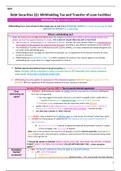
Debt Securities (3): Withholding Tax and Transfer of Loan Facilities
Withholding tax In relation to bonds
Withholding tax is not a threat to the margin per se, but it is a POTENTIAL THREAT to a bank recovering the FULL
AMOUNT OF INTEREST it is expecting.
What is withholding tax?
® Under the Income Tax Act 2007 (ITA 2007), there are certain circumstances in which a person paying interest must
deduct tax from the payment before it is made. IT IS A WAY OF COLLECTING TAX, NOT A TAX ITSELF
Þ This is known as ‘withholding tax’ or ‘deduction at source’, and (like the more familiar PAYE) it is a tax imposed on
the recipient of the payment but collected from the payer, providing a very efficient mechanism for tax collection.
Þ The withheld tax is either sent to HM Revenue and Customs (HMRC), or it may sometimes be netted off against any
tax credit of the withholding party.
Þ Withholding tax does not apply to repayments of principal, nor on repayment of the discount element of a loan
issued at a discount.
Þ Withholding tax is a question of law – it is NOT a question of contract. You cannot agree to not include
withholding tax in your deal. It is a legal requirement to have it.
ª Market expects international issues to be gross paying (i.e. ISSUER bears the cost of any withholding tax).
Hence, borrower will be concerned at outset to ensure that no WT deductible from interest payments
under bonds: à QUOTED EUROBOND EXEMPTION.
ª Withholding tax only applies to repayment of the interest (coupon) it DOES NOT apply to repayment of the
principal, NOR on repayment of the discount element of a loan issued at a discount
Section 874 Income Tax Act 2007 – Tax on yearly interest payments
Does ® 874(1)(a) – Withholding tax applies on YEARLY interest payments by a Company (distinguish
withholding tax from loan arrangement)
apply? ü Case law suggests that yearly interest is such which is payable under a debt which is
capable of having, and is intended to have, a term of at least 12 months.
ü Corinthian v Cato emphasises that the important point is the intention
Þ applies only to 'yearly' interest which is interest paid under a debt which is capable of
having, and is intended to have, a term of at least 12 months – maturity of debt
Þ Less than this is known as 'short' interest;
® s. 874(2) – duty to deduct by Co (20% tax rate) i.e. have to pay ‘net interest’ rather than ‘gross’.
® S.874(5): For the purposes of subsection (1) the following are to be treated as payments of
yearly interest—
a) a payment of interest made by a registered industrial and provident society in respect
of any mortgage, loan, loan stock or deposit
Note: One of the conditions for interest to be payable is that the interest payments must have a UK
source factors such as the borrower's residency, assets secured in the UK and payments being made
from or through the UK
**THEREFORE WHEN A COMPANY MAKES A BOND ISSUE AND THEN MAKES AN INTEREST PAYMENT,
IT MUST DEDUCT TAX FROM THIS PAYMENT (CALLED WITHHOLDING TAX)… unless exception
applies**
Exemption: ® s.882 – the duty to withhold tax does not apply to a quoted Eurobond
Quoted Þ s. 987 – def. of Eurobond:
Eurobond? ü Issued by Co
ü Listed on recognised stock exchange (defined under s.1005 and includes the Main Market
1
Debt Securities (3): Withholding Tax and Transfer of Loan Facilities
Withholding tax In relation to bonds
Withholding tax is not a threat to the margin per se, but it is a POTENTIAL THREAT to a bank recovering the FULL
AMOUNT OF INTEREST it is expecting.
What is withholding tax?
® Under the Income Tax Act 2007 (ITA 2007), there are certain circumstances in which a person paying interest must
deduct tax from the payment before it is made. IT IS A WAY OF COLLECTING TAX, NOT A TAX ITSELF
Þ This is known as ‘withholding tax’ or ‘deduction at source’, and (like the more familiar PAYE) it is a tax imposed on
the recipient of the payment but collected from the payer, providing a very efficient mechanism for tax collection.
Þ The withheld tax is either sent to HM Revenue and Customs (HMRC), or it may sometimes be netted off against any
tax credit of the withholding party.
Þ Withholding tax does not apply to repayments of principal, nor on repayment of the discount element of a loan
issued at a discount.
Þ Withholding tax is a question of law – it is NOT a question of contract. You cannot agree to not include
withholding tax in your deal. It is a legal requirement to have it.
ª Market expects international issues to be gross paying (i.e. ISSUER bears the cost of any withholding tax).
Hence, borrower will be concerned at outset to ensure that no WT deductible from interest payments
under bonds: à QUOTED EUROBOND EXEMPTION.
ª Withholding tax only applies to repayment of the interest (coupon) it DOES NOT apply to repayment of the
principal, NOR on repayment of the discount element of a loan issued at a discount
Section 874 Income Tax Act 2007 – Tax on yearly interest payments
Does ® 874(1)(a) – Withholding tax applies on YEARLY interest payments by a Company (distinguish
withholding tax from loan arrangement)
apply? ü Case law suggests that yearly interest is such which is payable under a debt which is
capable of having, and is intended to have, a term of at least 12 months.
ü Corinthian v Cato emphasises that the important point is the intention
Þ applies only to 'yearly' interest which is interest paid under a debt which is capable of
having, and is intended to have, a term of at least 12 months – maturity of debt
Þ Less than this is known as 'short' interest;
® s. 874(2) – duty to deduct by Co (20% tax rate) i.e. have to pay ‘net interest’ rather than ‘gross’.
® S.874(5): For the purposes of subsection (1) the following are to be treated as payments of
yearly interest—
a) a payment of interest made by a registered industrial and provident society in respect
of any mortgage, loan, loan stock or deposit
Note: One of the conditions for interest to be payable is that the interest payments must have a UK
source factors such as the borrower's residency, assets secured in the UK and payments being made
from or through the UK
**THEREFORE WHEN A COMPANY MAKES A BOND ISSUE AND THEN MAKES AN INTEREST PAYMENT,
IT MUST DEDUCT TAX FROM THIS PAYMENT (CALLED WITHHOLDING TAX)… unless exception
applies**
Exemption: ® s.882 – the duty to withhold tax does not apply to a quoted Eurobond
Quoted Þ s. 987 – def. of Eurobond:
Eurobond? ü Issued by Co
ü Listed on recognised stock exchange (defined under s.1005 and includes the Main Market
1