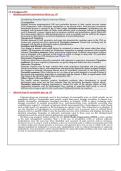
Detention for Questioning Before an Arrest
• The police, in the execution of their duty to keep the peace, prevent crime and bring
criminals to justice, may make reasonable enquiries and ask questions of the public:
Rice v Connolly [1966] 2 QB 414; 2 All ER 649.
•
• Rice v Connolly also established that a person is under no legal obligation to
answer such questions, and refusal to answer does not in itself constitute the offence
of wilful obstruction of a constable in the execution of his duty contrary to s.89 Police
Act 1996.
Persons voluntarily at the police station
S.29 PACE: persons voluntarily at police station entitled to leave at will unless placed under
arrest. If arrested - a person must be informed at once that he is under arrest and why
Cautions where suspect not under arrest
• Where a person is suspected of an offence but not yet arrested - s/he must be:
i. Told that s/he is not arrested; and
ii. Cautioned prior to questioning if s/he answers/silence are to be used by the
prosecution in
any subsequence court proceedings
• The person need not be cautioned when asked about his/her identity of vehicle
ownership
•
Cautions upon arrest: Code C para 10.5(a)
• “You do not have to say anything. But it may harm your defence if you do not
mention when
questioned something which you later rely on in court. Anything you do say may be given in
evidence.”
• If the suspect's conduct makes it impracticable to give the caution at the time of
arrest, this may be done later
• Failure to caution can lead a trial court to exclude the evidence obtained during
questioning
• The police, in the execution of their duty to keep the peace, prevent crime and bring
criminals to justice, may make reasonable enquiries and ask questions of the public:
Rice v Connolly [1966] 2 QB 414; 2 All ER 649.
•
• Rice v Connolly also established that a person is under no legal obligation to
answer such questions, and refusal to answer does not in itself constitute the offence
of wilful obstruction of a constable in the execution of his duty contrary to s.89 Police
Act 1996.
Persons voluntarily at the police station
S.29 PACE: persons voluntarily at police station entitled to leave at will unless placed under
arrest. If arrested - a person must be informed at once that he is under arrest and why
Cautions where suspect not under arrest
• Where a person is suspected of an offence but not yet arrested - s/he must be:
i. Told that s/he is not arrested; and
ii. Cautioned prior to questioning if s/he answers/silence are to be used by the
prosecution in
any subsequence court proceedings
• The person need not be cautioned when asked about his/her identity of vehicle
ownership
•
Cautions upon arrest: Code C para 10.5(a)
• “You do not have to say anything. But it may harm your defence if you do not
mention when
questioned something which you later rely on in court. Anything you do say may be given in
evidence.”
• If the suspect's conduct makes it impracticable to give the caution at the time of
arrest, this may be done later
• Failure to caution can lead a trial court to exclude the evidence obtained during
questioning