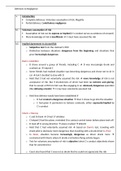
Defences to Negligence
a. Introduction
Complete defences: Voluntary assumption of risk, illegality
Partial defence: Contributory negligence
bi. Voluntary assumption of risk
Assumption of risk can be express or implied (C’s conduct serves as evidence of consent)
Mere knowledge of risk is insufficient C must have assumed the risk
bii. Implied Agreement to Accept Risk
o Subjective test from the claimant’s POV
o Distinction between situations dangerous from the beginning and situations that
grow increasingly dangerous
Dann v Hamilton
o D drove around a group of friends, including C D was increasingly drunk and
crashed car injured C
o Some friends had realised situation was becoming dangerous and chose not to sit in
car but C decided to stay with D
o Held that C had not voluntarily assumed the risk mere knowledge of risk is not
acceptance of risk. But if drunkenness of driver had been so extreme and glaring,
that to accept a lift from him was like engaging in an obviously dangerous operation
(like defusing a bomb) C may have voluntarily assumed risk
o Held that defence would have been established if
o D had created a dangerous situation then C chose to go into the situation
o C had given D permission to behave carelessly, either expressly/implied by
C’s conduct
Morris v Murray
o C and D drank D had 17 whiskies
o C helped D fuel the plane, reminded D to contact control tower before plane took off
o D took off in wrong direction plane crashed killed D
o Held that C had voluntarily assumed risk based on Dann’s test, traveling with
drunk pilot is obviously more dangerous than traveling with a drunk driver (LJ Fox)
o In Dann, situation became increasingly dangerous as driver drank more
contrasted with Morris where D drank a lot before flying activity began
o Test for voluntary assumption of risk is objective (what C’s conduct objectively shows
that he consented to)
o Court also found that C was not so drunk that he could not appreciate the risk
, Defences to Negligence
o In court, C had described himself to be quite sober
o C had driven them to the airport
o C had helped fuel the plane and contact the control tower
ICI Ltd v Shatwell
o C and his brother were testing explosives had insufficient wire with them to keep a
safe distance another man went to get more wire
o But C could not wait and tested explosives injured C
o C sued his brother for negligence sued employers on the grounds of vicarious
liability
o Held that C had implicitly given his brother permission to act negligently, inferred by
C’s extensive knowledge (company had given them lectures on the risks of using
short wires, one of their colleagues had recently been dismissed for using short
wires)
biia Whether C’s assumption of risk was voluntary
.
Corr v IBC Vehicles
o C had head injury from accident at work later suffered clinical depression
committed suicide
o Emphasised that assumption of risk must be voluntary held that C’s decision
making was distorted by his depression C’s suicide was not truly voluntary
Reeves v MPC
o C was in police custody and committed suicide police was negligent in failing to
keep him under observation as C had known risk of committing suicide
o Held that C had not voluntarily assumed risk. The nature of the police’s duty of care
required it to take positive steps to protect C from harming himself would not
make sense to grant the defence when C harms himself as D would always have this
defence would ‘empty the duty of content’ (Lord Hoffman)
c. Contributory Negligence
Before 1945, contributory negligence was a complete defence
Now a partial defence
Davies v Mann
o Court developed causation rule to soften harshness of contributory negligence as a
complete defence
o Court looked at the sequence of events if the last event is something that D can
be blamed for D caused the loss defence of contributory negligence would not
a. Introduction
Complete defences: Voluntary assumption of risk, illegality
Partial defence: Contributory negligence
bi. Voluntary assumption of risk
Assumption of risk can be express or implied (C’s conduct serves as evidence of consent)
Mere knowledge of risk is insufficient C must have assumed the risk
bii. Implied Agreement to Accept Risk
o Subjective test from the claimant’s POV
o Distinction between situations dangerous from the beginning and situations that
grow increasingly dangerous
Dann v Hamilton
o D drove around a group of friends, including C D was increasingly drunk and
crashed car injured C
o Some friends had realised situation was becoming dangerous and chose not to sit in
car but C decided to stay with D
o Held that C had not voluntarily assumed the risk mere knowledge of risk is not
acceptance of risk. But if drunkenness of driver had been so extreme and glaring,
that to accept a lift from him was like engaging in an obviously dangerous operation
(like defusing a bomb) C may have voluntarily assumed risk
o Held that defence would have been established if
o D had created a dangerous situation then C chose to go into the situation
o C had given D permission to behave carelessly, either expressly/implied by
C’s conduct
Morris v Murray
o C and D drank D had 17 whiskies
o C helped D fuel the plane, reminded D to contact control tower before plane took off
o D took off in wrong direction plane crashed killed D
o Held that C had voluntarily assumed risk based on Dann’s test, traveling with
drunk pilot is obviously more dangerous than traveling with a drunk driver (LJ Fox)
o In Dann, situation became increasingly dangerous as driver drank more
contrasted with Morris where D drank a lot before flying activity began
o Test for voluntary assumption of risk is objective (what C’s conduct objectively shows
that he consented to)
o Court also found that C was not so drunk that he could not appreciate the risk
, Defences to Negligence
o In court, C had described himself to be quite sober
o C had driven them to the airport
o C had helped fuel the plane and contact the control tower
ICI Ltd v Shatwell
o C and his brother were testing explosives had insufficient wire with them to keep a
safe distance another man went to get more wire
o But C could not wait and tested explosives injured C
o C sued his brother for negligence sued employers on the grounds of vicarious
liability
o Held that C had implicitly given his brother permission to act negligently, inferred by
C’s extensive knowledge (company had given them lectures on the risks of using
short wires, one of their colleagues had recently been dismissed for using short
wires)
biia Whether C’s assumption of risk was voluntary
.
Corr v IBC Vehicles
o C had head injury from accident at work later suffered clinical depression
committed suicide
o Emphasised that assumption of risk must be voluntary held that C’s decision
making was distorted by his depression C’s suicide was not truly voluntary
Reeves v MPC
o C was in police custody and committed suicide police was negligent in failing to
keep him under observation as C had known risk of committing suicide
o Held that C had not voluntarily assumed risk. The nature of the police’s duty of care
required it to take positive steps to protect C from harming himself would not
make sense to grant the defence when C harms himself as D would always have this
defence would ‘empty the duty of content’ (Lord Hoffman)
c. Contributory Negligence
Before 1945, contributory negligence was a complete defence
Now a partial defence
Davies v Mann
o Court developed causation rule to soften harshness of contributory negligence as a
complete defence
o Court looked at the sequence of events if the last event is something that D can
be blamed for D caused the loss defence of contributory negligence would not