Negligence: Duty of Care
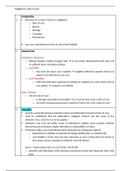
Introduction
a. Elements of a cause of action in negligence
o Duty of care
o Breach
o Damage
o Causation
o Remoteness
Law uses requirement of duty of care to limit liability
b. General Test
Donoghue v Stevenson
o Woman bought a bottle of ginger beer as she drank, decomposed snail came out
suffered shock and physical illness
o Lord Atkin
o You must not injure your neighbor neighbor defined as people whom you
expect to be affected by your acts
o Lord Macmillan
o Preferred alternative approach of looking at categories of cases where duty of
care applies categories are flexible
Anns v Merton
o Test for duty of care
o Is damage reasonably foreseeable? If so, D prima facie owes a duty of care
o Are there any good public policy reasons for there not to be a duty of care?
d. Causation
must be causal link between claimant’s injury and defendant’s breach of duty of care
must be established that the defendant’s negligent conduct was the cause of the
claimant’s loss; a but-for test to be applied.
claimant’s loss must fall within scope of defendant’s liability; must consider whether
intervening acts/omissions negate defendant’s responsibility for injury
if claimant makes use of something which obviously has a dangerous defect?
o Dependent on whether he ignored the danger deliberately or inadvertently
o Lord Wright in Grant: the man who consumes or uses a thing which he knows to
be noxious cannot complain of whatever mischief follows
Evans v Triplex Safety Glass Co Ltd [1936] 1 All ER 283
o plaintiffs sued defendant when defective windscreen broke and showered them with
glass
, Negligence: Duty of Care
o however, claim failed as there was no evidence that even assuming the defendant’s
negligence, that that was the cause rather than something else
Burrows v March Gas & Coke Co (1872) LR 7 Ex 96
o defendants supplied plaintiffs with defective pipe which leaked gas
o gas-fitter was called in to look for the source of the escaped gas and lit a match, which
exploded and injured the plaintiff
o held that the defendants could not be liable for damage which resulted from a third
party’s reckless conduct
e. Three-Stage Test
o Contrasted with the 2-stage test from Anns v Merton (what is the value of the Anns
test)
Caparo v Dickman
o Three-stage Test
o C must show it was reasonably foreseeable that C would be damaged if D was
careless
o C must establish that there is a proximity of relationship
o Must be shown that it is fair, just and reasonable that a duty of care should
arise
o Fair, just and reasonable requirement is policy-oriented. Tort is about relationships
between individuals, but tort decisions have effects beyond two individuals
controversial whether tort decisions should take into account broader policy
implications
o Lord Bridge’s 3-stage test is not conclusive qualifies that the law should be
developed incrementally, by analogy with existing duty situations
Assumption of Responsibility Test
Hedley v Heller
o Test
o Whether D assumed responsibility to C
Introduction
a. Elements of a cause of action in negligence
o Duty of care
o Breach
o Damage
o Causation
o Remoteness
Law uses requirement of duty of care to limit liability
b. General Test
Donoghue v Stevenson
o Woman bought a bottle of ginger beer as she drank, decomposed snail came out
suffered shock and physical illness
o Lord Atkin
o You must not injure your neighbor neighbor defined as people whom you
expect to be affected by your acts
o Lord Macmillan
o Preferred alternative approach of looking at categories of cases where duty of
care applies categories are flexible
Anns v Merton
o Test for duty of care
o Is damage reasonably foreseeable? If so, D prima facie owes a duty of care
o Are there any good public policy reasons for there not to be a duty of care?
d. Causation
must be causal link between claimant’s injury and defendant’s breach of duty of care
must be established that the defendant’s negligent conduct was the cause of the
claimant’s loss; a but-for test to be applied.
claimant’s loss must fall within scope of defendant’s liability; must consider whether
intervening acts/omissions negate defendant’s responsibility for injury
if claimant makes use of something which obviously has a dangerous defect?
o Dependent on whether he ignored the danger deliberately or inadvertently
o Lord Wright in Grant: the man who consumes or uses a thing which he knows to
be noxious cannot complain of whatever mischief follows
Evans v Triplex Safety Glass Co Ltd [1936] 1 All ER 283
o plaintiffs sued defendant when defective windscreen broke and showered them with
glass
, Negligence: Duty of Care
o however, claim failed as there was no evidence that even assuming the defendant’s
negligence, that that was the cause rather than something else
Burrows v March Gas & Coke Co (1872) LR 7 Ex 96
o defendants supplied plaintiffs with defective pipe which leaked gas
o gas-fitter was called in to look for the source of the escaped gas and lit a match, which
exploded and injured the plaintiff
o held that the defendants could not be liable for damage which resulted from a third
party’s reckless conduct
e. Three-Stage Test
o Contrasted with the 2-stage test from Anns v Merton (what is the value of the Anns
test)
Caparo v Dickman
o Three-stage Test
o C must show it was reasonably foreseeable that C would be damaged if D was
careless
o C must establish that there is a proximity of relationship
o Must be shown that it is fair, just and reasonable that a duty of care should
arise
o Fair, just and reasonable requirement is policy-oriented. Tort is about relationships
between individuals, but tort decisions have effects beyond two individuals
controversial whether tort decisions should take into account broader policy
implications
o Lord Bridge’s 3-stage test is not conclusive qualifies that the law should be
developed incrementally, by analogy with existing duty situations
Assumption of Responsibility Test
Hedley v Heller
o Test
o Whether D assumed responsibility to C