,Patient Information
Name: Michael Reynolds
Age: 45 years old
Gender: Male
Chief Complaint: Arm weakness
Informant: Patient (Michael Reynolds)
Case Overview
Michael Reynolds, a 45-year-old male, presents to the primary care
clinic with a one-week history of weakness in his right arm, impacting
his ability to perform work-related tasks. The i-Human simulation for
NRNP 6512 (Week 4) is designed to develop advanced health
assessment skills, requiring learners to conduct a detailed history,
perform a focused neurological and musculoskeletal physical exam,
formulate a differential diagnosis for arm weakness, order targeted
diagnostic tests, and develop an evidence-based, patient-centered
management plan. The case emphasizes clinical reasoning, precise
localization of neurological deficits, effective patient communication,
and integration of 2025 healthcare technologies (e.g., AI-driven
neurological wearables, telehealth) to optimize care. The goal is to
identify the underlying cause of arm weakness while ruling out serious
,conditions like stroke or malignancy, addressing the patient’s
occupational and functional concerns.
Step 1: History of Present Illness (HPI)
Chief Complaint: “My right arm has been weak for about a week, and
it’s making it hard to do my job.”History-Taking (i-Human Interface
Description):
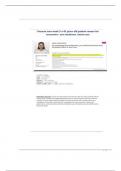
Screenshot Description: The i-Human history-taking interface
shows a virtual patient (Michael, a middle-aged male) seated in a
clinic exam room, with a neutral but slightly concerned
expression. The screen includes a text input field for free-text
questions and a dropdown menu with categories like “Chief
Complaint,” “Associated Symptoms,” “Past Medical History,” and
“Social History.” As the learner types questions (e.g., “When did
the weakness start?”), patient responses appear in a dialogue box,
with keywords (e.g., “weakness,” “numbness”) highlighted in red.
A progress bar in the top right corner tracks history completeness
(e.g., “History: 88% complete”), and a sidebar lists suggested
follow-up questions (e.g., “Have you had any recent injuries?”).
The interface provides real-time feedback, such as “Good
question: Explores symptom onset.”
, Process: The learner uses the OLDCARTS framework (Onset,
Location, Duration, Characteristics, Aggravating/Alleviating
factors, Related symptoms, Treatment, Severity) to systematically
gather a comprehensive history. Open-ended questions (e.g.,
“Can you tell me more about the weakness?”) encourage detailed
responses, while targeted questions (e.g., “Do you have
numbness or tingling?”) clarify neurological symptoms. The
learner ensures a supportive environment, addressing Michael’s
concerns about work limitations.
HPI Details:
Onset: Weakness began 7 days ago, noticed after a day of lifting
heavy boxes (15–20 lbs) at work. Onset was gradual, not sudden,
with no inciting event like trauma or fall.
Location: Right arm, primarily affecting proximal muscles
(shoulder, upper arm); weakness is most pronounced in shoulder
abduction and elbow flexion. Milder weakness noted in grip and
wrist movements.
Duration: Persistent for 7 days, with slight worsening over time;
no periods of complete resolution.
Characteristics:
Name: Michael Reynolds
Age: 45 years old
Gender: Male
Chief Complaint: Arm weakness
Informant: Patient (Michael Reynolds)
Case Overview
Michael Reynolds, a 45-year-old male, presents to the primary care
clinic with a one-week history of weakness in his right arm, impacting
his ability to perform work-related tasks. The i-Human simulation for
NRNP 6512 (Week 4) is designed to develop advanced health
assessment skills, requiring learners to conduct a detailed history,
perform a focused neurological and musculoskeletal physical exam,
formulate a differential diagnosis for arm weakness, order targeted
diagnostic tests, and develop an evidence-based, patient-centered
management plan. The case emphasizes clinical reasoning, precise
localization of neurological deficits, effective patient communication,
and integration of 2025 healthcare technologies (e.g., AI-driven
neurological wearables, telehealth) to optimize care. The goal is to
identify the underlying cause of arm weakness while ruling out serious
,conditions like stroke or malignancy, addressing the patient’s
occupational and functional concerns.
Step 1: History of Present Illness (HPI)
Chief Complaint: “My right arm has been weak for about a week, and
it’s making it hard to do my job.”History-Taking (i-Human Interface
Description):
Screenshot Description: The i-Human history-taking interface
shows a virtual patient (Michael, a middle-aged male) seated in a
clinic exam room, with a neutral but slightly concerned
expression. The screen includes a text input field for free-text
questions and a dropdown menu with categories like “Chief
Complaint,” “Associated Symptoms,” “Past Medical History,” and
“Social History.” As the learner types questions (e.g., “When did
the weakness start?”), patient responses appear in a dialogue box,
with keywords (e.g., “weakness,” “numbness”) highlighted in red.
A progress bar in the top right corner tracks history completeness
(e.g., “History: 88% complete”), and a sidebar lists suggested
follow-up questions (e.g., “Have you had any recent injuries?”).
The interface provides real-time feedback, such as “Good
question: Explores symptom onset.”
, Process: The learner uses the OLDCARTS framework (Onset,
Location, Duration, Characteristics, Aggravating/Alleviating
factors, Related symptoms, Treatment, Severity) to systematically
gather a comprehensive history. Open-ended questions (e.g.,
“Can you tell me more about the weakness?”) encourage detailed
responses, while targeted questions (e.g., “Do you have
numbness or tingling?”) clarify neurological symptoms. The
learner ensures a supportive environment, addressing Michael’s
concerns about work limitations.
HPI Details:
Onset: Weakness began 7 days ago, noticed after a day of lifting
heavy boxes (15–20 lbs) at work. Onset was gradual, not sudden,
with no inciting event like trauma or fall.
Location: Right arm, primarily affecting proximal muscles
(shoulder, upper arm); weakness is most pronounced in shoulder
abduction and elbow flexion. Milder weakness noted in grip and
wrist movements.
Duration: Persistent for 7 days, with slight worsening over time;
no periods of complete resolution.
Characteristics: