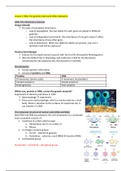
Lesson 1 DNA: the genetic material & DNA replication
DNA: The inheritance material
Gregor Mendel
Principle of mendelian inheritance
o Law of segregation: the two alleles for each gene are placed in different
gametes
o Law of independent assortment: the inheritance of one gene doesn’t affect
the inheritance of any other gene
o Law of dominance: When two different alleles are present, only one is
dominant and will be expressed
Thomas Hunt Morgan
Famous for his experimental research with the fruit fly (Drosophila Melanogaster)
Won the Nobel Prize in physiology and medicine is 1933 for his discoveries
concerning the role played by the chromosomes in heredity
Chromosomes
• Contain genetic information
• Consist of proteins and DNA
Proteins DNA
20 monomers (amino acids) 4 monomers (nucleotides)
Complex polymers Simple polymers
Heterogeneous Few variation
Which one, protein or DNA, carries the genetic material?
Experiment of Hershey and Chase in 1952
Bacteriophage T2 experiment
They used a bacteriophage, which is mainly made by a small
body. When is attaches to the surfaces of a bacterial cell, it
can transfer it’s DNA.
The molecular structure of nucleic acids (DNA and RNA)
Both DNA and RNA are polymers: the unit (monomer) is a nucleotide.
Each nucleotide consists of:
1. A pentose (5 carbon atoms) sugar
a. Deoxyribose (no O2 on carbon 2)
b. Ribose
2. A nitrogen containing base
a. Purine – adenine & guanine
b. Pyrimidine – cytosine, uracil (RNA) & thymine (DNA)
3. A phosphate group
Nucleoside = nucleotide – phosphate group
1
,The structure of a DNA nucleotide The structure of an RNA nucleotide
Called: deoxyadenosine 5’ - monophosphate Called: uridine 5’ - monophosphate
Molecular structure of a single DNA chain
At the 5th carbon, you have the phosphate group attached
The next phosphate is attached to the 3rd carbon of the previous pentose sugar
group and to the 5th carbon of the next pentose sugar group
o This bond is called the phosphodiester bond
When you have a deoxyribose with an adenine, it’s a nucleoside, namely adenosine
James Watson and Francis Crick
Famous for their discovery of the DNA double helix (in Cambridge, UK 1953)
Won the Nobel Prize in physiology and medicine is 1933 for their discoveries
concerning the molecular structure of nucleic acids
X-ray diffraction pattern of Rosalind Franklin (1952)
Rosalind did an X-ray on DNA where you can see the double helix → she’s not
awarded for a prize because she passed away
Watson & Crick took her data to have an imagination of the structure
2
,Molecular structure of the DNA
The 2 polynucleotide chains are oriented in opposite directions
One strand runs in a 5’ to 3’ orientation, the other strand runs in a 3’ to
5’ orientation – they are anti-parallel (they show opposite polarity)
Base pairs are complementary
Edwin Chargaff’s observation
A and T are always equal
G and C are always equal
Important observations
• Nitrogen bases are linked by
hydrogen bonds
• The chemical nature of these
bonds are different than covalent
bonds
• The bond G---C (3 hydrogen bonds)
is a stronger bond compared to the
A---T bond (2 hydrogen bonds)
Replication
Models for DNA replication – DNA replication is a semi-conservative process
DNA chain elongation
DNA polymerase: enzyme that catalyzes the reaction of DNA replication
o Adds nucleotides to the new chain
o Adds 3 phosphate groups, but only attaches 1 phosphate group to the 3’
carbon end. It releases the other 2 phosphate groups, which is called
pyrophosphate
o Proofreading → checks & corrects wrong added nucleotide
o DNA polymerase cannot start its synthesis without a 3’-OH group available
3
, Initiation of replication
1. DnaA attaches to a specific repeat and make a distortion in
the whole molecule. Thereby, other repeats that are close to
that specific repeat enlarges and become available for the
attachment of other molecules, which are helicases
(unwinding DNA helix)
2. Once the helicases are activated, the replication starts. It will
create a replication fork (group of enzymes, including the
DNA polymerase, helicases, etc.) that are unwinding and
creating two new strands. DNA primases are also important
in this process; they create RNA primers (adding few
nucleotides) and giving availability to the 3’ group. DNA
polymerase cannot start its synthesis without a primer.
If the DNA polymerase is running from 5’ → 3’, how can it successfully copy the other
strand?
Leading strand (5’ → 3’): DNA replication goes continuously.
Lagging strand (3’ → 5’): the polymerase synthesizes the new DNA in pieces, these are
called Okazaki fragments. With this process, there will be some pieces of RNA. This will
be removed by DNA polymerase I. The Okazaki fragment will be “glued” together by
ligase. Because of the lagging strand, DNA replication is a semi-discontinuous process.
Replication in E. coli goes differently; because it has a circular chromosome, it’s able to
connect two forks on the opposite sides. This is called theta-replication.
The problem of replicating a linear chromosome completely
Polymerase I needs a 3’ group available. But at the end of the chromosome, there is no
3’ side, therefore, it will shorten. Chromosome ends contain specific DNA sequences,
which are telomeres. Telomere is a repetitive sequence → TTAGGG.
• It delays damage to genes
• Chromosome ends will not be recognized as double strands breaks in the DNA
• Cells with short telomere stops dividing
Defensive mechanism against cancer: somatic cells have limited number of cell
divisions.
Cancer cells also express telomerase
Germ cells contain the enzyme telomerase. It maintains chromosome length by
adding telomere repeats (they need to maintain integrity)
4
DNA: The inheritance material
Gregor Mendel
Principle of mendelian inheritance
o Law of segregation: the two alleles for each gene are placed in different
gametes
o Law of independent assortment: the inheritance of one gene doesn’t affect
the inheritance of any other gene
o Law of dominance: When two different alleles are present, only one is
dominant and will be expressed
Thomas Hunt Morgan
Famous for his experimental research with the fruit fly (Drosophila Melanogaster)
Won the Nobel Prize in physiology and medicine is 1933 for his discoveries
concerning the role played by the chromosomes in heredity
Chromosomes
• Contain genetic information
• Consist of proteins and DNA
Proteins DNA
20 monomers (amino acids) 4 monomers (nucleotides)
Complex polymers Simple polymers
Heterogeneous Few variation
Which one, protein or DNA, carries the genetic material?
Experiment of Hershey and Chase in 1952
Bacteriophage T2 experiment
They used a bacteriophage, which is mainly made by a small
body. When is attaches to the surfaces of a bacterial cell, it
can transfer it’s DNA.
The molecular structure of nucleic acids (DNA and RNA)
Both DNA and RNA are polymers: the unit (monomer) is a nucleotide.
Each nucleotide consists of:
1. A pentose (5 carbon atoms) sugar
a. Deoxyribose (no O2 on carbon 2)
b. Ribose
2. A nitrogen containing base
a. Purine – adenine & guanine
b. Pyrimidine – cytosine, uracil (RNA) & thymine (DNA)
3. A phosphate group
Nucleoside = nucleotide – phosphate group
1
,The structure of a DNA nucleotide The structure of an RNA nucleotide
Called: deoxyadenosine 5’ - monophosphate Called: uridine 5’ - monophosphate
Molecular structure of a single DNA chain
At the 5th carbon, you have the phosphate group attached
The next phosphate is attached to the 3rd carbon of the previous pentose sugar
group and to the 5th carbon of the next pentose sugar group
o This bond is called the phosphodiester bond
When you have a deoxyribose with an adenine, it’s a nucleoside, namely adenosine
James Watson and Francis Crick
Famous for their discovery of the DNA double helix (in Cambridge, UK 1953)
Won the Nobel Prize in physiology and medicine is 1933 for their discoveries
concerning the molecular structure of nucleic acids
X-ray diffraction pattern of Rosalind Franklin (1952)
Rosalind did an X-ray on DNA where you can see the double helix → she’s not
awarded for a prize because she passed away
Watson & Crick took her data to have an imagination of the structure
2
,Molecular structure of the DNA
The 2 polynucleotide chains are oriented in opposite directions
One strand runs in a 5’ to 3’ orientation, the other strand runs in a 3’ to
5’ orientation – they are anti-parallel (they show opposite polarity)
Base pairs are complementary
Edwin Chargaff’s observation
A and T are always equal
G and C are always equal
Important observations
• Nitrogen bases are linked by
hydrogen bonds
• The chemical nature of these
bonds are different than covalent
bonds
• The bond G---C (3 hydrogen bonds)
is a stronger bond compared to the
A---T bond (2 hydrogen bonds)
Replication
Models for DNA replication – DNA replication is a semi-conservative process
DNA chain elongation
DNA polymerase: enzyme that catalyzes the reaction of DNA replication
o Adds nucleotides to the new chain
o Adds 3 phosphate groups, but only attaches 1 phosphate group to the 3’
carbon end. It releases the other 2 phosphate groups, which is called
pyrophosphate
o Proofreading → checks & corrects wrong added nucleotide
o DNA polymerase cannot start its synthesis without a 3’-OH group available
3
, Initiation of replication
1. DnaA attaches to a specific repeat and make a distortion in
the whole molecule. Thereby, other repeats that are close to
that specific repeat enlarges and become available for the
attachment of other molecules, which are helicases
(unwinding DNA helix)
2. Once the helicases are activated, the replication starts. It will
create a replication fork (group of enzymes, including the
DNA polymerase, helicases, etc.) that are unwinding and
creating two new strands. DNA primases are also important
in this process; they create RNA primers (adding few
nucleotides) and giving availability to the 3’ group. DNA
polymerase cannot start its synthesis without a primer.
If the DNA polymerase is running from 5’ → 3’, how can it successfully copy the other
strand?
Leading strand (5’ → 3’): DNA replication goes continuously.
Lagging strand (3’ → 5’): the polymerase synthesizes the new DNA in pieces, these are
called Okazaki fragments. With this process, there will be some pieces of RNA. This will
be removed by DNA polymerase I. The Okazaki fragment will be “glued” together by
ligase. Because of the lagging strand, DNA replication is a semi-discontinuous process.
Replication in E. coli goes differently; because it has a circular chromosome, it’s able to
connect two forks on the opposite sides. This is called theta-replication.
The problem of replicating a linear chromosome completely
Polymerase I needs a 3’ group available. But at the end of the chromosome, there is no
3’ side, therefore, it will shorten. Chromosome ends contain specific DNA sequences,
which are telomeres. Telomere is a repetitive sequence → TTAGGG.
• It delays damage to genes
• Chromosome ends will not be recognized as double strands breaks in the DNA
• Cells with short telomere stops dividing
Defensive mechanism against cancer: somatic cells have limited number of cell
divisions.
Cancer cells also express telomerase
Germ cells contain the enzyme telomerase. It maintains chromosome length by
adding telomere repeats (they need to maintain integrity)
4