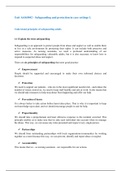
Unit A6165042 - Safeguarding and protection in care settings 1.
Understand principles of safeguarding adults
1.1 Explain the term safeguarding
Safeguarding is an approach to protect people from abuse and neglect as well as enable them
to live in a safe environment by protecting their rights. It can include both proactive and
active measures. As nursing assistants, we need a profound understanding of our
responsibilities for safeguarding vulnerable adults, but it is also necessary to know how to
respond to suspected abuse and neglect.
There are six principles of safeguarding that steer good practise:
Empowerment
People should be supported and encouraged to make their own informed choices and
decisions.
Protection
We need to support our patients - who are in the most significant need/at risk - and reduce the
number of issues; moreover, we need to keep staff healthy and safe at work. It also means that
we should take measures to help stop abuse from happening and offer our help.
Prevention of harm
It is always better to take action before harm takes place. That is why it is important to keep
our knowledge up-to-date, and we should encourage people to ask for help.
Proportionality
We should take a proportionate and least obtrusive response to the incident occurred. This
principle enables us to make sure that we take each individual into account when we manage
the abuse. This way, we can assess any risks presented and respect every single person.
Partnerships
We should form outstanding partnerships with local organisations/communities by working
together as a team because this way, we can prevent, identify and report abuse or neglect.
Accountability
This means that we - as nursing assistants - are responsible for our actions.
Understand principles of safeguarding adults
1.1 Explain the term safeguarding
Safeguarding is an approach to protect people from abuse and neglect as well as enable them
to live in a safe environment by protecting their rights. It can include both proactive and
active measures. As nursing assistants, we need a profound understanding of our
responsibilities for safeguarding vulnerable adults, but it is also necessary to know how to
respond to suspected abuse and neglect.
There are six principles of safeguarding that steer good practise:
Empowerment
People should be supported and encouraged to make their own informed choices and
decisions.
Protection
We need to support our patients - who are in the most significant need/at risk - and reduce the
number of issues; moreover, we need to keep staff healthy and safe at work. It also means that
we should take measures to help stop abuse from happening and offer our help.
Prevention of harm
It is always better to take action before harm takes place. That is why it is important to keep
our knowledge up-to-date, and we should encourage people to ask for help.
Proportionality
We should take a proportionate and least obtrusive response to the incident occurred. This
principle enables us to make sure that we take each individual into account when we manage
the abuse. This way, we can assess any risks presented and respect every single person.
Partnerships
We should form outstanding partnerships with local organisations/communities by working
together as a team because this way, we can prevent, identify and report abuse or neglect.
Accountability
This means that we - as nursing assistants - are responsible for our actions.