

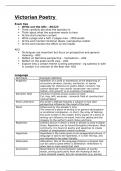
Victorian Poetry
Exam tips
Write out the AOs – AO123
Think carefully abt what the question is
Think about what the examiner wants to hear
At the start mention context
Write a page and a half, 2 pages max - 1500 words
At the end mention Victorian ideals / perspective and/or
At the end mention the effect on the reader
AO2
Techniques are important but focus on perspective and general
meaning – AO2
Reflect on Narrative perspective – motivations – AO2
Reflect on the poets world view – AO2
Explore why a certain theme is being presented – eg sadness in wife
in London is a criticism of the Boer war- AO2
Language
Technique Example/ definition
Anaphora repetition of a word or expression at the beginning of
successive phrases, clauses, sentences, or verses
especially for rhetorical or poetic effect. Lincoln's "we
cannot dedicate—we cannot consecrate—we cannot
hallow—this ground" is an example of anaphora.
Semantic field A theme of words across a piece of work
Cut, dug, drill, excavate – semantic field of construction/
manual labour
Tone/ undertone the writer's attitude towards a subject or how their
perspective influences the mood of the text.
Mood Influenced by the speaker’s tone
The mood of a piece of writing is its general atmosphere
or emotional complexion—in short, the array of feelings
the work evokes in the reader. Every aspect of a piece of
writing can influence its mood, from the setting and the
imagery to the author's word choice and tone.
Repetition Literary device in which a word or phrase is used multiple
times. Repetition can be found throughout literature. Most
commonly, it is found in poetry and speeches to create
rhythm or emphasised a word or phrase.
Hyperbole Hyperbole is the name given to an exaggerated phrase. If
language is said to be hyperbolic, it is over the top, and
not intended to be taken literally.
Alliteration Alliteration. One of the language features in English that
can be used to great effect is alliteration. Alliteration is
when two or more words that start
Assonance Resemblance of sound between syllables of nearby
words, arising particularly from the rhyming of two or
more stressed vowels, but not consonants (e.g. sonnet,
, porridge ), but also from the use of identical consonants
with different vowels (e.g. killed, cold, culled ).
Sibilance Sibilance is a type of literary device and figure of speech
wherein a hissing sound is created in a group of words
through the repetition of 's' sounds.
Plosives The sounds that are generally associated with the letters
p, t, k, b, d, g in English words such pat, kid, bag are
examples of plosives.
Metaphor A metaphor is a figure of speech that implicitly compares
two unrelated things, typically by stating that one thing is
another (e.g., “that chef is a magician”). Metaphors can
be used to create vivid imagery, exaggerate a
characteristic or action, or express a complex idea.
Personification The attribution of a personal nature or human
characteristics to something non-human, or the
representation of an abstract quality in human form.
Smilie A figure of speech involving the comparison of one thing
with another thing of a different kind, used to make a
description more emphatic or vivid (e.g. as brave as a lion
).
Onomatopoeia Examples of Onomatopoeia: Buzz-The bee buzzed in my
ear. Boom-The boom of the fireworks scared the baby.
Meow-The cat meowed for some milk.
Juxtaposition / The fact of two things being seen or placed close together
oxymoron with contrasting effect.
Irony When a person says something or does something that
departs from what we’d expect them to say or do.
Allusion an expression designed to call something to mind without
mentioning it explicitly; an indirect or passing reference.
Ie he’s in a better place
Ellipsis .. .
Structure
Technique Example/ definition
Simple sentence A simple sentence is a single independent clause with a
subject and predicate. Simple sentences convey a
complete thought, but they do not contain any dependent
clauses (also known as subordinate clauses). Simple
sentence examples Juliet waited on her balcony. Mice love
snacks.
Compound An example of a compound sentence is, 'This house is too
sentence expensive, and that house is too small.' This sentence is a
compound sentence because it has two independent
clauses, 'This house is too expensive' and 'that house is
too small' separated by a comma and the conjunction
'and.
Tenses Simple past: She wrote last night. Past progressive: She
was writing when he called. Simple future: She will write
tomorrow. Future progressive: She will be writing when
you arrive.
Exposition It is the background information on the characters and
setting explained at the beginning of the story. The
EXPOSITION will often have information about events that
, happened before the story began. The EXPOSITION is
often the very first part of the PLOT.
Rhyme Cat-hat, rotten-forgotten, and heard-bird
Couplet, triplet, In poetry, stanzas are visual groupings of lines. A group of
quatrain two lines is called a couplet. A three line stanza is called a
tercet. A four line stanza is a quatrain, and a five line
stanza is a quintet.
Caesura A caesura is a poetic device in which there is a pause
between a line of poetry. This pause follows natural
speech patterns and is usually indicated by punctuation.
Enjambement (in verse) the continuation of a sentence without a pause
beyond the end of a line, couplet, or stanza.
"he uses enjambment less than many poets
Key word bank
Insipid lacking in qualities that interest, stimulate, or challenge :
dull, flat. insipid prose. 2. : lacking taste or savor :
tasteless.
Galvanise to inspire, stimulate, or excite someone into action, often
in a sudden or forceful way.
Pathos the use of language or narrative techniques to evoke
strong emotional responses in the reader or audience
Apotheosis the elevation of a person or thing to divine status, or,
more broadly, the glorification or idealization of
something
- Christina Rossetti
- Tennyson in Maud
Form Type of structure
Like:
a sonnet - 14 lines
haiku
ballad
villanelle
Free verse, lyrical
Structure Specific arrangement of the poem on the page
A 1-line stanza is called a monostich. It's the smallest unit
of lines that can be considered a stanza, and it can even
be an entire poem in itself. Other types of stanzas include
couplets (2 lines), tercets (3 lines), quatrains (4 lines),
quintet, sextet, septet, octave
How many stanzas is also included in structure
Conceit Running theme of extended metaphor in a poem
Pastoral a work of literature portraying an idealized version of
country life.
- Thomas Hardy
Enigmatic there is no absolute reading of the text
- Charlotte Brontë poetry
- Love in a life
, General Contextual points
Key dates
From 1837 until her death in 1901
The Origin of the species 1859
The married women’s property act 1882
Mortality levels were high in Victorian England - significantly
higher than they are today, particularly for infants and the
working class
When was the Victorian era?
The Victorian era spans the 63 years of Queen Victoria's reign over Great Britain
and Ireland from 1837 until her death in 1901. It was a time of great power and
wealth for Britain as it expanded its empire across the globe.
The Enlightenment: - Thomas Hardy
This movement lasted from the mid-1600s to the late 1700s/early 1800s.
The Enlightenment, also known as the Age of Reason, was a European
intellectual and philosophical movement from the late 17th to the early 19th
century that emphasized reason, science, and individual rights,
challenging traditional authority and promoting secular thought.
Romanticism:
This movement lasted from the late 1700 to the late 1800
This artistic and intellectual movement began in Europe in the late 18th century.
It was a reaction to the Enlightenment's emphasis on reason and order, and the
disillusionment that followed the French Revolution of 1789. characterised by an
emphasis on the individual, imagination, and emotion. It was also a reaction
against the rationalism and materialism of the 18th century.
Pre-Raphaelite movement – Christina Rossetti
This movement lasted from the mid 1800 to the late 1800
19th-century art movement that began in London in 1848, characterised by a
rejection of the Royal Academy's academic painting style and a return to the
simplicity and sincerity of pre-Renaissance art, particularly Italian art from before
Raphael.
Elizabeth Brarrett Browning
General context
Key dates
Born: 1812
Died:1889
Married to Robert Barret Browning – they eloped in secret and their
marriage was frowned upon
At the age of 15, she fell seriously ill, probably as the result of a spinal
injury, and her health was permanently affected.
Mid Victorian period
Exam tips
Write out the AOs – AO123
Think carefully abt what the question is
Think about what the examiner wants to hear
At the start mention context
Write a page and a half, 2 pages max - 1500 words
At the end mention Victorian ideals / perspective and/or
At the end mention the effect on the reader
AO2
Techniques are important but focus on perspective and general
meaning – AO2
Reflect on Narrative perspective – motivations – AO2
Reflect on the poets world view – AO2
Explore why a certain theme is being presented – eg sadness in wife
in London is a criticism of the Boer war- AO2
Language
Technique Example/ definition
Anaphora repetition of a word or expression at the beginning of
successive phrases, clauses, sentences, or verses
especially for rhetorical or poetic effect. Lincoln's "we
cannot dedicate—we cannot consecrate—we cannot
hallow—this ground" is an example of anaphora.
Semantic field A theme of words across a piece of work
Cut, dug, drill, excavate – semantic field of construction/
manual labour
Tone/ undertone the writer's attitude towards a subject or how their
perspective influences the mood of the text.
Mood Influenced by the speaker’s tone
The mood of a piece of writing is its general atmosphere
or emotional complexion—in short, the array of feelings
the work evokes in the reader. Every aspect of a piece of
writing can influence its mood, from the setting and the
imagery to the author's word choice and tone.
Repetition Literary device in which a word or phrase is used multiple
times. Repetition can be found throughout literature. Most
commonly, it is found in poetry and speeches to create
rhythm or emphasised a word or phrase.
Hyperbole Hyperbole is the name given to an exaggerated phrase. If
language is said to be hyperbolic, it is over the top, and
not intended to be taken literally.
Alliteration Alliteration. One of the language features in English that
can be used to great effect is alliteration. Alliteration is
when two or more words that start
Assonance Resemblance of sound between syllables of nearby
words, arising particularly from the rhyming of two or
more stressed vowels, but not consonants (e.g. sonnet,
, porridge ), but also from the use of identical consonants
with different vowels (e.g. killed, cold, culled ).
Sibilance Sibilance is a type of literary device and figure of speech
wherein a hissing sound is created in a group of words
through the repetition of 's' sounds.
Plosives The sounds that are generally associated with the letters
p, t, k, b, d, g in English words such pat, kid, bag are
examples of plosives.
Metaphor A metaphor is a figure of speech that implicitly compares
two unrelated things, typically by stating that one thing is
another (e.g., “that chef is a magician”). Metaphors can
be used to create vivid imagery, exaggerate a
characteristic or action, or express a complex idea.
Personification The attribution of a personal nature or human
characteristics to something non-human, or the
representation of an abstract quality in human form.
Smilie A figure of speech involving the comparison of one thing
with another thing of a different kind, used to make a
description more emphatic or vivid (e.g. as brave as a lion
).
Onomatopoeia Examples of Onomatopoeia: Buzz-The bee buzzed in my
ear. Boom-The boom of the fireworks scared the baby.
Meow-The cat meowed for some milk.
Juxtaposition / The fact of two things being seen or placed close together
oxymoron with contrasting effect.
Irony When a person says something or does something that
departs from what we’d expect them to say or do.
Allusion an expression designed to call something to mind without
mentioning it explicitly; an indirect or passing reference.
Ie he’s in a better place
Ellipsis .. .
Structure
Technique Example/ definition
Simple sentence A simple sentence is a single independent clause with a
subject and predicate. Simple sentences convey a
complete thought, but they do not contain any dependent
clauses (also known as subordinate clauses). Simple
sentence examples Juliet waited on her balcony. Mice love
snacks.
Compound An example of a compound sentence is, 'This house is too
sentence expensive, and that house is too small.' This sentence is a
compound sentence because it has two independent
clauses, 'This house is too expensive' and 'that house is
too small' separated by a comma and the conjunction
'and.
Tenses Simple past: She wrote last night. Past progressive: She
was writing when he called. Simple future: She will write
tomorrow. Future progressive: She will be writing when
you arrive.
Exposition It is the background information on the characters and
setting explained at the beginning of the story. The
EXPOSITION will often have information about events that
, happened before the story began. The EXPOSITION is
often the very first part of the PLOT.
Rhyme Cat-hat, rotten-forgotten, and heard-bird
Couplet, triplet, In poetry, stanzas are visual groupings of lines. A group of
quatrain two lines is called a couplet. A three line stanza is called a
tercet. A four line stanza is a quatrain, and a five line
stanza is a quintet.
Caesura A caesura is a poetic device in which there is a pause
between a line of poetry. This pause follows natural
speech patterns and is usually indicated by punctuation.
Enjambement (in verse) the continuation of a sentence without a pause
beyond the end of a line, couplet, or stanza.
"he uses enjambment less than many poets
Key word bank
Insipid lacking in qualities that interest, stimulate, or challenge :
dull, flat. insipid prose. 2. : lacking taste or savor :
tasteless.
Galvanise to inspire, stimulate, or excite someone into action, often
in a sudden or forceful way.
Pathos the use of language or narrative techniques to evoke
strong emotional responses in the reader or audience
Apotheosis the elevation of a person or thing to divine status, or,
more broadly, the glorification or idealization of
something
- Christina Rossetti
- Tennyson in Maud
Form Type of structure
Like:
a sonnet - 14 lines
haiku
ballad
villanelle
Free verse, lyrical
Structure Specific arrangement of the poem on the page
A 1-line stanza is called a monostich. It's the smallest unit
of lines that can be considered a stanza, and it can even
be an entire poem in itself. Other types of stanzas include
couplets (2 lines), tercets (3 lines), quatrains (4 lines),
quintet, sextet, septet, octave
How many stanzas is also included in structure
Conceit Running theme of extended metaphor in a poem
Pastoral a work of literature portraying an idealized version of
country life.
- Thomas Hardy
Enigmatic there is no absolute reading of the text
- Charlotte Brontë poetry
- Love in a life
, General Contextual points
Key dates
From 1837 until her death in 1901
The Origin of the species 1859
The married women’s property act 1882
Mortality levels were high in Victorian England - significantly
higher than they are today, particularly for infants and the
working class
When was the Victorian era?
The Victorian era spans the 63 years of Queen Victoria's reign over Great Britain
and Ireland from 1837 until her death in 1901. It was a time of great power and
wealth for Britain as it expanded its empire across the globe.
The Enlightenment: - Thomas Hardy
This movement lasted from the mid-1600s to the late 1700s/early 1800s.
The Enlightenment, also known as the Age of Reason, was a European
intellectual and philosophical movement from the late 17th to the early 19th
century that emphasized reason, science, and individual rights,
challenging traditional authority and promoting secular thought.
Romanticism:
This movement lasted from the late 1700 to the late 1800
This artistic and intellectual movement began in Europe in the late 18th century.
It was a reaction to the Enlightenment's emphasis on reason and order, and the
disillusionment that followed the French Revolution of 1789. characterised by an
emphasis on the individual, imagination, and emotion. It was also a reaction
against the rationalism and materialism of the 18th century.
Pre-Raphaelite movement – Christina Rossetti
This movement lasted from the mid 1800 to the late 1800
19th-century art movement that began in London in 1848, characterised by a
rejection of the Royal Academy's academic painting style and a return to the
simplicity and sincerity of pre-Renaissance art, particularly Italian art from before
Raphael.
Elizabeth Brarrett Browning
General context
Key dates
Born: 1812
Died:1889
Married to Robert Barret Browning – they eloped in secret and their
marriage was frowned upon
At the age of 15, she fell seriously ill, probably as the result of a spinal
injury, and her health was permanently affected.
Mid Victorian period


