

15/10/2019
LECTURE 5: TRADE FLOWS AND INTERNATIONAL TRADE THEORY
TODAY’S TOPICS TODAY’S LEARNING OUTCOMES
• What is international trade? By the end of this session you will be able to:
• Trade barriers • Recognise trade barriers
• Classical trade theories • Understand classical trade theories
• New trade theories • Understand new trade theories
• Implications for International Business
INTERNATIONAL TRADE THEORY
Trade is the “buying and selling” of goods and services across national borders.
It makes both parties to any transaction better off (in theory).
Trade theories attempt to explain who trades, how much of what with whom, and why… and at what price.
No one theory explains all trade…
We will look more about trade theories and how they explain what governments and businesses
have done over time. These theories are mostly written by economists.
Always address a business problem using different modules and framework.
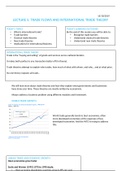
WORLD TRADE GROWTH
World trade generally tends to bust economies, often
more developed economies at the expenses of less
developed economies. And the WTO is trying to address
this.
LINKING TRADE AND ECONOMIC GROWTH
Open economies grow faster
Sachs and Warner (1995) 1970 to 1990 study:
• Open economy developing countries grew 4.49% per year
, What we tend to find is that developing countries, which have open economies, tend to have a
higher growth.
We will go back to the idea of specializing in what you do best. This is the same principle for IB and
governments in creating trade policies. It is best to try and create an approach to trade which
plays your strengths.
Video about British Leyland, the design of the car was bad as it was cheap to make and due to
no competition, they had no need to innovate
https://www.youtube.com/watch?v=xm1aJx45F6k
AFTER THE 2011 EU-S. KOREA FREE TRADE DEAL, HOW
MUCH DID THE UK’S EXPORTS TO S. KOREA INCREASE BY?
A. 20%
B. 30% Answer is D
C. 40%
D. 50%
BLOCKING TRADE FLOWS
…protectionism and trade blocks remain
• Increase/retain local jobs by protecting businesses from competition
• Encourage local production to increase output and jobs
• Promote exports
• Reduce reliance on foreign suppliers
• Ban trade with countries for political reasons
Often protectionism and trade blocks still remain. Some governments try to create protectionism,
sometimes for good intention and sometimes for trying to get votes (politics).
Good intentions may be, save a local company which will also create more domestic jobs.
HOW TO BLOCK TRADE FLOWS
Tariffs
• Taxes on products
Non-Tariffs Look at the European
• Quotas Market database to see the
• Technical barriers different taxes
• Limits to FDI: production sharing agreements (Cuba and China)
• Regulations: EU–US Open Skies Agreement
CLASSICAL TRADE THEORIES
DIVISION OF LABOUR: MAKING EFFICIENT LABOUR
In a factory (context):
Split production into set tasks:
• Workers become quicker
• Workers become more skilled
LECTURE 5: TRADE FLOWS AND INTERNATIONAL TRADE THEORY
TODAY’S TOPICS TODAY’S LEARNING OUTCOMES
• What is international trade? By the end of this session you will be able to:
• Trade barriers • Recognise trade barriers
• Classical trade theories • Understand classical trade theories
• New trade theories • Understand new trade theories
• Implications for International Business
INTERNATIONAL TRADE THEORY
Trade is the “buying and selling” of goods and services across national borders.
It makes both parties to any transaction better off (in theory).
Trade theories attempt to explain who trades, how much of what with whom, and why… and at what price.
No one theory explains all trade…
We will look more about trade theories and how they explain what governments and businesses
have done over time. These theories are mostly written by economists.
Always address a business problem using different modules and framework.
WORLD TRADE GROWTH
World trade generally tends to bust economies, often
more developed economies at the expenses of less
developed economies. And the WTO is trying to address
this.
LINKING TRADE AND ECONOMIC GROWTH
Open economies grow faster
Sachs and Warner (1995) 1970 to 1990 study:
• Open economy developing countries grew 4.49% per year
, What we tend to find is that developing countries, which have open economies, tend to have a
higher growth.
We will go back to the idea of specializing in what you do best. This is the same principle for IB and
governments in creating trade policies. It is best to try and create an approach to trade which
plays your strengths.
Video about British Leyland, the design of the car was bad as it was cheap to make and due to
no competition, they had no need to innovate
https://www.youtube.com/watch?v=xm1aJx45F6k
AFTER THE 2011 EU-S. KOREA FREE TRADE DEAL, HOW
MUCH DID THE UK’S EXPORTS TO S. KOREA INCREASE BY?
A. 20%
B. 30% Answer is D
C. 40%
D. 50%
BLOCKING TRADE FLOWS
…protectionism and trade blocks remain
• Increase/retain local jobs by protecting businesses from competition
• Encourage local production to increase output and jobs
• Promote exports
• Reduce reliance on foreign suppliers
• Ban trade with countries for political reasons
Often protectionism and trade blocks still remain. Some governments try to create protectionism,
sometimes for good intention and sometimes for trying to get votes (politics).
Good intentions may be, save a local company which will also create more domestic jobs.
HOW TO BLOCK TRADE FLOWS
Tariffs
• Taxes on products
Non-Tariffs Look at the European
• Quotas Market database to see the
• Technical barriers different taxes
• Limits to FDI: production sharing agreements (Cuba and China)
• Regulations: EU–US Open Skies Agreement
CLASSICAL TRADE THEORIES
DIVISION OF LABOUR: MAKING EFFICIENT LABOUR
In a factory (context):
Split production into set tasks:
• Workers become quicker
• Workers become more skilled


