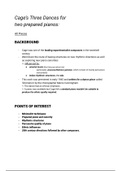
Cage’s Three Dances for
two prepared pianos:
All Pieces
BACKGROUND
- Cage was one of the leading experimentalist composers in the twentieth
century.
- Went down the route of basing structures on new rhythmic directions as well
as exploring new piano sonorities
↪ influenced by:
● oriental music (like Debussy before him)
- particularly Javanese/Balinese gamelan, which consist of mainly percussive
instruments
● Indian rhythmic structures, the tala.
- This work was premiered in early 1945 and written for a dance piece called
‘Dromenon’ by the chorographer Merce Cunningham.
↪ The dance had an African emphasis.
↪ A piano was available but Cage felt a standard piano wouldn’t be suitable to
produce the ethnic quality required.
POINTS OF INTEREST
- Minimalist techniques
- Prepared piano and sonority
- Rhythmic structures
- Percussive quality of piano
- Ethnic influences
- 20th century directions followed by other composers.
, No.1
STRUCTURE
Point Explanation Reference(s)
1st of a set of three that form the ballet:
- 2nd one = slower
- Last one = fast & frenetic
Structure = based on tempo and rhythm
- Temporal proportion is at the heart of the
work’s construction
Micro-macrocosmic structure From 1939 up until mid-1950s,
- Small structure (‘micro’) Cage employed rather original
Repeated in order to create a larger approach to musical structure
structure (‘macro’) - Based upon
mathematical
proportion -------------------
--------------------------- Quartet Romantic
Experiments with rhythmic (1915-1917) & Quartet
structure: Euphometric (1916-18),
- Influenced by Cage’s Cowell
teacher, Cowell
-------------------
---------------------------- ‘In Just’, ‘Five Songs for
Cage’s interest in Rhythm as a Contralto’ (1938), Cage
structural architect: - Develop from idea of
symmetrical
arrangements of
phrase lengths
‘Imaginary Landscapes No.1’,
(1939), Cage
- To grouping of phrases
into larger units
‘First Construction (In metal)
(1939), Cage
- Idea then further
refined and
methodology of
micro-macrocosmic
structure
two prepared pianos:
All Pieces
BACKGROUND
- Cage was one of the leading experimentalist composers in the twentieth
century.
- Went down the route of basing structures on new rhythmic directions as well
as exploring new piano sonorities
↪ influenced by:
● oriental music (like Debussy before him)
- particularly Javanese/Balinese gamelan, which consist of mainly percussive
instruments
● Indian rhythmic structures, the tala.
- This work was premiered in early 1945 and written for a dance piece called
‘Dromenon’ by the chorographer Merce Cunningham.
↪ The dance had an African emphasis.
↪ A piano was available but Cage felt a standard piano wouldn’t be suitable to
produce the ethnic quality required.
POINTS OF INTEREST
- Minimalist techniques
- Prepared piano and sonority
- Rhythmic structures
- Percussive quality of piano
- Ethnic influences
- 20th century directions followed by other composers.
, No.1
STRUCTURE
Point Explanation Reference(s)
1st of a set of three that form the ballet:
- 2nd one = slower
- Last one = fast & frenetic
Structure = based on tempo and rhythm
- Temporal proportion is at the heart of the
work’s construction
Micro-macrocosmic structure From 1939 up until mid-1950s,
- Small structure (‘micro’) Cage employed rather original
Repeated in order to create a larger approach to musical structure
structure (‘macro’) - Based upon
mathematical
proportion -------------------
--------------------------- Quartet Romantic
Experiments with rhythmic (1915-1917) & Quartet
structure: Euphometric (1916-18),
- Influenced by Cage’s Cowell
teacher, Cowell
-------------------
---------------------------- ‘In Just’, ‘Five Songs for
Cage’s interest in Rhythm as a Contralto’ (1938), Cage
structural architect: - Develop from idea of
symmetrical
arrangements of
phrase lengths
‘Imaginary Landscapes No.1’,
(1939), Cage
- To grouping of phrases
into larger units
‘First Construction (In metal)
(1939), Cage
- Idea then further
refined and
methodology of
micro-macrocosmic
structure