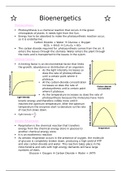
Bioenergetics
Photosynthesis:
Photosynthesis is a chemical reaction that occurs in the green
chloroplasts of plants. It needs light from the Sun.
Energy has to be absorbed to make the photosynthesis reaction occur,
so it is endothermic.
Carbon Dioxide + Water Glucose + Oxygen
6CO₂ + 6H₂O C₆H₁₂O₆ + 6O₂
The carbon dioxide required for photosynthesis comes from the air. It
enters the leaves through the stomata. Water enters the plant through
the roots and is transported to the leaves in the xylem.
Limiting Factors:
A limiting factor is an environmental factor that limits
the growth, abundance or distribution of an organism.
As the light intensity increases so
does the rate of photosynthesis
until a certain point where it
plateaux.
At the carbon dioxide concentration
increases so does the rate of
photosynthesis until a certain point
where it plateaux.
As the temperature increases so does the rate of
photosynthesis because the molecules have more
kinetic energy and therefore collide more until it
reaches the optimum temperature. After the optimum
temperature the enzymes start to denature so the rate
of reaction slows down.
1
light intensity= 2
d
Aerobic Respiration:
Respiration is the chemical reaction that transfers
energy from the chemical energy store in glucose to
another chemical energy store.
It is an exothermic reaction
As aerobic respiration occurs in the presence of oxygen, the molecule
of glucose is completely broken down, producing a high yield of ATP
and also carbon dioxide and water. This reaction takes place in the
mitochondria and cells with high energy demands will have large
numbers of them.
Glucose + Oxygen Carbon Dioxide + Water + (ATP)
Photosynthesis:
Photosynthesis is a chemical reaction that occurs in the green
chloroplasts of plants. It needs light from the Sun.
Energy has to be absorbed to make the photosynthesis reaction occur,
so it is endothermic.
Carbon Dioxide + Water Glucose + Oxygen
6CO₂ + 6H₂O C₆H₁₂O₆ + 6O₂
The carbon dioxide required for photosynthesis comes from the air. It
enters the leaves through the stomata. Water enters the plant through
the roots and is transported to the leaves in the xylem.
Limiting Factors:
A limiting factor is an environmental factor that limits
the growth, abundance or distribution of an organism.
As the light intensity increases so
does the rate of photosynthesis
until a certain point where it
plateaux.
At the carbon dioxide concentration
increases so does the rate of
photosynthesis until a certain point
where it plateaux.
As the temperature increases so does the rate of
photosynthesis because the molecules have more
kinetic energy and therefore collide more until it
reaches the optimum temperature. After the optimum
temperature the enzymes start to denature so the rate
of reaction slows down.
1
light intensity= 2
d
Aerobic Respiration:
Respiration is the chemical reaction that transfers
energy from the chemical energy store in glucose to
another chemical energy store.
It is an exothermic reaction
As aerobic respiration occurs in the presence of oxygen, the molecule
of glucose is completely broken down, producing a high yield of ATP
and also carbon dioxide and water. This reaction takes place in the
mitochondria and cells with high energy demands will have large
numbers of them.
Glucose + Oxygen Carbon Dioxide + Water + (ATP)