Infection and Response
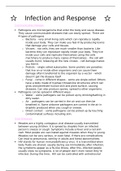
Communicable Disease:
Pathogens are microorganisms that enter the body and cause disease.
They cause communicable diseases that can easily spread. There are
4 types of pathogens
o Bacteria – very small living cells which can reproduce rapidly
inside your body. They can make you feel ill by producing toxins
that damage your cells and tissues.
o Viruses – not cells, they are much smaller than bacteria. Like
bacteria they can reproduce rapidly inside your body. They live
inside your cells and replicate themselves using the cells
machinery to produce many copies of themselves – the cell will
usually burst, releasing all the new viruses – cell damage makes
you feel ill.
o Protists – single celled eukaryotes. Some protists are parasites
that live on or inside other organisms and can cause them
damage often transferred to the organism by a vector – which
doesn’t get the disease itself
o Fungi – come in different shapes – some are single-celled. Others
have a body made of hyphae (thread-like structures) which can
grow and penetrate human skin and plant surface, causing
diseases. Can also produce spores, spread to other organisms.
Pathogens can be spread in different ways:
o Water – some pathogens can be picked up by drinking/bathing in
dirty water.
o Air – pathogens can be carried in the air and can then be
breathed in. Some airborne pathogens are carried in the air in
droplets produced when you cough or sneeze.
o Direct contact – some pathogens can be picked up by touching
contaminated surfaces including skin.
Viral Diseases:
Measles are a highly contagious viral disease usually transmitted
between young children. It is spread by droplets from an infected
person’s sneeze or cough. Symptoms include a fever and a red skin
rash. Most people are vaccinated against measles when they’re young.
Measles can be very serious, or even fatal, if there are complications.
Can lead to pneumonia, sterility in adults and foetal abnormalities.
HIV stands for human immunodeficiency virus. It is transmitted when
body fluids are shared, usually during sex Immediately after infection,
the symptoms appear as a flu-like illness. After this, infected people
usually show no symptoms. A lot of people don’t even notice they’re
infected. During this time, HIV can be controlled with antiretroviral
Communicable Disease:
Pathogens are microorganisms that enter the body and cause disease.
They cause communicable diseases that can easily spread. There are
4 types of pathogens
o Bacteria – very small living cells which can reproduce rapidly
inside your body. They can make you feel ill by producing toxins
that damage your cells and tissues.
o Viruses – not cells, they are much smaller than bacteria. Like
bacteria they can reproduce rapidly inside your body. They live
inside your cells and replicate themselves using the cells
machinery to produce many copies of themselves – the cell will
usually burst, releasing all the new viruses – cell damage makes
you feel ill.
o Protists – single celled eukaryotes. Some protists are parasites
that live on or inside other organisms and can cause them
damage often transferred to the organism by a vector – which
doesn’t get the disease itself
o Fungi – come in different shapes – some are single-celled. Others
have a body made of hyphae (thread-like structures) which can
grow and penetrate human skin and plant surface, causing
diseases. Can also produce spores, spread to other organisms.
Pathogens can be spread in different ways:
o Water – some pathogens can be picked up by drinking/bathing in
dirty water.
o Air – pathogens can be carried in the air and can then be
breathed in. Some airborne pathogens are carried in the air in
droplets produced when you cough or sneeze.
o Direct contact – some pathogens can be picked up by touching
contaminated surfaces including skin.
Viral Diseases:
Measles are a highly contagious viral disease usually transmitted
between young children. It is spread by droplets from an infected
person’s sneeze or cough. Symptoms include a fever and a red skin
rash. Most people are vaccinated against measles when they’re young.
Measles can be very serious, or even fatal, if there are complications.
Can lead to pneumonia, sterility in adults and foetal abnormalities.
HIV stands for human immunodeficiency virus. It is transmitted when
body fluids are shared, usually during sex Immediately after infection,
the symptoms appear as a flu-like illness. After this, infected people
usually show no symptoms. A lot of people don’t even notice they’re
infected. During this time, HIV can be controlled with antiretroviral