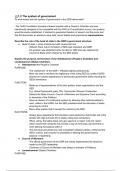
🏢1.2 The system of government
To what extent was the system of government in the GDR democratic?
The 1949 Constitution founded a federal republic with a People’s Chamber and was
intentionally designed to be compatible with the FRG so if reunification occurs, the systems
would be easily established. It claimed to guarantee freedom of speech and the press and
this felt democratic as elections were held, secret ballots and proportional representation.
Describe the role of the head of state in the GDR’s government structure.
● Head of state = prime minister but with ceremonial role
- Wilhelm Pieck role in formation of SED was important and GDR
- His position was abolished when he died in 1960 and was replaced by
Council of State which chaired by the SED leader
Explain the purpose and function of the Volkskammer (People’s Chamber) and
Landerkammer (States Chamber).
● Volkskammer/the People’s Chamber
PURPOSE:
- The “parliament” of the GDR + officially highest political body
- Main role was to reinforce the legitimacy of the ruling SED by (unlike USSR)
present an outward appearance of democratic government while ensuring the
SEDs dominance
FUNCTION:
- Made up of representatives of the bloc parties, mass organisations and the
SED
- E.g. Liberal Democratic party, FDJ, Democratic Women’s Federation
- Elected the State Council, Council of Ministers and Supreme Court according
to demands of the Politburo
- Gave an illusion of a multi-party system by allowing other political parties to
exist, unlike in the USSR, but the SED predetermined the allocation of seats,
ensuring its control
- Many other parties had to accept the control by the SED
ELECTIONS:
- Always gave appearance that members were elected by democratic will of the
people with high turnouts (H) in reality voting was compulsory
- When voting, the ballot sheet only give approve or reject ‘unity list’ option
which meant that voting did not provide a way of removing a government or
even altering the balance within it
- This structure prevented any real competition between parties, reinforced the
SED’s control, and ensured no possibility of altering the government’s
balance or leadership.
● Council of Ministers
- The official government of the GDR but merely implemented the decisions
made by the SED leadership
- Chairman of Council of Ministers was always a member of Politburo
● Landerkammer (States Chamber)
PURPOSE:
To what extent was the system of government in the GDR democratic?
The 1949 Constitution founded a federal republic with a People’s Chamber and was
intentionally designed to be compatible with the FRG so if reunification occurs, the systems
would be easily established. It claimed to guarantee freedom of speech and the press and
this felt democratic as elections were held, secret ballots and proportional representation.
Describe the role of the head of state in the GDR’s government structure.
● Head of state = prime minister but with ceremonial role
- Wilhelm Pieck role in formation of SED was important and GDR
- His position was abolished when he died in 1960 and was replaced by
Council of State which chaired by the SED leader
Explain the purpose and function of the Volkskammer (People’s Chamber) and
Landerkammer (States Chamber).
● Volkskammer/the People’s Chamber
PURPOSE:
- The “parliament” of the GDR + officially highest political body
- Main role was to reinforce the legitimacy of the ruling SED by (unlike USSR)
present an outward appearance of democratic government while ensuring the
SEDs dominance
FUNCTION:
- Made up of representatives of the bloc parties, mass organisations and the
SED
- E.g. Liberal Democratic party, FDJ, Democratic Women’s Federation
- Elected the State Council, Council of Ministers and Supreme Court according
to demands of the Politburo
- Gave an illusion of a multi-party system by allowing other political parties to
exist, unlike in the USSR, but the SED predetermined the allocation of seats,
ensuring its control
- Many other parties had to accept the control by the SED
ELECTIONS:
- Always gave appearance that members were elected by democratic will of the
people with high turnouts (H) in reality voting was compulsory
- When voting, the ballot sheet only give approve or reject ‘unity list’ option
which meant that voting did not provide a way of removing a government or
even altering the balance within it
- This structure prevented any real competition between parties, reinforced the
SED’s control, and ensured no possibility of altering the government’s
balance or leadership.
● Council of Ministers
- The official government of the GDR but merely implemented the decisions
made by the SED leadership
- Chairman of Council of Ministers was always a member of Politburo
● Landerkammer (States Chamber)
PURPOSE: