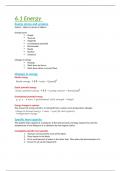
6.1 Energy
Energy stores and systems
System - object or group of objects
Energy stores
Kinetic
Thermal
Magnetic
Gravitational potential
Electrostatic
Elastic
Nuclear
Chemical
Changes in energy
Heating
Work done by forces
Work done when a current flows
Changes in energy
Kinetic energy
Elastic potential energy
Gravitational potential energy
Energy changes in systems
The amount of energy stored in or released from a system as its temperature changes
Specific heat capacity
The specific heat capacity of a substance is the total amount of energy required to raise the
temperature of one kilogram of a substance by one degree Celsius.
Investigating specific heat capacities
1. Measure and record the mass of the block
2. Place heater in the block
3. Put a small amount of water in the other hole. Then place the thermometer in it.
4. Ensure to set up the equipment;
, 5. Switch on power pack to 12v
6. Record ammeter and voltmeter readings (these shouldn't change)
7. Measure the temperature and start stop clock
8. Record temperature every minute for 10 mins. Record in table
9. Calculate power of heater in watts (ammeter reading x voltmeter reading)
10. Calculate work down by the heater (time in secs x power)
11. Plot graph. X = temperature in oC and Y = work done in J
12. Draw line of best fit and calculate the gradient
13. Heat capacity of the block is 1/gradient
14. Specific heat capacity is heat capacity/ mass of block
15. Repeat the whole experiment with different materials of the block
Power
Rate at which energy is transferred
Rate at which work is done
Measured in watts
Work done in joules
An energy transfer of 1 joule per second is equal to a power of 1 watts
Example of definition of power
Comparing two electric motors that both lift the same weight to same height but one does it faster
than the other
Conservation of energy
Energy can be transferred usefully, stored or dissipated but cannot be create or destroyed
High thermal conductivity of a material the higher the rate of energy transfer by conduction across a
material
Wasted energy
Energy from battery in phone is transferred chemically to power phone but some is transferred to
thermal
, No net change in total energy for closed systems
Dropping a cold spoon in a hot flask that is sealed
Reducing unwanted energy transfers
Lubrication - reduces frictional force by allowing an easy flow between object when
they rub together therefore less thermal energy is dissipated
Thermal insulation - using thicker walls made from a material with low thermal
conductivity will mean the rate of energy transfer is slower (less energy lost)
Cooling a building
Affected by:
Wall thickness as thicker walls provide more resistance to heat flow, trapping warmth
inside for longer
Thermal conductivity - materials with low thermal conductivity are better at insulating,
meaning they prevent heat from escaping quickly
Energy resources
Uses of energy resources
Transport
Electricity generation
Heating
Non-renewable
An energy source that will eventually run out. Fossil and nuclear fuels
1. Coal
2. Oil
3. Natural gas
Harm the environment
Provide us with the most energy
Renewable
An energy source that is being (or can be) replenished as it is used
1. The sun (solar)
2. Wind
3. Water waves
4. Hydro electricity
5. Bio-fuel
6. Tides
7. Geothermal
Less harm to environment than non-renewable
Provide us with less energy and some are unreliable
Methods of renewable energy
Wind power
Wind turbine blades turns the generator to produce electricity
Pros Cons
No pollution Spoil
No fuels/ minimal scenery
Energy stores and systems
System - object or group of objects
Energy stores
Kinetic
Thermal
Magnetic
Gravitational potential
Electrostatic
Elastic
Nuclear
Chemical
Changes in energy
Heating
Work done by forces
Work done when a current flows
Changes in energy
Kinetic energy
Elastic potential energy
Gravitational potential energy
Energy changes in systems
The amount of energy stored in or released from a system as its temperature changes
Specific heat capacity
The specific heat capacity of a substance is the total amount of energy required to raise the
temperature of one kilogram of a substance by one degree Celsius.
Investigating specific heat capacities
1. Measure and record the mass of the block
2. Place heater in the block
3. Put a small amount of water in the other hole. Then place the thermometer in it.
4. Ensure to set up the equipment;
, 5. Switch on power pack to 12v
6. Record ammeter and voltmeter readings (these shouldn't change)
7. Measure the temperature and start stop clock
8. Record temperature every minute for 10 mins. Record in table
9. Calculate power of heater in watts (ammeter reading x voltmeter reading)
10. Calculate work down by the heater (time in secs x power)
11. Plot graph. X = temperature in oC and Y = work done in J
12. Draw line of best fit and calculate the gradient
13. Heat capacity of the block is 1/gradient
14. Specific heat capacity is heat capacity/ mass of block
15. Repeat the whole experiment with different materials of the block
Power
Rate at which energy is transferred
Rate at which work is done
Measured in watts
Work done in joules
An energy transfer of 1 joule per second is equal to a power of 1 watts
Example of definition of power
Comparing two electric motors that both lift the same weight to same height but one does it faster
than the other
Conservation of energy
Energy can be transferred usefully, stored or dissipated but cannot be create or destroyed
High thermal conductivity of a material the higher the rate of energy transfer by conduction across a
material
Wasted energy
Energy from battery in phone is transferred chemically to power phone but some is transferred to
thermal
, No net change in total energy for closed systems
Dropping a cold spoon in a hot flask that is sealed
Reducing unwanted energy transfers
Lubrication - reduces frictional force by allowing an easy flow between object when
they rub together therefore less thermal energy is dissipated
Thermal insulation - using thicker walls made from a material with low thermal
conductivity will mean the rate of energy transfer is slower (less energy lost)
Cooling a building
Affected by:
Wall thickness as thicker walls provide more resistance to heat flow, trapping warmth
inside for longer
Thermal conductivity - materials with low thermal conductivity are better at insulating,
meaning they prevent heat from escaping quickly
Energy resources
Uses of energy resources
Transport
Electricity generation
Heating
Non-renewable
An energy source that will eventually run out. Fossil and nuclear fuels
1. Coal
2. Oil
3. Natural gas
Harm the environment
Provide us with the most energy
Renewable
An energy source that is being (or can be) replenished as it is used
1. The sun (solar)
2. Wind
3. Water waves
4. Hydro electricity
5. Bio-fuel
6. Tides
7. Geothermal
Less harm to environment than non-renewable
Provide us with less energy and some are unreliable
Methods of renewable energy
Wind power
Wind turbine blades turns the generator to produce electricity
Pros Cons
No pollution Spoil
No fuels/ minimal scenery