100% satisfaction guarantee Immediately available after payment Both online and in PDF No strings attached 4.2 TrustPilot
logo-home
Exam (elaborations)

Test Bank Campbell Biology All Chapters

Rating
-
Sold
-
Pages
1267
Grade
A+
Uploaded on
02-07-2025
Written in
2024/2025

Test Bank Campbell Biology All Chapters Contents Chapter 1 Introduction: Themes in the Study of Life 1 Chapter 2 The Chemical Context of Life 17 Chapter 3 Water and the Fitness of the Environment 41 Chapter 4 Carbon and the Molecular Diversity of Life 61 Chapter 5 The Structure and Function of Large Biological Molecules 82 Chapter 6 A Tour of the Cell 110 Chapter 7 Membrane Structure and Function 129 Chapter 8 An Introduction to Metabolism 150 Chapter 9 Cellular Respiration: Harvesting Chemical Energy 172 Chapter 10 Photosynthesis 200 Chapter 11 Cell Communication 220 Chapter 12 The Cell Cycle 236 Chapter 13 Meiosis and Sexual Life Cycles 257 Chapter 14 Mendel and the Gene Idea 277 Chapter 15 The Chromosomal Basis of Inheritance 301 Chapter 16 The Molecular Basis of Inheritance 321 Chapter 17 From Gene to Protein 340 Chapter 18 Regulation of Gene Expression 364 Chapter 19 Viruses 389 Chapter 20 Biotechnology 400 Chapter 21 Genomes and Their Evolution 420 Chapter 22 Descent with Modification: A Darwinian View of Life 430 Chapter 23 The Evolution of Populations 447 Chapter 24 The Origin of Species 472 Chapter 25 The History of Life on Earth 491 Chapter 26 Phylogeny and the Tree of Life 519 Chapter 27 Bacteria and Archaea 546 Chapter 28 Protists 571 Chapter 29 Plant Diversity I: How Plants Colonized Land 595 Chapter 30 Plant Diversity II: The Evolution of Seed Plants 615 Chapter 31 Fungi 642 Chapter 32 An Introduction to Animal Diversity 665 Chapter 33 Invertebrates 689 Chapter 34 Vertebrates 717 Chapter 35 Plant Structure, Growth, and Development 744 Chapter 36 Resource Acquisition and Transport in Vascular Plants 764 Chapter 37 Soil and Plant Nutrition 784 Chapter 38 Angiosperm Reproduction and Biotechnology 805 Chapter 39 Plant Responses to Internal and External Signals 825 Chapter 40 Basic Principles of Animal Form and Function 851 Chapter 41 Animal Nutrition 869 Chapter 42 Circulation and Gas Exchange 886 Chapter 43 The Immune System 905 Chapter 44 Osmoregulation and Excretion 927 Chapter 45 Hormones and the Endocrine System 939 Chapter 46 Animal Reproduction 956 Chapter 47 Animal Development 976 Chapter 48 Neurons, Synapses, and Signaling 993 Chapter 49 Nervous Systems 1007 Chapter 50 Sensory and Motor Mechanisms 1019 Chapter 51 Animal Behavior 1035 Chapter 52 An Introduction to Ecology and the Biosphere 1054 Chapter 53 Population Ecology 1074 Chapter 54 Community Ecology 1102 Chapter 55 Ecosystems 1121 Chapter 56 Conservation Biology and Restoration Ecology 1144 Test Bank Campbell Biology All Chapters Chapter 1 Introduction: Themes in the Study of Life The introduction to the study of biology in Chapter 1 highlights seven book -wide themes, with special emphasis on the core theme of evolution. How scientists use inductive reasoning to draw general conclusions and deductive reasoning to test hypotheses is emphasized. Questions in this chapter are designed to help assess a student’s understanding of the content of Chapter 1 based on the three key concepts. Multiple-Choice Questions 1) Which of the following properties or processes do we associate with living things? A) evolutionary adaptations B) energy processing C) responding to the environment D) growth and reproduction E) all of the above Answer: E Topic: Overview Skill: Knowledge/Application 2) Which of the following is not a theme that unifies biology? A) interaction with the environment B) emergent properties C) evolution D) reductionism E) structure and function Answer: D Topic: Concept 1.1 Skill: Knowledge/Application 3) Which of the following sequences represents the hierarchy of biological organization from the least to the most complex level? A) organelle, tissue, biosphere, ecosystem, population, organism B) cell, community, population, organ system, molecule, organelle C) organism, community, biosphere, molecule, tissue, organ D) ecosystem, cell, population, tissue, organism, organ system E) molecule, cell, organ system, population, ecosystem, biosphere Answer: E Topic: Concept 1.1 Skill: Knowledge/Application 4) A localized group of organisms that belong to the same species is called a A) biosystem. B) community. C) population. D) ecosystem. E) family. Answer: C Topic: Concept 1.1 Skill: Knowledge/Application 1 2 Chapter 1, Introduction: Themes in the Study of Life Test Bank Campbell Biology All Chapters 5) Which of the following is a false statement regarding DNA? A) Each chromosome has one very long DNA molecule with hundreds of thousands of genes. B) Every cell is enclosed by a membrane. C) Every cell uses DNA as its genetic information. D) All forms of life are composed of cells that have a membrane-enclosed nucleus. E) DNA is the unit of inheritance that is transmitted from parent to offspring. Answer: D Topic: Concept 1.1 Skill: Knowledge/Application 6) In terms of the hierarchical organization of life, a bacterium is at the level of organization, whereas a human is at the level of organization. A) single-celled organism; multicellular organism B) single organelle; organism C) organelle; organ system D) single tissue; multicellular organism E) tissue; organism Answer: A Topic: Concept 1.1 Skill: Knowledge/Application 7) Which of these is a correct representation of the hierarchy of biological organization from least to most complex? A) organelle of a stomach cell, digestive system, large intestine, small intestine, intestinal tissue, organism B) organelle of an intestinal cell, digestive system, small intestine, large intestine, intestinal tissue, organism C) molecule, intestinal cell organelle, intestinal cell, intestinal tissue, digestive system, organism D) molecule, small intestine, large intestine, intestinal tissue, digestive system, organism E) molecule, digestive system, digestive cell organelle, small intestine, large intestine, intestinal cell, organism Answer: C Topic: Concept 1.1 Skill: Knowledge/Application 8) Organisms interact with their environments, exchanging matter and energy. For example, plant chloroplasts convert the energy of sunlight into A) the energy of motion. B) carbon dioxide and water. C) the potential energy of chemical bonds. D) oxygen. E) kinetic energy. Answer: C Topic: Concept 1.1 Skill: Knowledge/Application Chapter 1, Introduction: Themes in the Study of Life 3 9) The main source of energy for producers in an ecosystem is A) light energy. B) kinetic energy. C) thermal energy. D) chemical energy. E) ATP. Answer: A Topic: Concept 1.1 Skill: Knowledge/Application 10) The dynamics of any ecosystem include the following major processes: A) the flow of energy from sunlight to producers B) the flow of energy from sunlight to producers and then to consumers C) the recycling of chemical nutrients D) the flow of energy to producers and the recycling of nutrients E) the flow of energy from sunlight to producers and then to consumers, and the recycling of chemical nutrients. Answer: E Topic: Concept 1.1 Skill: Knowledge/Application 11) For most ecosystems is (are) the ultimate source of energy, and energy leaves the ecosystem in the form of . A) sunlight; heat B) heat; light C) plants; animals D) plants; heat E) producers; consumers Answer: A Topic: Concept 1.1 Skill: Knowledge/Application 4 Chapter 1, Introduction: Themes in the Study of Life Test Bank Campbell Biology All Chapters 12) The illustration above represents A) a computer simulation of the structure of a eukaryotic cell. B) a map of a network of protein interactions within a eukaryotic cell. C) an inventory of all the genes in a fruit fly. D) an X-ray diffraction image of the nucleus and cytoplasm of a eukaryotic cell. E) a computer generated map of the interaction of genes and cytoplasm in a prokaryotic cell. Answer: B Topic: Concept 1.1 Skill: Knowledge/Application 13) The lowest level of biological organization that can perform all the activities required for life is the A) organelle–for example, a chloroplast. B) cell–for example, a skin cell. C) tissue–for example, nervous tissue. D) organ system–for example, the reproductive system. E) organism–for example, an amoeba, dog, human, or maple tree. Answer: B Topic: Concept 1.1 Skill: Knowledge/Application Chapter 1, Introduction: Themes in the Study of Life 5 14) Which of the following is a false statement regarding deoxyribonucleic acid (DNA)? A) Each deoxyribonucleic acid molecule is composed of two long chains of nucleotides arranged in a double helix. B) Genes are composed of deoxyribonucleic acid. C) DNA is composed of chemical building blocks called nucleotides. D) DNA is a code for the sequence of amino acids in a protein. E) DNA is an enzyme that puts together amino acids to make a protein. Answer: E Topic: Concept 1.1 Skill: Knowledge/Application 15) Which of the following types of cells utilize deoxyribonucleic acid (DNA) as their genetic material but do not have their DNA encased within a nuclear envelope? A) animal B) plant C) archaea D) fungi E) protists Answer: C Topic: Concept 1.1 Skill: Application/Analysis 16) Which of the following statements concerning prokaryotic and eukaryotic cells is not correct? A) Prokaryotic cells lack a membrane-bound nucleus. B) Prokaryotic cells contain small membrane-enclosed organelles. C) Eukaryotic cells contain a membrane-bound nucleus. D) DNA, or deoxyribonucleic acid, is present in both prokaryotic cells and eukaryotic cells. E) DNA or deoxyribonucleic acid is present in the nucleus of eukaryotic cells. Answer: B Topic: Concept 1.1 Skill: Knowledge/Application 17) Which of the following is reflective of the phrase ʺthe whole is greater than the sum of its partsʺ? A) high-throughput technology B) emergent properties C) natural selection D) reductionism E) feedback regulations Answer: B Topic: Concept 1.1 Skill: Knowledge/Application 6 Chapter 1, Introduction: Themes in the Study of Life Test Bank Campbell Biology All Chapters 18) In order to understand the chemical basis of inheritance, one must understand the molecular structure of DNA. This is an example of the application of to the study of biology. A) evolution B) emergent properties C) reductionism D) the cell theory E) feedback regulation Answer: C Topic: Concept 1.1 Skill: Application/Analysis 19) A type of protein critical to all cells is organic catalysts called A) feedback activators. B) feedback inhibitors. C) enzymes. D) metabolites. E) nutrients. Answer: C Topic: Concept 1.1 Skill: Knowledge/Application 20) Once labor begins in childbirth, contractions increase in intensity and frequency until delivery. The increasing labor contractions of childbirth are an example of A) a bioinformatic system. B) positive feedback. C) negative feedback. D) feedback inhibition. E) enzymatic catalysis. Answer: B Topic: Concept 1.1 Skill: Application/Analysis 21) When blood glucose level rises, the pancreas secretes insulin, and as a result blood glucose level declines. When blood glucose level is low, the pancreas secretes glucagon, and as a result blood glucose level rises. Such regulation of blood glucose level is the result of A) catalytic feedback. B) positive feedback. C) negative feedback. D) bioinformatic regulation. E) protein-protein interactions. Answer: C Topic: Concept 1.1 Skill: Application/Analysis Chapter 1, Introduction: Themes in the Study of Life 7 22) Life is diverse. How many species are estimated to be presently on the earth? A) 1,800 B) 180,000 C) 1,800,000 D) 18,000,000 E) 180,000,000 Answer: C Topic: Concept 1.1 Skill: Knowledge/Application 23) Which branch of biology is concerned with the naming and classifying of organisms? A) informatics B) schematic biology C) taxonomy D) genomics E) evolution Answer: C Topic: Concept 1.1 Skill: Knowledge/Application 24) Prokaryotic and eukaryotic cells generally have which of the following features in common? A) a membrane-bounded nucleus B) a cell wall made of cellulose C) ribosomes D) flagella or cilia that contain microtubules E) linear chromosomes made of DNA and protein Answer: C Topic: Concept 1.1 Skill: Knowledge/Application 25) Prokaryotes are classified as belonging to two different domains. What are the domains? A) Bacteria and Eukarya B) Archaea and Monera C) Eukarya and Monera D) Bacteria and Protista E) Bacteria and Archaea Answer: E Topic: Concept 1.1 Skill: Knowledge/Application 26) Species that are in the same are more closely related than species that are only in the same . A) phylum; class B) family; order C) class; order D) family; genus E) kingdom; phylum Answer: B Topic: Concept 1.2 Skill: Application/Analysis 8 Chapter 1, Introduction: Themes in the Study of Life Test Bank Campbell Biology All Chapters 27) Two species that belong to the same genus must also belong to the same A) kingdom. B) phylum. C) class. D) order. E) all of the above Answer: E Topic: Concept 1.2 Skill: Application/Analysis 28) Which of these is reflective of the hierarchical organization of life from most to least inclusive? A) kingdom, order, family, phylum, class, genus, species B) phylum, class, order, kingdom, family, genus, species C) kingdom, phylum, class, order, family, genus, species D) genus, species, kingdom, phylum, class, order, family E) class, order, kingdom, phylum, family, genus, species Answer: C Topic: Concept 1.2 Skill: Knowledge/Application 29) A water sample from a hot thermal vent contained a single-celled organism that had a cell wall but lacked a nucleus. What is its most likely classification? A) Eukarya B) Archaea C) Animalia D) Protista E) Fungi Answer: B Topic: Concept 1.2 Skill: Application/Analysis 30) A filamentous organism has been isolated from decomposing organic matter. This organism has a cell wall but no chloroplasts. How would you classify this organism? A) domain Bacteria, kingdom Prokaryota B) domain Archaea, kingdom Bacteria C) domain Eukarya, kingdom Plantae D) domain Eukarya, kingdom Protista E) domain Eukarya, kingdom Fungi Answer: E Topic: Concept 1.2 Skill: Application/Analysis Chapter 1, Introduction: Themes in the Study of Life 9 31) Which of these provides evidence of the common ancestry of all life? A) the ubiquitous use of catalysts by living systems B) the universality of the genetic code C) the structure of the nucleus D) the structure of cilia E) the structure of chloroplasts Answer: B Topic: Concept 1.2 Skill: Application/Analysis 32) Which of the following is (are) true of natural selection? A) requires genetic variation B) results in descent with modification C) involves differential reproductive success D) B and C only E) A, B, and C Answer: E Topic: Concept 1.2 Skill: Knowledge/Application 33) Charles Darwin proposed a mechanism for descent with modification which stated that organisms of a particular species are adapted to their environment when they possess A) non-inheritable traits that enhance their survival in the local environment. B) non-inheritable traits that enhance their reproductive success in the local environment. C) non-inheritable traits that enhance their survival and reproductive success in the local environment. D) inheritable traits that enhance their survival and reproductive success in the local environment. E) inheritable traits that decrease their survival and reproductive success in the local environment. Answer: D Topic: Concept 1.2 Skill: Application/Analysis 34) All of the following statements are part of Charles Darwinʹs concept of natural selection except A) Slight inheritable variations within a population may make an individual significantly more or less likely to survive in its environment, and thus to reproduce. B) Every organism has the potential to produce more offspring than the local environment can support. C) Characteristics of organisms are inherited as genes on chromosomes. D) Better adapted members of a species will survive and reproduce more successfully. E) Most individuals in a species do not survive to reproduce. Answer: C Topic: Concept 1.2 Skill: Application/Analysis 10 Chapter 1, Introduction: Themes in the Study of Life Test Bank Campbell Biology All Chapters 35) Which of these individuals is most likely to be successful in an evolutionary sense? A) a reproductively sterile individual who never falls ill B) an organism that dies after 5 days of life but leaves 10 offspring, all of whom survive to reproduce C) a male who mates with 20 females and fathers 1 offspring D) an organism that lives 100 years and leaves 2 offspring, both of whom survive to reproduce E) a female who mates with 20 males and produces 1 offspring Answer: B Topic: Concept 1.2 Skill: Application/Analysis 36) In a hypothetical world, every 50 years people over 6 feet tall are eliminated from the population. Based on your knowledge of natural selection, you would predict that the average height of the human population will A) remain unchanged. B) gradually decline. C) rapidly decline. D) gradually increase. E) rapidly increase. Answer: B Topic: Concept 1.2 Skill: Application/Analysis 37) Through time, the lineage that led to modern whales shows a change from four -limbed land animals to aquatic animals with two limbs that function as flippers. This change is best explained by A) natural philosophy. B) creationism. C) the hierarchy of the biological organization of life. D) natural selection. E) feedback inhibition. Answer: D Topic: Concept 1.2 Skill: Application/Analysis 38) Evolution is biologyʹs core theme that ties together all the other themes. This is because evolution explains A) the unity and diversity of life. B) how organisms become adapted to their environment through the differential reproductive success of varying individuals. C) why distantly related organisms sometimes resemble each other. D) explains why some organisms have traits in common. E) all of the above Answer: E Topic: Concept 1.2 Skill: Application/Analysis Chapter 1, Introduction: Themes in the Study of Life 11 39) The method of scientific inquiry that describes natural structures and processes as accurately as possible through careful observation and the analysis of data is known as A) hypothesis-based science. B) discovery science. C) experimental science. D) quantitative science. E) qualitative science. Answer: B Topic: Concept 1.3 Skill: Knowledge/Application 40) Collecting data based on observation is an example of ; analyzing this data to reach a conclusion is an example of reasoning. A) hypothesis-based science; inductive B) the process of science; deductive C) discovery science; inductive D) descriptive science; deductive E) hypothesis-based science; deductive Answer: C Topic: Concept 1.3 Skill: Application/Analysis 41) What is a hypothesis? A) the same thing as an unproven theory B) a tentative explanation that can be tested and is falsifiable C) a verifiable observation sensed directly, or sensed indirectly with the aid of scientific instrumentation D) a fact based on qualitative data that is testable E) a fact based on quantitative data that is falsifiable Answer: B Topic: Concept 1.3 Skill: Knowledge/Application 42) Which of these is based on a deduction? A) My car wonʹt start. B) My carʹs battery is dead. C) My car is out of gas. D) I lost my car key. E) If I turn the key in the ignition while stepping on the gas pedal, then my car will start. Answer: E Topic: Concept 1.3 Skill: Application/Analysis 12 Chapter 1, Introduction: Themes in the Study of Life Test Bank Campbell Biology All Chapters 43) When applying the process of science, which of these is tested? A) a question B) a result C) an observation D) a prediction E) a hypothesis Answer: D Topic: Concept 1.3 Skill: Application/Analysis 44) A controlled experiment is one in which A) the experiment is repeated many times to ensure that the results are accurate. B) the experiment proceeds at a slow pace to guarantee that the scientist can carefully observe all reactions and process all experimental data. C) there are at least two groups, one of which does not receive the experimental treatment. D) there are at least two groups, one differing from the other by two or more variables. E) there is one group for which the scientist controls all variables. Answer: C Topic: Concept 1.3 Skill: Application/Analysis 45) Why is it important that an experiment include a control group? A) The control group is the group that the researcher is in control of; it is the group in which the researcher predetermines the nature of the results. B) The control group provides a reserve of experimental subjects. C) A control group is required for the development of an ʺif, thenʺ statement. D) A control group assures that an experiment will be repeatable. E) Without a control group, there is no basis for knowing if a particular result is due to the variable being tested or to some other factor. Answer: E Topic: Concept 1.3 Skill: Application/Analysis 46) The application of scientific knowledge for some specific purpose is known as A) technology. B) deductive science. C) inductive science. D) anthropologic science. E) pure science. Answer: A Topic: Concept 1.3 Skill: Knowledge/Comprehension True/False Questions 47) A common form of regulation in which accumulation of an end product of a process slows that process is called positive feedback. Answer: FALSE Topic: Concept 1.1 Skill: Application/Analysis Chapter 1, Introduction: Themes in the Study of Life 13 48) Charles Darwin presented verifiable evidence that supported the view that life can arise by spontaneous generation. Answer: FALSE Topic: Concept 1.2 Skill: Application/Analysis 49) Recent evidence points to the conclusion that the ancestral finches of the Galapagos originated in the islands of the Caribbean. Answer: TRUE Topic: Concept 1.2 Skill: Application/Analysis 50) Discovery science uses inductive reasoning to derive generalizations from a large number of specific observations. Answer: TRUE Topic: Concept 1.3 Skill: Application/Analysis 51) In hypothesis-based science, deductive reasoning is used to predict a result that would be found if a particular hypothesis is correct. Answer: TRUE Topic: Concept 1.3 Skill: Application/Analysis 52) Discovery science has contributed much to our understanding of nature without most of the steps of the so-called scientific method. Answer: TRUE Topic: Concept 1.3 Skill: Application/Analysis 53) Science requires that hypothesis be testable and falsifiable and that observations be repeatable. Answer: TRUE Topic: Concept 1.3 Skill: Application/Analysis 54) A theory in science is equivalent in scope to a well-structured hypothesis. Answer: FALSE Topic: Concept 1.3 Skill: Application/Analysis 55) The goal of systems biology is to construct models to predict the emergent properties of cells. Answer: FALSE Topic: Concept 1.3 Skill: Application/Analysis 14 Chapter 1, Introduction: Themes in the Study of Life Test Bank Campbell Biology All Chapters Self-Quiz Questions The following questions are from the end-of-chapter-review Self-Quiz questions in Chapter 1 of the textbook. 1) All the organisms on your campus make up A) an ecosystem. B) a community. C) a population. D) an experimental group. E) a taxonomic domain. Answer: B 2) Which of the following is a correct sequence of levels in lifeʹs hierarchy, proceeding downward from an individual animal? A) brain, organ system, nerve cell, nervous tissue B) organ system, nervous tissue, brain C) organism, organ system, tissue, cell, organ D) nervous system, brain, nervous tissue, nerve cell E) organ system, tissue, molecule, cell Answer: D 3) Which of the following is not an observation or inference on which Darwinʹs theory of natural selection is based? A) Poorly adapted individuals never produce offspring. B) There is heritable variation among individuals. C) Because of overproduction of offspring, there is competition for limited resources. D) Individuals whose inherited characteristics best fit them to the environment will generally produce more offspring. E) A population can become adapted to its environment. Answer: A 4) Systems biology is mainly an attempt to A) understand the integration of all levels of biological organization from molecules to the biosphere. B) simplify complex problems by reducing the system into smaller, less complex units. C) construct models of the behavior of entire biological systems. D) build high-throughput machines for the rapid acquisition of biological data. E) speed up the technological application of scientific knowledge. Answer: C 5) Protists and bacteria are grouped into different domains because A) protists eat bacteria. B) bacteria are not made of cells. C) protists have a membrane-bounded nucleus, which bacterial cells lack. D) bacteria decompose protists. E) protists are photosynthetic. Answer: C Chapter 1, Introduction: Themes in the Study of Life 15 6) Which of the following best demonstrates the unity among all organisms? A) matching DNA nucleotide sequences B) descent with modification C) the structure and function of DNA D) natural selection E) emergent properties Answer: C 7) Which of the following is an example of qualitative data? A) The temperature decreased from 20°C to 15°C. B) The plantʹs height is 25 centimeters (cm). C) The fish swam in a zig-zag motion. D) The six pairs of robins hatched an average of three chicks. E) The contents of the stomach are mixed every 20 seconds. Answer: C 8) Which of the following best describes the logic of hypothesis-based science? A) If I generate a testable hypothesis, tests and observations will support it. B) If my prediction is correct, it will lead to a testable hypothesis. C) If my observations are accurate, they will support my hypothesis. D) If my hypothesis is correct, I can expect certain test results. E) If my experiments are set up right, they will lead to a testable hypothesis. Answer: D 9) A controlled experiment is one that A) proceeds slowly enough that a scientist can make careful records of the results. B) may include experimental groups and control groups tested in parallel. C) is repeated many times to make sure the results are accurate. D) keeps all environmental variables constant. E) is supervised by an experienced scientist. Answer: B 10) Which of the following statements best distinguishes hypotheses from theories in science? A) Theories are hypotheses that have been proved. B) Hypotheses are guesses; theories are correct answers. C) Hypotheses usually are relatively narrow in scope; theories have broad explanatory power. D) Hypotheses and theories are essentially the same thing. E) Theories are proved true in all cases; hypotheses are usually falsified by tests. Answer: C 16 Chapter 1, Introduction: Themes in the Study of Life Test Bank Campbell Biology All Chapters 11) With rough sketches, draw a biological hierarchy similar to the one in Figure 1.4 in the text but using a coral reef as the ecosystem, a fish as the organism, its stomach as the organ, and DNA as the molecule. Include all levels in the hierarchy. Answer: Your figure should show: (1) For the biosphere, the Earth with an arrow coming out of a tropical ocean; (2) for the ecosystem, a distant view of a coral reef; (3) For the community, a collection of reef animals and algae, with corals, fishes, some seaweed, and any other organisms you can think of; (4) for the population, a group of fish of the same species; (5) for the organism, one fish from your population; (6) for the organ, the fishʹs stomach, and for the organ system, the whole digestive tract (see Chapter 41 for help); (7) for a tissue, a group of similar cells from the stomach; (8) for a cell, one cell from the tissue, showing its nucleus and a few other organelles; (9) for an organelle, the nucleus, where most of the cellʹs DNA is located; and (10) for a molecule, a DNA double helix. Your sketches can be very rough! Chapter 2 The Chemical Context of Life Information in this chapter establishes a foundation for later discussion and elaboration of molecular-level events and processes in biological systems. Ensuring that students possess the technical vocabulary (terms and definitions) to understand descriptions in later chapters is a major focus. Test Bank questions emphasize understanding and application of technical vocabulary, as well as comprehension of atomic structure and processes such as electron orbitals, bond formation, ionization, etc. Questions near the end of this Test Bank set emphasize ability to relate terminology and word descriptions to pictorial or symbolic representations of atomic structures and processes. Most students will probably find these later questions most difficult. Multiple-Choice Questions 1) About 25 of the 92 natural elements are known to be essential to life. Which four of these 25 elements make up approximately 96% of living matter? A) carbon, sodium, chlorine, nitrogen B) carbon, sulfur, phosphorus, hydrogen C) oxygen, hydrogen, calcium, sodium D) carbon, hydrogen, nitrogen, oxygen E) carbon, oxygen, sulfur, calcium Answer: D Topic: Concept 2.1 Skill: Knowledge/Comprehension 2) Trace elements are those required by an organism in only minute quantities. Which of the following is a trace element that is required by humans and other vertebrates? A) nitrogen B) calcium C) iodine D) sodium E) phosphorus Answer: C Topic: Concept 2.1 Skill: Knowledge/Comprehension 3) Three or four of the following statements are true and correct. Which one, if any, is false? If all the statements are true, choose answer E. A) Carbon, hydrogen, oxygen, and nitrogen make up approximately 96% of living matter. B) The trace element iodine is required only in very small quantities by vertebrates. C) Virtually all organisms require the same elements in the same quantities. D) Iron is an example of an element needed by all organisms. E) All of the other statements are true and correct. Answer: C Topic: Concept 2.1 Skill: Knowledge/Comprehension 17 18 Chapter 2, The Chemical Context of Life Test Bank Campbell Biology All Chapters 4) Which of the following statements is false? A) Atoms of the various elements differ in their number of subatomic particles. B) All atoms of a particular element have the same number of protons in their nuclei. C) The neutrons and protons present in the nucleus of an atom are almost identical in mass; each has a mass of about 1 dalton. D) An atom is the smallest unit of an element that still retains the properties of the element. E) Protons and electrons are electrically charged particles. Protons have one unit of negative charge, and electrons have one unit of positive charge. Answer: E Topic: Concept 2.2 Skill: Knowledge/Comprehension 5) Each element is unique and different from other elements because of the number of protons in the nuclei of its atoms. Which of the following indicates the number of protons in an atomʹs nucleus? A) atomic mass B) atomic weight C) atomic number D) mass weight E) mass number Answer: C Topic: Concept 2.2 Skill: Knowledge/Comprehension 6) The mass number of an element can be easily approximated by adding together the number of in an atom of that element. A) protons and neutrons B) energy levels C) protons and electrons D) neutrons and electrons E) isotopes Answer: A Topic: Concept 2.2 Skill: Knowledge/Comprehension 7) What is the approximate atomic mass of an atom with 16 neutrons, 15 protons, and 15 electrons? A) 15 daltons B) 16 daltons C) 30 daltons D) 31 daltons E) 46 daltons Answer: D Topic: Concept 2.2 Skill: Knowledge/Comprehension Chapter 2, The Chemical Context of Life 19 8) Oxygen has an atomic number of 8 and a mass number of 16. Thus, the atomic mass of an oxygen atom is A) exactly 8 grams. B) exactly 8 daltons. C) approximately 16 grams. D) approximately 16 daltons. E) 24 amu (atomic mass units). Answer: D Topic: Concept 2.2 Skill: Knowledge/Comprehension 9) The nucleus of a nitrogen atom contains 7 neutrons and 7 protons. Which of the following is a correct statement concerning nitrogen? A) The nitrogen atom has a mass number of approximately 7 daltons and an atomic mass of 14. B) The nitrogen atom has a mass number of approximately 14 daltons and an atomic mass of 7. C) The nitrogen atom has a mass number of 14 and an atomic mass of 7 grams. D) The nitrogen atom has a mass number of 7 grams and an atomic number of 14. E) The nitrogen atom has a mass number of 14 and an atomic mass of approximately 14 daltons. Answer: E Topic: Concept 2.2 Skill: Knowledge/Comprehension 10) Calcium has an atomic number of 20 and an atomic mass of 40. Therefore, a calcium atom must have A) 20 protons. B) 40 electrons. C) 40 neutrons. D) A and B only E) A, B, and C Answer: A Topic: Concept 2.2 Skill: Knowledge/Comprehension 11) An atom with an atomic number of 9 and a mass number of 19 would have an atomic mass of approximately A) 9 daltons. B) 9 grams. C) 10 daltons. D) 20 grams. E) 19 daltons. Answer: E Topic: Concept 2.2 Skill: Knowledge/Comprehension 20 Chapter 2, The Chemical Context of Life Test Bank Campbell Biology All Chapters 12) Different atomic forms of an element contain the same number of protons but a different number of neutrons. What are these different atomic forms called? A) ions B) isotopes C) neutronic atoms D) isomers E) radioactive atoms Answer: B Topic: Concept 2.2 Skill: Knowledge/Comprehension 13) How do isotopes of the same element differ from each other? A) number of protons B) number of electrons C) number of neutrons D) valence electron distribution E) amount of radioactivity Answer: C Topic: Concept 2.2 Skill: Knowledge/Comprehension 14) Which of the following best describes the relationship between the atoms described below? Atom 1 Atom 2 1 H 3 H 1 1 A) They are isomers. B) They are polymers. C) They are isotopes. D) They contain 1 and 3 protons, respectively. E) They each contain 1 neutron. Answer: C Topic: Concept 2.2 Skill: Knowledge/Comprehension 15) Which of the following best describes the relationship between the atoms described below? Atom 1 Atom 2 31 P 32 P 15 15 A) They contain 31 and 32 electrons, respectively. B) They are both phosphorus cations. C) They are both phosphorus anions. D) They are both isotopes of phosphorus. E) They contain 31 and 32 protons, respectively. Answer: D Topic: Concept 2.2 Skill: Knowledge/Comprehension Chapter 2, The Chemical Context of Life 21 16) One difference between carbon-12 ( 12 C) and carbon-14 ( 14 C) is that carbon-14 has 6 6 A) two more protons than carbon-12. B) two more electrons than carbon-12. C) two more neutrons than carbon-12. D) A and C only E) B and C only Answer: C Topic: Concept 2.2 Skill: Knowledge/Comprehension 17) 3 H is a radioactive isotope of hydrogen. One difference between hydrogen-1 ( 1 H) and 1 hydrogen-3 ( 3 H) is that hydrogen-3 has 1 A) one more neutron and one more proton than hydrogen-1. B) one more proton and one more electron than hydrogen -1. C) one more electron and one more neutron than hydrogen-1. D) two more neutrons than hydrogen-1. E) two more protons than hydrogen-1. Answer: D Topic: Concept 2.2 Skill: Knowledge/Comprehension 18) The atomic number of carbon is 6. Carbon-14 is heavier than carbon-12 because the atomic nucleus of carbon-14 contains neutrons. A) 6 B) 7 C) 8 D) 12 E) 14 Answer: C Topic: Concept 2.2 Skill: Knowledge/Comprehension 19) Electrons exist only at fixed levels of potential energy. However, if an atom absorbs sufficient energy, a possible result is that A) an electron may move to an electron shell farther out from the nucleus. B) an electron may move to an electron shell closer to the nucleus. C) the atom may become a radioactive isotope. D) the atom would become a positively charged ion, or cation. E) the atom would become a negatively charged ion, or anion. Answer: A Topic: Concept 2.2 Skill: Knowledge/Comprehension 22 Chapter 2, The Chemical Context of Life Test Bank Campbell Biology All Chapters 20) The atomic number of neon is 10. Therefore, which of the following is correct about an atom of neon? A) It has 8 electrons in its outer electron shell. B) It is inert. C) It has an atomic mass of 10 daltons. D) A and B only E) A, B, and C are correct. Answer: D Topic: Concept 2.2 Skill: Knowledge/Comprehension 21) From its atomic number of 15, it is possible to predict that the phosphorus atom has A) 15 neutrons. B) 15 protons. C) 15 electrons. D) 8 electrons in its outermost electron shell. E) B and C only Answer: E Topic: Concept 2.2 Skill: Knowledge/Comprehension Please refer to Figure 2.1 to answer the following questions. Figure 2.1 22) Which drawing depicts the electron configuration of neon ( 20 Ne)? 10 Answer: E Topic: Concept 2.2 Skill: Knowledge/Comprehension 23) Which drawing depicts the electron configuration of oxygen ( 16 O)? 8 Answer: C Topic: Concept 2.2 Skill: Knowledge/Comprehension 24) Which drawing depicts the electron configuration of nitrogen ( 14 N)? 7 Answer: B Topic: Concept 2.2 Skill: Knowledge/Comprehension Chapter 2, The Chemical Context of Life 23 25) Which drawing is of an atom with the atomic number of 6? Answer: A Topic: Concept 2.2 Skill: Knowledge/Comprehension 26) Which drawing depicts an atom that is inert or chemically unreactive? Answer: E Topic: Concept 2.2 Skill: Knowledge/Comprehension 27) Which drawing depicts an atom with a valence of 3? Answer: B Topic: Concept 2.2 Skill: Knowledge/Comprehension 28) Which drawing depicts an atom with a valence of 2? Answer: C Topic: Concept 2.2 Skill: Knowledge/Comprehension 29) Atoms whose outer electron shells contain eight electrons tend to A) form ionic bonds in aqueous solutions. B) form covalent bonds in aqueous solutions. C) be stable and chemically nonreactive, or inert. D) be unstable and chemically very reactive. E) be isotopes and very radioactive. Answer: C Topic: Concept 2.2 Skill: Knowledge/Comprehension Use the information extracted from the periodic table in Figure 2.2 to answer the following questions. Figure 2.2 30) How many electrons does nitrogen have in its valence shell? A) 2 B) 5 C) 7 D) 8 E) 14 Answer: B Topic: Concept 2.2 Skill: Knowledge/Comprehension 24 Chapter 2, The Chemical Context of Life Test Bank Campbell Biology All Chapters 31) How many electrons does phosphorus have in its valence shell? A) 1 B) 2 C) 3 D) 4 E) 5 Answer: E Topic: Concept 2.2 Skill: Knowledge/Comprehension 32) How many neutrons are present in the nucleus of a phosphorus atom? A) 8 B) 15 C) 16 D) 31 E) 46 Answer: C Topic: Concept 2.2 Skill: Knowledge/Comprehension 33) How many electrons does an atom of sulfur have in its valence shell? A) 4 B) 6 C) 8 D) 16 E) 32 Answer: B Topic: Concept 2.2 Skill: Knowledge/Comprehension 34) Based on electron configuration, which of these elements would exhibit chemical behavior most like that of oxygen? A) carbon B) hydrogen C) nitrogen D) sulfur E) phosphorus Answer: D Topic: Concept 2.2 Skill: Application/Analysis 35) How many electrons would be expected in the outermost electron shell of an atom with atomic number 12? A) 1 B) 2 C) 4 D) 6 E) 8 Answer: B Topic: Concept 2.2 Skill: Knowledge/Comprehension Chapter 2, The Chemical Context of Life 25 36) The atomic number of each atom is given to the left of each of the elements below. Which of the atoms has the same valence as carbon ( 12 C)? 6 A) 7nitrogen B) 9flourine C) 10neon D) 12magnesium E) 14silicon Answer: E Topic: Concept 2.2 Skill: Application/Analysis 37) What is the valence of an atom with six electrons in its outer electron shell? A) 1 B) 2 C) 3 D) 4 E) 5 Answer: B Topic: Concept 2.2 Skill: Knowledge/Comprehension 38) Fluorine has an atomic number of 9 and a mass number of 19. How many electrons are needed to complete the valence shell of a fluorine atom? A) 1 B) 3 C) 5 D) 7 E) 9 Answer: A Topic: Concept 2.2 Skill: Knowledge/Comprehension 39) What is the maximum number of electrons in the 1s orbital of an atom? A) 1 B) 2 C) 3 D) 4 E) 5 Answer: B Topic: Concept 2.2 Skill: Knowledge/Comprehension 26 Chapter 2, The Chemical Context of Life Test Bank Campbell Biology All Chapters 40) What is the maximum number of electrons in a 2p orbital of an atom? A) 1 B) 2 C) 3 D) 4 E) 5 Answer: B Topic: Concept 2.2 Skill: Knowledge/Comprehension 41) A covalent chemical bond is one in which A) electrons are removed from one atom and transferred to another atom so that the two atoms become oppositely charged. B) protons and neutrons are shared by two atoms so as to satisfy the requirements of both atoms. C) outer-shell electrons of two atoms are shared so as to satisfactorily fill the outer electron shells of both atoms. D) outer-shell electrons of one atom are transferred to the inner electron shells of another atom. E) the inner-shell electrons of one atom are transferred to the outer shell of another atom. Answer: C Topic: Concept 2.3 Skill: Knowledge/Comprehension 42) If an atom of sulfur (atomic number 16) were allowed to react with atoms of hydrogen (atomic number 1), which of the molecules below would be formed? A) S H B) H S H C) H S H | H D) H | H S H | H E) H S H Answer: B Topic: Concept 2.3 Skill: Application/Analysis Chapter 2, The Chemical Context of Life 27 43) What is the maximum number of covalent bonds an element with atomic number 8 can make with hydrogen? A) 1 B) 2 C) 3 D) 4 E) 6 Answer: B Topic: Concept 2.3 Skill: Knowledge/Comprehension 44) A molecule of carbon dioxide (CO2) is formed when one atom of carbon (atomic number 6) is covalently bonded with two atoms of oxygen (atomic number 8). What is the total number of electrons that must be shared between the carbon atom and the oxygen atoms in order to complete the outer electron shell of all three atoms? A) 1 B) 2 C) 3 D) 4 E) 5 Answer: D Topic: Concept 2.3 Skill: Application/Analysis 45) Nitrogen (N) is much more electronegative than hydrogen (H). Which of the following statements is correct about the atoms in ammonia (NH3)? A) Each hydrogen atom has a partial positive charge. B) The nitrogen atom has a strong positive charge. C) Each hydrogen atom has a slight negative charge. D) The nitrogen atom has a partial positive charge. E) There are covalent bonds between the hydrogen atoms. Answer: A Topic: Concept 2.3 Skill: Knowledge/Comprehension 46) When two atoms are equally electronegative, they will interact to form A) equal numbers of isotopes. B) ions. C) polar covalent bonds. D) nonpolar covalent bonds. E) ionic bonds. Answer: D Topic: Concept 2.3 Skill: Knowledge/Comprehension 28 Chapter 2, The Chemical Context of Life Test Bank Campbell Biology All Chapters 47) What results from an unequal sharing of electrons between atoms? A) a nonpolar covalent bond B) a polar covalent bond C) an ionic bond D) a hydrogen bond E) a hydrophobic interaction Answer: B Topic: Concept 2.3 Skill: Knowledge/Comprehension 48) A covalent bond is likely to be polar when A) one of the atoms sharing electrons is much more electronegative than the other atom. B) the two atoms sharing electrons are equally electronegative. C) the two atoms sharing electrons are of the same element. D) it is between two atoms that are both very strong electron acceptors. E) the two atoms sharing electrons are different elements. Answer: A Topic: Concept 2.3 Skill: Knowledge/Comprehension 49) Which of the following molecules contains the strongest polar covalent bond? A) H2 B) O2 C) CO2 D) H2O E) CH4 Answer: D Topic: Concept 2.3 Skill: Knowledge/Comprehension The following questions refer to Figure 2.3. Figure 2.3 50) What results from the chemical reaction illustrated in Figure 2.3? A) a cation with a net charge of +1 B) a cation with a net charge of -1 C) an anion with a net charge of +1 D) an anion with a net charge of -1 E) A and D Answer: E Topic: Concept 2.3 Skill: Knowledge/Comprehension Chapter 2, The Chemical Context of Life 29 51) What is the atomic number of the cation formed in the reaction illustrated in Figure 2.3? A) 1 B) 8 C) 10 D) 11 E) 16 Answer: D Topic: Concept 2.3 Skill: Application/Analysis 52) The ionic bond of sodium chloride is formed when A) chlorine gains an electron from sodium. B) sodium and chlorine share an electron pair. C) sodium and chlorine both lose electrons from their outer valence shells. D) sodium gains an electron from chlorine. E) chlorine gains a proton from sodium. Answer: A Topic: Concept 2.3 Skill: Knowledge/Comprehension 53) What is the difference between covalent bonds and ionic bonds? A) Covalent bonds involve the sharing of protons between atoms, and ionic bonds involve the sharing of electrons between atoms. B) Covalent bonds involve the sharing of neutrons between atoms, and ionic bonds involve the sharing of electrons between atoms. C) Covalent bonds involve the sharing of electrons between atoms, and ionic bonds involve the electrical attraction between atoms. D) Covalent bonds involve the sharing of protons between atoms, and ionic bonds involve the sharing of neutrons between atoms. E) Covalent bonds involve the transfer of electrons between atoms, and ionic bonds involve the sharing of neutrons between atoms. Answer: C Topic: Concept 2.3 Skill: Knowledge/Comprehension 54) In ammonium chloride salt (NH4Cl) the anion is a single chloride ion, Cl-. What is the cation of NH4Cl? A) N, with a charge of +3 B) H, with a charge of +1 C) H2 with a charge of +4 D) NH4 with a charge of +1 E) NH4 with a charge of +4 Answer: D Topic: Concept 2.3 Skill: Knowledge/Comprehension 30 Chapter 2, The Chemical Context of Life Test Bank Campbell Biology All Chapters 55) The atomic number of chlorine is 17. The atomic number of magnesium is 12. What is the formula for magnesium chloride? A) MgCl B) MgCl2 C) Mg2Cl D) Mg2Cl2 E) MgCl3 Answer: B Topic: Concept 2.3 Skill: Application/Analysis 56) Which of the following results from a transfer of electron(s) between atoms? A) nonpolar covalent bond B) polar covalent bond C) ionic bond D) hydrogen bond E) hydrophobic interaction Answer: C Topic: Concept 2.3 Skill: Knowledge/Comprehension 57) Which of the following explains most specifically the attraction of water molecules to one another? A) nonpolar covalent bond B) polar covalent bond C) ionic bond D) hydrogen bond E) hydrophobic interaction Answer: D Topic: Concept 2.3 Skill: Knowledge/Comprehension 58) Van der Waals interactions result when A) hybrid orbitals overlap. B) electrons are not symmetrically distributed in a molecule. C) molecules held by ionic bonds react with water. D) two polar covalent bonds react. E) a hydrogen atom loses an electron. Answer: B Topic: Concept 2.3 Skill: Knowledge/Comprehension Chapter 2, The Chemical Context of Life 31 59) A van der Waals interaction is the weak attraction between A) the electrons of one molecule and the electrons of a nearby molecule. B) the nucleus of one molecule and the electrons of a nearby molecule. C) a polar molecule and a nearby nonpolar molecule. D) a polar molecule and a nearby molecule that is also polar. E) a nonpolar molecule and a nearby molecule that is also nonpolar. Answer: B Topic: Concept 2.3 Skill: Knowledge/Comprehension 60) Which of the following is not considered to be a weak molecular interaction? A) a covalent bond B) a van der Waals interaction C) an ionic bond in the presence of water D) a hydrogen bond E) A and B only Answer: A Topic: Concept 2.3 Skill: Knowledge/Comprehension 61) Which of the following would be regarded as compounds? A) H2 B) H2O C) O2 D) CH4 E) B and D, but not A and C Answer: E Topic: Concept 2.3 Skill: Application/Analysis 62) Sometimes atoms form molecules by sharing two pairs of valence electrons. When this occurs, the atoms are said to be joined by A) a double covalent bond. B) an electronegative bond. C) a hydrogen bond. D) a protonic bond. E) a complex bond. Answer: A Topic: Concept 2.3 Skill: Knowledge/Comprehension 32 Chapter 2, The Chemical Context of Life Test Bank Campbell Biology All Chapters Refer to the following figure to answer the following questions. 63) The molecule shown here could be described in chemical symbols as A) CH4. B) H2O. C) C2H3. D) C4H4. E) CH2O. Answer: A Topic: Concept 2.3 Skill: Application/Analysis 64) The molecule shown here is the simplest of organic compounds. It is called A) a carbohydrate. B) carbon dioxide. C) methane. D) carbonic hydrate. E) methyl carbonate. Answer: C Topic: Concept 2.3 Skill: Application/Analysis Refer to the following figure to answer the following questions. 65) In the methane molecule shown here, bonds have formed that include both the s orbital valence electrons of the hydrogen atoms and the p orbital valence electrons of the carbon. The electrons in these bonds are said to have A) double orbitals. B) tetrahedral orbitals. C) complex orbitals. D) hybrid orbitals. E) reduced orbitals. Answer: D Topic: Concept 2.3 Skill: Application/Analysis Chapter 2, The Chemical Context of Life 33 66) Which one of the atoms shown would be most likely to form a cation with a charge of +1? A) B) C) D) E) Answer: A Topic: Concept 2.3 Skill: Application/Analysis 34 Chapter 2, The Chemical Context of Life Test Bank Campbell Biology All Chapters 67) Which one of the atoms shown would be most likely to form an anion with a charge of -1? A) B) C) D) E) Answer: D Topic: Concept 2.3 Skill: Application/Analysis Chapter 2, The Chemical Context of Life 35 68) Which of the following pairs of atoms would be most likely to form a covalent bond? A) B) C) D) E) Answer: A Topic: Concept 2.3 Skill: Application/Analysis 36 Chapter 2, The Chemical Context of Life Test Bank Campbell Biology All Chapters 69) Which of the following pairs of atoms would be most likely to form an ionic bond? A) B) C) D) E) Answer: B Topic: Concept 2.3 Skill: Application/Analysis 70) The hybrid orbitals in a molecule of methane are oriented A) toward the corners of a tetrahedron centered on the carbon atom. B) toward the corners of a cube centered on the carbon atom. C) toward the corners of a triangle centered on the carbon atom. D) toward the corners of a rectangle centered on the carbon atom. E) toward the edges of an oval centered on the carbon atom. Answer: A Topic: Concept 2.3 Skill: Application/Analysis Chapter 2, The Chemical Context of Life 37 71) Which of the following is true for this reaction? 3 H2 + N2 ↔2 NH3 A) The reaction is nonreversible. B) Hydrogen and nitrogen are the reactants of the reverse reaction. C) Hydrogen and nitrogen are the products of the forward reaction. D) Ammonia is being formed and decomposed. E) Hydrogen and nitrogen are being decomposed. Answer: D Topic: Concept 2.4 Skill: Knowledge/Comprehension 72) Which of the following best describes chemical equilibrium? A) Forward and reverse reactions continue with no effect on the concentrations of the reactants and products. B) Concentrations of products are higher than the concentrations of the reactants. C) Forward and reverse reactions have stopped so that the concentration of the reactants equals the concentration of the products. D) Reactions stop only when all reactants have been converted to products. E) There are equal concentrations of reactants and products, and the reactions have stopped. Answer: A Topic: Concept 2.4 Skill: Knowledge/Comprehension 73) Which of the following describes any reaction that has reached chemical equilibrium? A) The concentration of the reactants equals the concentration of the products. B) The rate of the forward reaction is equal to the rate of the reverse reaction. C) All of the reactants have been converted to the products of the reaction. D) All of the products have been converted to the reactants of the reaction. E) Both the forward and the reverse reactions have stopped with no net effect on the concentration of the reactants and the products. Answer: B Topic: Concept 2.4 Skill: Knowledge/Comprehension 74) A group of molecular biologists is trying to synthesize a new artificial compound to mimic the effects of a known hormone that influences sexual behavior. They have turned to you for advice. Which of the following compounds is most likely to mimic the effects of the hormone? A) a compound with the same number of carbon atoms as the hormone B) a compound with the same molecular mass (measured in daltons) as the hormone C) a compound with the same three-dimensional shape as part of the hormone D) a compound with the same number of orbital electrons as the hormone E) a compound with the same number of hydrogen and nitrogen atoms as the hormone Answer: C Topic: Concept 2.4 Skill: Application/Analysis 38 Chapter 2, The Chemical Context of Life Test Bank Campbell Biology All Chapters Self-Quiz Questions The following questions are from the end-of-chapter-review Self-Quiz questions in Chapter 2 of the textbook. 1) In the term trace element, the modifier trace means A) the element is required in very small amounts. B) the element can be used as a label to trace atoms through an organismʹs metabolism. C) the element is very rare on Earth. D) the element enhances health but is not essential for the organismʹs long-term survival. E) the element passes rapidly through the organism. Answer: A 2) Compared with 31P, the radioactive isotope 32P has A) a different atomic number. B) one more neutron. C) one more proton. D) one more electron. E) a different charge. Answer: B 3) Atoms can be represented by simply listing the number of protons, neutrons, and electrons for example, 2p+; 2n0; 2e- for helium. Which one of the following lists represents the 18Oisotope of oxygen? A) 6p+; 8n0; 6eB) 8p+; 10n0; 8eC) 9p+; 9n0; 9eD) 7p+; 2n0; 9eE) 10p+; 8n0; 9eAnswer: B 4) The atomic number of sulfur is 16. Sulfur combines with hydrogen by covalent bonding to form a compound, hydrogen sulfide. Based on the number of valence electrons in a sulfur atom, predict the molecular formula of the compound: A) HS B) HS2 C) H2S D) H3S2 E) H4S Answer: C Chapter 2, The Chemical Context of Life 39 5) The reactivity of an atom arises from A) the average distance of the outermost electron shell from the nucleus. B) the existence of unpaired electrons in the valence shell. C) the sum of the potential energies of all the electron shells. D) the potential energy of the valence shell. E) the energy difference between the s and p orbitals. Answer: B 6) Which statement is true of all atoms that are anions? A) The atom has more electrons than protons. B) The atom has more protons than electrons. C) The atom has fewer protons than does a neutral atom of the same element. D) The atom has more neutrons than protons. E) The net charge is 12. Answer: A 7) What coefficients must be placed in the following blanks so that all atoms are accounted for in the products? C6H12O6 → C2H6O + CO2 A) 1; 2 B) 2; 2 C) 1; 3 D) 1; 1 E) 3; 1 Answer: B 8) Which of the following statements correctly describes any chemical reaction that has reached equilibrium? A) The concentrations of products and reactants are equal. B) The rate of the forward reaction equals the rate of the reverse reaction. C) Both forward and reverse reactions have halted. D) The reaction is now irreversible. E) No reactants remain. Answer: B 40 Chapter 2, The Chemical Context of Life Test Bank Campbell Biology All Chapters 9) Draw Lewis structures for each hypothetical molecule shown below, using the correct number of valence electrons for each atom. Determine which molecule makes sense because each atom has a complete valence shell and each bond has the correct number of electrons. Explain what makes the other molecules nonsensical, considering the number of bonds each type of atom can make. Answer: Chapter 3 Water and the Fitness of the Environment As far as we know, life depends on water. Chemical and physical properties of water determine many of the features and processes that are fundamental to life. This chapter describes the structure of the water molecule and explores the many ways that polar covalent bonds and hydrogen bonds among water molecules affect organisms and their interactions with their environments. In addition, this chapter discusses topics including concentrations of solutions, hydrogen ion concentration (pH), and buffer solutions. Material in this chapter lends itself to high-level questions involving Application/Analysis and Synthesis/Evaluation of information. In this edition, we have added a number of questions that require interpretation of graphs or translation of information from one format to another (data table to graph, graph to narrative, etc.). Multiple-Choice Questions 1) In a single molecule of water, two hydrogen atoms are bonded to a single oxygen atom by A) hydrogen bonds. B) nonpolar covalent bonds. C) polar covalent bonds. D) ionic bonds. E) van der Waals interactions. Answer: C Topic: Concept 3.1 Skill: Knowledge/Comprehension 2) The slight negative charge at one end of one water molecule is attracted to the slight positive charge of another water molecule. What is this attraction called? A) a covalent bond B) a hydrogen bond C) an ionic bond D) a hydrophilic bond E) a hydrophobic bond Answer: B Topic: Concept 3.1 Skill: Knowledge/Comprehension 3) An example of a hydrogen bond is the bond between A) C and H in methane (CH4). B) the H of one water molecule and the O of another water molecule. C) Na+and Cl- in salt. D) the two hydrogen atoms in a molecule of hydrogen gas (H 2). E) Mg+and Cl- in MgCl2. Answer: B Topic: Concept 3.1 Skill: Application/Analysis 41 42 Chapter 3, Water and the Fitness of the Environment Test Bank Campbell Biology All Chapters 4) Water is able to form hydrogen bonds because A) oxygen has a valence of 2. B) the water molecule is shaped like a tetrahedron. C) the bonds that hold together the atoms in a water molecule are polar covalent bonds. D) the oxygen atom in a water molecule has a weak positive charge. E) each of the hydrogen atoms in a water molecule is weakly negative in charge. Answer: C Topic: Concept 3.1 Skill: Knowledge/Comprehension 5) What gives rise to the cohesiveness of water molecules? A) hydrophobic interactions B) nonpolar covalent bonds C) ionic bonds D) hydrogen bonds E) both A and C Answer: D Topic: Concept 3.2 Skill: Knowledge/Comprehension 6) Which of the following effects is produced by the high surface tension of water? A) Lakes donʹt freeze solid in winter, despite low temperatures. B) A water strider can walk across the surface of a small pond. C) Organisms resist temperature changes, although they give off heat due to chemical reactions. D) Water can act as a solvent. E) The pH of water remains exactly neutral. Answer: B Topic: Concept 3.2 Skill: Application/Analysis 7) Which of the following takes place as an ice cube cools a drink? A) Molecular collisions in the drink increase. B) Kinetic energy in the drink decreases. C) A calorie of heat energy is transferred from the ice to the water of the drink. D) The specific heat of the water in the drink decreases. E) Evaporation of the water in the drink increases. Answer: B Topic: Concept 3.2 Skill: Application/Analysis 8) Which of the following statements correctly defines a kilocalorie? A) the amount of heat required to raise the temperature of 1 g of water by 1°F B) the amount of heat required to raise the temperature of 1 g of water by 1°C C) the amount of heat required to raise the temperature of 1 kg of water by 1°F D) the amount of heat required to raise the temperature of 1 kg of water by 1°C E) the amount of heat required to raise the temperature of 1,000 g of water by 1°F Answer: D Topic: Concept 3.2 Skill: Knowledge/Comprehension Chapter 3, Water and the Fitness of the Environment 43 9) The nutritional information on a cereal box shows that one serving of a dry cereal has 200 kilocalories. If one were to burn one serving of the cereal, the amount of heat given off would be sufficient to raise the temperature of 20 kg of water how many degrees Celsius? A) 0.2°C B) 1.0°C C) 2.0°C D) 10.0°C E) 20.0°C Answer: D Topic: Concept 3.2 Skill: Application/Analysis 10) Waterʹs high specific heat is mainly a consequence of the A) small size of the water molecules. B) high specific heat of oxygen and hydrogen atoms. C) absorption and release of heat when hydrogen bonds break and form. D) fact that water is a poor heat conductor. E) inability of water to dissipate heat into dry air. Answer: C Topic: Concept 3.2 Skill: Application/Analysis 11) Which type of bond must be broken for water to vaporize? A) ionic bonds B) nonpolar covalent bonds C) polar covalent bonds D) hydrogen bonds E) covalent bonds Answer: D Topic: Concept 3.2 Skill: Knowledge/Comprehension 12) Temperature usually increases when water condenses. Which behavior of water is most directly responsible for this phenomenon? A) the change in density when it condenses to form a liquid or solid B) reactions with other atmospheric compounds C) the release of heat by the formation of hydrogen bonds D) the release of heat by the breaking of hydrogen bonds E) the high surface tension of water Answer: C Topic: Concept 3.2 Skill: Application/Analysis 44 Chapter 3, Water and the Fitness of the Environment Test Bank Campbell Biology All Chapters 13) At what temperature is water at its densest? A) 0°C B) 4°C C) 32°C D) 100°C E) 212°C Answer: B Topic: Concept 3.2 Skill: Knowledge/Comprehension 14) Why does ice float in liquid water? A) The liquid water molecules have more kinetic energy and thus support the ice. B) The ionic bonds between the molecules in ice prevent the ice from sinking. C) Ice always has air bubbles that keep it afloat. D) Hydrogen bonds stabilize and keep the molecules of ice farther apart than the water molecules of liquid water. E) The crystalline lattice of ice causes it to be denser than liquid water. Answer: D Topic: Concept 3.2 Skill: Application/Analysis The following question is based on Figure 3.1: solute molecule surrounded by a hydration shell of water. Figure 3.1 15) Based on your knowledge of the polarity of water molecules, the solute molecule is most likely A) positively charged. B) negatively charged. C) without charge. D) hydrophobic. E) nonpolar. Answer: A Topic: Concept 3.2 Skill: Application/Analysis Chapter 3, Water and the Fitness of the Environment 45 16) Hydrophobic substances such as vegetable oil are A) nonpolar substances that repel water molecules. B) nonpolar substances that have an attraction for water molecules. C) polar substances that repel water molecules. D) polar substances that have an affinity for water. E) charged molecules that hydrogen-bond with water molecules. Answer: A Topic: Concept 3.2 Skill: Knowledge/Comprehension 17) One mole (mol) of a substance is A) 6.02 × 10²³ molecules of the substance. B) 1 g of the substance dissolved in 1 L of solution. C) the largest amount of the substance that can be dissolved in 1 L of solution. D) the molecular mass of the substance expressed in grams. E) A and D only Answer: E Topic: Concept 3.2 Skill: Knowledge/Comprehension 18) How many molecules of glucose (C6H2O6 molecular mass =180 daltons) would be present in one mole of glucose? A) 24 B) 342 C) 23 × 1014 D) 180 × 1014 E) 6.02 × 10²³ Answer: E Topic: Concept 3.2 Skill: Knowledge/Comprehension 19) How many molecules of glycerol (C3H8O3) would be present in 1 L of a 1 M glycerol solution? A) 1 B) 14 C) 92 D) 1 × 10⁷ E) 6.02 × 10²³ Answer: E Topic: Concept 3.2 Skill: Knowledge/Comprehension 46 Chapter 3, Water and the Fitness of the Environment Test Bank Campbell Biology All Chapters 20) When an ionic compound such as sodium chloride (NaCl) is placed in water the component atoms of the NaCl crystal dissociate into individual sodium ions (Na+) and chloride ions (Cl-). In contrast, the atoms of covalently bonded molecules (e.g., glucose, sucrose, glycerol) do not generally dissociate when placed in aqueous solution. Which of the following solutions would be expected to contain the gr

Show more Read less
Institution
Campbell Biology All Chapters
Module
Campbell Biology All Chapters


Whoops! We can’t load your doc right now. Try again or contact support.

Written for

Institution
Campbell Biology All Chapters
Module
Campbell Biology All Chapters

Document information

Uploaded on
July 2, 2025
Number of pages
1267
Written in
2024/2025
Type
Exam (elaborations)
Contains
Questions & answers

Subjects

Content preview

Test Bank Campbell Biology All Chapters
YY YY YY YY YY


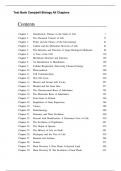
Contents
Chapter 1
YY Introduction: Themes in the Study of Life YY YY YY YY YY YY 1
Chapter 2
YY The Chemical Context of Life
YY YY YY YY 17
Chapter 3
YY Water and the Fitness of the Environment
YY YY YY YY YY YY 41
Chapter 4
YY Carbon and the Molecular Diversity of Life
YY YY YY YY YY YY 61
Chapter 5
YY The Structure and Function of Large Biological Molecules
YY YY YY YY YY YY YY 82
Chapter 6
YY A Tour of the Cell
YY YY YY YY 110
Chapter 7
YY Membrane Structure and Function YY YY YY 129
Chapter 8
YY An Introduction to Metabolism
YY YY YY 150
Chapter 9
YY Cellular Respiration: Harvesting Chemical Energy
YY YY YY YY 172
Chapter 10
YY Photosynthesis 200
Chapter 11
YY Cell Communication
YY 220
Chapter 12
YY The Cell Cycle
YY YY 236
Chapter 13
YY Meiosis and Sexual Life Cycles
YY YY YY YY 257
Chapter 14
YY Mendel and the Gene Idea YY YY YY YY 277
Chapter 15
YY The Chromosomal Basis of Inheritance
YY YY YY YY 301
Chapter 16
YY The Molecular Basis of Inheritance
YY YY YY YY 321
Chapter 17
YY From Gene to Protein
YY YY YY 340
Chapter 18
YY Regulation of Gene Expression YY YY YY 364
Chapter 19
YY Viruses 389
Chapter 20
YY Biotechnology 400
Chapter 21
YY Genomes and Their Evolution YY YY YY 420
Chapter 22
YY Descent with Modification: A Darwinian View of Life
YY YY YY YY YY YY YY 430
Chapter 23
YY The Evolution of Populations
YY YY YY 447
Chapter 24
YY The Origin of Species
YY YY YY 472
Chapter 25
YY The History of Life on Earth
YY YY YY YY YY 491
Chapter 26
YY Phylogeny and the Tree of Life YY YY YY YY YY 519
Chapter 27
YY Bacteria and Archaea YY YY 546
Chapter 28
YY Protists 571
Chapter 29
YY Plant Diversity I: How Plants Colonized Land
YY YY YY YY YY YY 595
Chapter 30
YY Plant Diversity II: The Evolution of Seed Plants
YY YY YY YY YY YY YY 615

,Chapter 31
YY Fungi 642
Chapter 32
YY An Introduction to Animal Diversity
YY YY YY YY 665
Chapter 33
YY Invertebrates 689
Chapter 34
YY Vertebrates 717
Chapter 35
YY Plant Structure, Growth, and Development
YY YY YY YY 744
Chapter 36
YY Resource Acquisition and Transport in Vascular Plants
YY YY YY YY YY YY 764
Chapter 37
YY Soil and Plant Nutrition
YY YY YY 784
Chapter 38
YY Angiosperm Reproduction and Biotechnology
YY YY YY 805
Chapter 39
YY Plant Responses to Internal and External Signals
YY YY YY YY YY YY 825
Chapter 40
YY Basic Principles of Animal Form and Function
YY YY YY YY YY YY 851
Chapter 41
YY Animal Nutrition YY 869
Chapter 42
YY Circulation and Gas Exchange YY YY YY 886
Chapter 43
YY The Immune System
YY YY 905
Chapter 44
YY Osmoregulation and Excretion YY YY 927
Chapter 45
YY Hormones and the Endocrine System
YY YY YY YY 939
Chapter 46
YY Animal Reproduction
YY 956
Chapter 47
YY Animal DevelopmentYY 976
Chapter 48
YY Neurons, Synapses, and Signaling
YY YY YY 993
Chapter 49
YY Nervous Systems YY 1007
Chapter 50
YY Sensory and Motor Mechanisms
YY YY YY 1019
Chapter 51
YY Animal Behavior YY 1035
Chapter 52
YY An Introduction to Ecology and the Biosphere
YY YY YY YY YY YY 1054
Chapter 53
YY Population Ecology YY 1074
Chapter 54
YY Community Ecology YY 1102
Chapter 55
YY Ecosystems 1121
Chapter 56
YY Conservation Biology and Restoration Ecology
YY YY YY YY 1144

,Test Bank Campbell Biology All Chapters
YY YY YY YY YY

, Chapter 1 Introduction: Themes in the Study of Life
YY YY YY YY YY YY YY


The introduction to the study of biology in Chapter 1 highlights seven book -wide themes, with
YY YY YY YY YY YY YY YY YY YY YY YY YY YY YY


special emphasis on the core theme of evolution. How scientists use inductive
YY YY Y Y Y Y Y Y Y Y Y Y Y Y Y Y Y Y Y Y Y Y


reasoning to draw general conclusions and deductive reasoning to test hypotheses is
Y Y Y Y Y Y Y Y YY Y Y Y Y Y Y Y Y Y Y Y Y Y Y


emphasized. Questions in this chapter are designed to help assess a student’s
Y Y Y Y Y Y Y Y Y Y Y Y YY YY YY Y Y Y Y YY


YYunderstanding of the content of Chapter 1 based on the three key concepts.
YY YY YY YY YY YY YY YY YY YY YY YY


Multiple-Choice Questions YY


1) Which of the following properties or processes do we associate with living things?
YY YY YY YY YY YY YY YY YY YY YY YY


A) evolutionary adaptations YY


B) energy processing YY


C) responding to the environment YY YY YY


D) growth and reproduction YY YY


E) all of the YY YY


YY above Answer: YY Y Y E
Topic: Overview Y Y


Skill: Knowledge/Application
Y Y


2) Which of the following is not a theme that unifies biology?
YY YY YY YY YY YY YY YY YY YY


A) interaction with the environment YY YY YY


B) emergent properties YY


C) evolution
D) reductionism
E) structure and YY


function Answer:
YY YY Y Y D
Topic: Concept 1.1
Y Y YY


Skill: Knowledge/Application
Y Y


3) Which of the following sequences represents the hierarchy of biological organization
YY YY YY YY YY YY YY YY YY YY


from the least to the most complex level?
YY YY YY YY YY YY YY YY


A) organelle, tissue, biosphere, ecosystem, population, organism
YY YY YY YY YY


B) cell, community, population, organ system, molecule, organelle
YY YY YY YY YY YY


C) organism, community, biosphere, molecule, tissue, organYY YY YY YY YY


D) ecosystem, cell, population, tissue, organism, organ system YY YY YY YY YY YY


E) molecule, cell, organ system, population, ecosystem, YY YY YY YY YY


YY biosphere Answer: YY Y Y E
Topic: Concept 1.1
Y Y YY


Skill: Knowledge/Application
Y Y


4) A localized group of organisms that belong to the same species is called a
YY YY YY YY YY YY YY YY YY YY YY YY YY


A) biosystem.
B) community.
C) population.
D) ecosystem.
E) family.
YY Answer: C YY


Topic: Concept 1.1
Y Y YY


Skill: Knowledge/Application
Y Y


1
£13.53
Get access to the full document:

100% satisfaction guarantee
Immediately available after payment
Both online and in PDF
No strings attached


Also available in package deal

Get to know the seller

Seller avatar
Reputation scores are based on the amount of documents a seller has sold for a fee and the reviews they have received for those documents. There are three levels: Bronze, Silver and Gold. The better the reputation, the more your can rely on the quality of the sellers work.
WickyAplus Oxford College Of Emory University
Follow You need to be logged in order to follow users or courses
Sold
91
Member since
1 year
Number of followers
8
Documents
1050
Last sold
19 hours ago
Kings venue

Here, you will find everything you need in KINGS VENUE EXAM TESTBANKS. Contact us, to fetch it for you in minutes if we do not have it in this shop.BUY WITHOUT DOUBT!!!!!!!!Always leave a review after purchasing any document so as to make sure our customer

4.8

169 reviews

5
156
4
2
3
6
2
4
1
1

Recently viewed by you

Why students choose Stuvia

Created by fellow students, verified by reviews

Quality you can trust: written by students who passed their exams and reviewed by others who've used these revision notes.

Didn't get what you expected? Choose another document

No problem! You can straightaway pick a different document that better suits what you're after.

Pay as you like, start learning straight away

No subscription, no commitments. Pay the way you're used to via credit card and download your PDF document instantly.

Student with book image

“Bought, downloaded, and smashed it. It really can be that simple.”

Alisha Student

Frequently asked questions