Unit 2
Assignment 3
TITLE: Separate to Identify
Chromatography is the separation of a solution by distributing each component using a solvent. In
chromatography, there are 3 phases; the stationary phase, the contiguous phase, and the mobile
phase. The mobile phase can be in the form of a gas or a liquid, and the stationary phase can be in
the form of a solid or a liquid. There are many different types of chromatography, including paper
chromatography and thin-layer chromatography. Paper chromatography can separate dissolved
chemical substances and is a cheaper method compared to other types of chromatography. It uses
different ranges of migration of different substances across a sheet of chromatography paper. Thin-
layer chromatography is another type of chromatography that can be used to separate compounds
within a mixture. The name of the method comes from it occurring on a material that is coated with
a thin layer of absorbent material. Thin-layer chromatography uses a sheet of paper, plastic, or foil
that is coated as a chromatogram. The separated compounds of the mixture are shown as spots on
the chromatogram. The Rf value is a ratio that measures the distance that a separated component of
a mixture moves across the chromatogram compared to the distance the solvent moves across the
chromatogram. It can be used in order to determine any other unknown substances by comparing
the Rf values of known substances to unknown ones.
Chromatography can be used for lots of different things and processes such as:
● Beverage Testing
● Drug Development
● Drug Testing
● Forensics
● Immunisation [1]
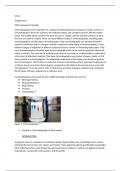
Figure 1: Chromatography [2]
1. Practical 1: Chromatography of Plant extract
- INTRODUCTION
A pigment refers to a substance or material capable of generating color, imparting hues to various
elements like human hair, skin, plants, and insects. These pigments absorb specific light wavelengths
while reflecting others, determining the perceived colors of objects. In plants, key pigments include
chlorophylls, carotenoids, anthocyanins, and flavonoids.
,- AIMS
● To carry out a practical to identify plant pigments using paper chromatography and TLC
● To plan and adhere to a risk assessment
● To produce and keep a record of a chromatogram
● To analyse results using Rf value calculations
● To make conclusions about the types of pigment present in plant cells
- APPARATUS
● Small beaker
● Wooden splint, paper clip
● Strip of chromatography or filter paper
● Running solvent
● Propanone
● Scissors
● Tweezers
● Green leaves such as carrot leaves (if available) or spinach (fresh or frozen)
● Clamp stand
● Capillary tube
- DIAGRAM
, - RISK ASSESSMENT
Hazard Risk Method to minimise Emergency procedure
risk
Propanone irritant or harmful Goggles, wash skin on Seek medical help
contact, wear a lab
coat, do not consume
Running solvent irritant or harmful Goggles, wash skin on Seek medical help
contact, wear a lab
coat, do not consume
Glassware Cuts/scrapes Handle with care, Seek medical help
dispose of in a glass
bin
Hazard Symbols [3]
- METHOD OF DOING TLC
Assignment 3
TITLE: Separate to Identify
Chromatography is the separation of a solution by distributing each component using a solvent. In
chromatography, there are 3 phases; the stationary phase, the contiguous phase, and the mobile
phase. The mobile phase can be in the form of a gas or a liquid, and the stationary phase can be in
the form of a solid or a liquid. There are many different types of chromatography, including paper
chromatography and thin-layer chromatography. Paper chromatography can separate dissolved
chemical substances and is a cheaper method compared to other types of chromatography. It uses
different ranges of migration of different substances across a sheet of chromatography paper. Thin-
layer chromatography is another type of chromatography that can be used to separate compounds
within a mixture. The name of the method comes from it occurring on a material that is coated with
a thin layer of absorbent material. Thin-layer chromatography uses a sheet of paper, plastic, or foil
that is coated as a chromatogram. The separated compounds of the mixture are shown as spots on
the chromatogram. The Rf value is a ratio that measures the distance that a separated component of
a mixture moves across the chromatogram compared to the distance the solvent moves across the
chromatogram. It can be used in order to determine any other unknown substances by comparing
the Rf values of known substances to unknown ones.
Chromatography can be used for lots of different things and processes such as:
● Beverage Testing
● Drug Development
● Drug Testing
● Forensics
● Immunisation [1]
Figure 1: Chromatography [2]
1. Practical 1: Chromatography of Plant extract
- INTRODUCTION
A pigment refers to a substance or material capable of generating color, imparting hues to various
elements like human hair, skin, plants, and insects. These pigments absorb specific light wavelengths
while reflecting others, determining the perceived colors of objects. In plants, key pigments include
chlorophylls, carotenoids, anthocyanins, and flavonoids.
,- AIMS
● To carry out a practical to identify plant pigments using paper chromatography and TLC
● To plan and adhere to a risk assessment
● To produce and keep a record of a chromatogram
● To analyse results using Rf value calculations
● To make conclusions about the types of pigment present in plant cells
- APPARATUS
● Small beaker
● Wooden splint, paper clip
● Strip of chromatography or filter paper
● Running solvent
● Propanone
● Scissors
● Tweezers
● Green leaves such as carrot leaves (if available) or spinach (fresh or frozen)
● Clamp stand
● Capillary tube
- DIAGRAM
, - RISK ASSESSMENT
Hazard Risk Method to minimise Emergency procedure
risk
Propanone irritant or harmful Goggles, wash skin on Seek medical help
contact, wear a lab
coat, do not consume
Running solvent irritant or harmful Goggles, wash skin on Seek medical help
contact, wear a lab
coat, do not consume
Glassware Cuts/scrapes Handle with care, Seek medical help
dispose of in a glass
bin
Hazard Symbols [3]
- METHOD OF DOING TLC