

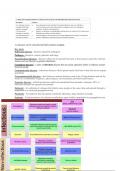
1.a diseases can be classified and their patterns mapped.
Key terms
Infectious diseases - diseases spread by pathogens
Pathogen - Bacteria, viruses, parasites and fungi
Non-infectious diseases - diseases which are not spread from host to host and are caused by external
factors such as lifestyle or genetic inheritance
Contagious diseases - a class of infectious disease that are easily spread by direct or indirect contact
between people
Communicable diseases - infectious diseases which spread easily from host to host but do not require
quarantine
Noncommunicable diseases - also known as chronic diseases, tend to be of long duration and are the
result of a combination of genetic, physiological, environmental and behavioural factors.
Zoonotic diseases - infectious diseases which are transmitted from animals to humans. 60% of
infectious diseases are spread from animals
Epidemic - An outbreak of a disease that infects many people at the same time and spreads through a
population in a restricted geographical area.
Pandemic - An epidemic that has spread worldwide affecting a large number of people.
Endemic - Usual prevalence of a disease or infectious agent within a population or geographical area
,Classifying diseases
Infectious diseases
➔ Infectious diseases are those spread by pathogens (tiny living organisms that make people
sick), such as bacteria (microscopic living organisms), viruses (microscopic parasites which
can infect living organisms and cause disease), parasites (organisms that live off or in another
organism, obtaining nourishment and protection while offering no benefit in return) and fungi.
Some, but not all, infectious diseases spread directly from one person to another. Infectious
diseases that spread from person to person are said to be contagious (capable of being
transmitted by infection; easily diffused or spread as from one person to another). Examples
of contagious disease might include bacterial infections such as typhoid and plague or viral
diseases like yellow fever and Ebola. Infectious diseases that spread from host to host (but do
not require quarantine ) are sometimes referred to as communicable diseases.
➔ Not all infectious diseases are communicable; an example of a non-communicable infectious
disease is tetanus, an infection caused by toxins in the environment. Some infectious diseases
are also non-contagious (cannot be spread from person to person), and are spread to people
by disease vectors such as an animal or insect. Non-contagious infectious diseases might
include malaria or filariasis. When infectious diseases are transmitted from animals to
humans they can also be said to be zoonotic diseases (diseases that normally exist in animals
but have the potential to infect humans). Examples of zoonotic diseases include rabies and
plague.
➔ Contagious infectious diseases have historically been the main cause of death; as late as 1900,
infectious diseases (pneumonia and influenza, tuberculosis, gastrointestinal infections and
diphtheria) caused more than half of all deaths in the US. They remain important in the
developing world with malaria killing 583,000 people worldwide in 2013, mostly in
developing countries. In the developed world medical technologies such as antibiotics and
vaccination have largely eliminated the most dangerous contagious diseases.
Non-infectious diseases
➔ Non-infectious diseases are diseases which are not spread from host to host (they are
non-communicable). The first major classification of non-infectious diseases is those
associated with nutritional deficiencies. Where there is prolonged deficiency of total energy
and nutrients then rickets can occur. In the developing world this can be associated with
famine crises, whilst in the developed world eating disorders such as anorexia and bulimia
can cause malnutrition. Sometimes diseases arise as a result of something specific lacking in
the diet, e.g. a lack of vitamin D can cause rickets and a lack of vitamin C can cause scurvy
(both of these diseases were often associated with early sailors who would spend long periods
at sea with a poor diet).
➔ The second major group of non-infectious diseases are linked with lifestyle factors, e.g.
over-consumption, smoking, drinking etc. Lifestyle-related diseases include diabetes, heart
, disease and certain cancers. The third group of non-infectious diseases are linked to genetic
inheritance. The first major group of these is single gene inherited diseases caused by
changes or mutations that occur in the DNA sequence of a single gene (1 in every 200 births
is affected by one of more than 6,000 known single gene disorders). Including cystic fibrosis,
Huntington’s disease and sickle cell anaemia. The second major group is multifactorial
inheritance (mutations in multiple genes) and includes heart disease, certain cancers (read
about Angelina Jolie), Alzheimer’s disease, arthritis and diabetes. Multifactorial inheritance
diseases are common.
➔ There are also diseases caused by chromosome abnormalities and mitochondrial inheritance.
Non-infectious diseases are the main cause of death in developed countries and are
increasingly so in developing countries (nine of the top ten disease-related causes of death in
the UK are non-infectious/non-communicable with coronary heart disease, stroke and lung
cancer the top three).
Endemic, Epidemic and Pandemic
Endemic Epidemic Pandemic
Usual prevalence of a disease or infectious agent An outbreak of a disease that infects Pandemic
within a population or geographical area many people at the same time and An epidemic that has spread
★ e.g. chicken pox occurs at a predictable rate spreads through a population in a worldwide affecting a large
in young children in the UK restricted geographical area. number of people.
★ Malaria – there are estimates that half the ★ e.g. Ebola outbreak in West ★ E.g. Black Death
world’s population lives in areas where there Africa, 2014 onwards causing (bubonic plague) of the
is a risk of malarial infection (it is such a 10,500 deaths, mainly in Liberia, mid-fourteenth century,
fixture that in certain parts of Africa that a Sierra Leone and Guinea Killed an estimated
protective mutation - sickle cell trait - has ★ Nearly 10,000 killed in cholera 75-200 million people
become common in local populations) outbreaks following the 2010 worldwide
★ According to the Center for Disease Control Haiti earthquake ★ Killed possibly half of
and Prevention, approximately 7.6 million ★ 931 killed in the 2009-2010 West Europe’s population in
people are infected with Chagas disease, African meningitis outbreak, just four years
endemic in Mexico, South and Central more than 300 killed in a 2017
America – it is caused by tiny parasites outbreak in Nigeria E.g. Spanish flu in 1918-19
transmitted by blood-sucking insects and ★ 847 killed by a yellow fever ★ Affected 1/3 of the
eventually causes congestive heart failure outbreak in Darfur, Sudan global population
★ Sleeping sickness is also caused by a ★ 775 killed by the SARS outbreak ★ One in 5 infected
parasite, transmitted to humans by the bite of in Asia and Canada, 2002-2003 people died
an infected tsetse fly and causing headaches, (zoonotic origin traced to cave ★ Worldwide death toll of
fever, joint pain, sweating before the bats in a province of China) 50 million
parasite invades the central nervous system ★ 2015-2016 Zika virus outbreak ★ Killed more people than
in Brazil that spread through WWI
travellers
, What are degenerative and lifestyle-related diseases?
Degenerative Diseases: These are diseases that result from the gradual decline in the function or
structure of tissues and organs over time. They are often associated with ageing and include
conditions such as heart disease, cancer, and Alzheimer's disease. Degenerative diseases typically
have long-term impacts and are prevalent in societies where life expectancy is higher.
Examples
- Heart attack
- Stroke
- Cancer
- Arthritis
Lifestyle Diseases: These are diseases linked to the way people live their lives. They are primarily
caused by unhealthy habits or behaviours, such as a poor diet, lack of physical activity, smoking, or
excessive alcohol consumption. Common examples include type 2 diabetes, obesity, cardiovascular
diseases, and certain types of cancer. Lifestyle diseases are increasingly prevalent in both developed
and developing countries, particularly where urbanisation and sedentary lifestyles are common.
Malaria
- Large amounts of people die from malaria in Africa with highest rates coming from Sierra
Leone (central Africa)
- Other countries may have cases but no deaths
- INFECTIOUS - NON CONTAGIOUS DISEASE
- World malaria report - 2022 = 247 million cases
- 619,000 deaths by 2021
- Malaria is more common in rural areas, but urban malaria can occur, especially in places with
poor sanitation and standing water
- can be preventable and managed
- Malaria prevention methods include insecticide-treated nets and antimalarial drugs, and it can
be managed with prompt diagnosis and treatment.
HIV (Human immunodeficiency virus) causes AIDS
- Can be fatal by attacking the immune system of the body and causing it to fail
- HIV is most commonly spread through unprotected sexual contact but can also be transmitted
via contaminated needles, blood transfusions, and from mother to child during childbirth or
breastfeeding.
- South Africa = high prevalence of HIV - large number of new infections per 1,000 people.
- Russia is an anomaly and has a high death rate
- INFECTIONS - COMMUNICABLE - NON CONTAGIOUS
- can spread through specific actions but not casual contact like touching or sharing food.
- Spread through human bodily fluids such as blood + semen
- 2022, 39 million people globally were living with HIV
Key terms
Infectious diseases - diseases spread by pathogens
Pathogen - Bacteria, viruses, parasites and fungi
Non-infectious diseases - diseases which are not spread from host to host and are caused by external
factors such as lifestyle or genetic inheritance
Contagious diseases - a class of infectious disease that are easily spread by direct or indirect contact
between people
Communicable diseases - infectious diseases which spread easily from host to host but do not require
quarantine
Noncommunicable diseases - also known as chronic diseases, tend to be of long duration and are the
result of a combination of genetic, physiological, environmental and behavioural factors.
Zoonotic diseases - infectious diseases which are transmitted from animals to humans. 60% of
infectious diseases are spread from animals
Epidemic - An outbreak of a disease that infects many people at the same time and spreads through a
population in a restricted geographical area.
Pandemic - An epidemic that has spread worldwide affecting a large number of people.
Endemic - Usual prevalence of a disease or infectious agent within a population or geographical area
,Classifying diseases
Infectious diseases
➔ Infectious diseases are those spread by pathogens (tiny living organisms that make people
sick), such as bacteria (microscopic living organisms), viruses (microscopic parasites which
can infect living organisms and cause disease), parasites (organisms that live off or in another
organism, obtaining nourishment and protection while offering no benefit in return) and fungi.
Some, but not all, infectious diseases spread directly from one person to another. Infectious
diseases that spread from person to person are said to be contagious (capable of being
transmitted by infection; easily diffused or spread as from one person to another). Examples
of contagious disease might include bacterial infections such as typhoid and plague or viral
diseases like yellow fever and Ebola. Infectious diseases that spread from host to host (but do
not require quarantine ) are sometimes referred to as communicable diseases.
➔ Not all infectious diseases are communicable; an example of a non-communicable infectious
disease is tetanus, an infection caused by toxins in the environment. Some infectious diseases
are also non-contagious (cannot be spread from person to person), and are spread to people
by disease vectors such as an animal or insect. Non-contagious infectious diseases might
include malaria or filariasis. When infectious diseases are transmitted from animals to
humans they can also be said to be zoonotic diseases (diseases that normally exist in animals
but have the potential to infect humans). Examples of zoonotic diseases include rabies and
plague.
➔ Contagious infectious diseases have historically been the main cause of death; as late as 1900,
infectious diseases (pneumonia and influenza, tuberculosis, gastrointestinal infections and
diphtheria) caused more than half of all deaths in the US. They remain important in the
developing world with malaria killing 583,000 people worldwide in 2013, mostly in
developing countries. In the developed world medical technologies such as antibiotics and
vaccination have largely eliminated the most dangerous contagious diseases.
Non-infectious diseases
➔ Non-infectious diseases are diseases which are not spread from host to host (they are
non-communicable). The first major classification of non-infectious diseases is those
associated with nutritional deficiencies. Where there is prolonged deficiency of total energy
and nutrients then rickets can occur. In the developing world this can be associated with
famine crises, whilst in the developed world eating disorders such as anorexia and bulimia
can cause malnutrition. Sometimes diseases arise as a result of something specific lacking in
the diet, e.g. a lack of vitamin D can cause rickets and a lack of vitamin C can cause scurvy
(both of these diseases were often associated with early sailors who would spend long periods
at sea with a poor diet).
➔ The second major group of non-infectious diseases are linked with lifestyle factors, e.g.
over-consumption, smoking, drinking etc. Lifestyle-related diseases include diabetes, heart
, disease and certain cancers. The third group of non-infectious diseases are linked to genetic
inheritance. The first major group of these is single gene inherited diseases caused by
changes or mutations that occur in the DNA sequence of a single gene (1 in every 200 births
is affected by one of more than 6,000 known single gene disorders). Including cystic fibrosis,
Huntington’s disease and sickle cell anaemia. The second major group is multifactorial
inheritance (mutations in multiple genes) and includes heart disease, certain cancers (read
about Angelina Jolie), Alzheimer’s disease, arthritis and diabetes. Multifactorial inheritance
diseases are common.
➔ There are also diseases caused by chromosome abnormalities and mitochondrial inheritance.
Non-infectious diseases are the main cause of death in developed countries and are
increasingly so in developing countries (nine of the top ten disease-related causes of death in
the UK are non-infectious/non-communicable with coronary heart disease, stroke and lung
cancer the top three).
Endemic, Epidemic and Pandemic
Endemic Epidemic Pandemic
Usual prevalence of a disease or infectious agent An outbreak of a disease that infects Pandemic
within a population or geographical area many people at the same time and An epidemic that has spread
★ e.g. chicken pox occurs at a predictable rate spreads through a population in a worldwide affecting a large
in young children in the UK restricted geographical area. number of people.
★ Malaria – there are estimates that half the ★ e.g. Ebola outbreak in West ★ E.g. Black Death
world’s population lives in areas where there Africa, 2014 onwards causing (bubonic plague) of the
is a risk of malarial infection (it is such a 10,500 deaths, mainly in Liberia, mid-fourteenth century,
fixture that in certain parts of Africa that a Sierra Leone and Guinea Killed an estimated
protective mutation - sickle cell trait - has ★ Nearly 10,000 killed in cholera 75-200 million people
become common in local populations) outbreaks following the 2010 worldwide
★ According to the Center for Disease Control Haiti earthquake ★ Killed possibly half of
and Prevention, approximately 7.6 million ★ 931 killed in the 2009-2010 West Europe’s population in
people are infected with Chagas disease, African meningitis outbreak, just four years
endemic in Mexico, South and Central more than 300 killed in a 2017
America – it is caused by tiny parasites outbreak in Nigeria E.g. Spanish flu in 1918-19
transmitted by blood-sucking insects and ★ 847 killed by a yellow fever ★ Affected 1/3 of the
eventually causes congestive heart failure outbreak in Darfur, Sudan global population
★ Sleeping sickness is also caused by a ★ 775 killed by the SARS outbreak ★ One in 5 infected
parasite, transmitted to humans by the bite of in Asia and Canada, 2002-2003 people died
an infected tsetse fly and causing headaches, (zoonotic origin traced to cave ★ Worldwide death toll of
fever, joint pain, sweating before the bats in a province of China) 50 million
parasite invades the central nervous system ★ 2015-2016 Zika virus outbreak ★ Killed more people than
in Brazil that spread through WWI
travellers
, What are degenerative and lifestyle-related diseases?
Degenerative Diseases: These are diseases that result from the gradual decline in the function or
structure of tissues and organs over time. They are often associated with ageing and include
conditions such as heart disease, cancer, and Alzheimer's disease. Degenerative diseases typically
have long-term impacts and are prevalent in societies where life expectancy is higher.
Examples
- Heart attack
- Stroke
- Cancer
- Arthritis
Lifestyle Diseases: These are diseases linked to the way people live their lives. They are primarily
caused by unhealthy habits or behaviours, such as a poor diet, lack of physical activity, smoking, or
excessive alcohol consumption. Common examples include type 2 diabetes, obesity, cardiovascular
diseases, and certain types of cancer. Lifestyle diseases are increasingly prevalent in both developed
and developing countries, particularly where urbanisation and sedentary lifestyles are common.
Malaria
- Large amounts of people die from malaria in Africa with highest rates coming from Sierra
Leone (central Africa)
- Other countries may have cases but no deaths
- INFECTIOUS - NON CONTAGIOUS DISEASE
- World malaria report - 2022 = 247 million cases
- 619,000 deaths by 2021
- Malaria is more common in rural areas, but urban malaria can occur, especially in places with
poor sanitation and standing water
- can be preventable and managed
- Malaria prevention methods include insecticide-treated nets and antimalarial drugs, and it can
be managed with prompt diagnosis and treatment.
HIV (Human immunodeficiency virus) causes AIDS
- Can be fatal by attacking the immune system of the body and causing it to fail
- HIV is most commonly spread through unprotected sexual contact but can also be transmitted
via contaminated needles, blood transfusions, and from mother to child during childbirth or
breastfeeding.
- South Africa = high prevalence of HIV - large number of new infections per 1,000 people.
- Russia is an anomaly and has a high death rate
- INFECTIONS - COMMUNICABLE - NON CONTAGIOUS
- can spread through specific actions but not casual contact like touching or sharing food.
- Spread through human bodily fluids such as blood + semen
- 2022, 39 million people globally were living with HIV


