4 - Inorganic chemistry & the periodic table
● ***s-block (+) compounds tend to be colourless
Ions of transition metals tend to have colours
Group 2 elements (alkali earth metals)/Group 1 (alkali metals)
● See reactivity
●
Solubility
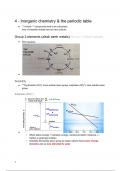
● ***Hydroxides (OH-): more soluble down group, sulphates (SO42-): less soluble down
group
Sulphates (SO42-)
●
○ When lattice energy > hydration energy, compound doesn’t dissolve (∴
CaSO4 is sparingly soluble)
○ Solubility decreases down group as larger cations have lower charge
densities and so less attracted to water
1
, Hydroxides (OH-)
● Larger cations down group, ∴ increasing coordination number for more water
molecules to fit in...
● ***Group 2 hydroxides have higher pH down group (ie increasing basic strength)
Reactions (Mg as eg for Group 2, Na ```` 1, Cl2 as common halogen)
Metal-acid
● Group 2: Mg (s) + 2 HCl (aq) → MgCl2 (s) + H2 (g)
● Group 1: 2Na (s) + 2 HCl (aq) → 2NaCl (s) + H2 (g)
Metal-oxygen
● Group 2: 2Mg (s) + O2 (g) → 2MgO (s)
● Group 1: 4Na (s) + O2 (g) → 2Na2O (s)
Metal-water
● ***With H2O: cold - produces OH-, hot - produces O2-
● Group 2: Mg (s) + 2H2O (l) → Mg(OH)2 (aq) + H2 (g)
Mg (s) + H2O (g) → MgO (s) + H2 (g)
● Group 1: 2Na (s) + 2H2O (l) → 2NaOH (aq) + H2 (g)
2Na (s) + H2O (g) → Na2O (s) + H2 (g)
Metal-halogen
● Group 2: Mg (s) + Cl2 (g) → MgCl2 (s)
● Group 1: 2Na (s) + Cl2 (g) → 2NaCl (s)
Metal oxide-water
● Group 2: MgO (s) + H2O (l) → Mg(OH)2 (aq)
● Group 1: Na2O (s) + H2O (l) → 2NaOH (aq)
Metal oxide-acid (acid-base)
● Group 2: MgO (s) + 2HCl (aq) → MgCl2 (s) + H2O (l)
● Group 1: Na2O (s) + 2HCl (aq) → NaCl (s) + H2O (l)
Metal hydroxide-acid (acid-base)
● Group 2: Mg(OH)2 (s) + 2HCl (aq) → MgCl2 (s) + 2H2O (l)
● Group 1: NaOH (aq) (s) + HCl (aq) → NaCl (s) + H2O (l)
Thermal decomposition
● ***Thermal stability increases down group
● Carbonates (CO32-)
○ Group 2: MgCO3 (s) → MgO (s) + CO2 (g)
○ Group 1 (Li ONLY): Li2CO3 (s) → Li2O (s) + CO2 (g)
● Nitrates (NO3-) - N in nitrate is being reduced (ox: +5 → +4)
2
● ***s-block (+) compounds tend to be colourless
Ions of transition metals tend to have colours
Group 2 elements (alkali earth metals)/Group 1 (alkali metals)
● See reactivity
●
Solubility
● ***Hydroxides (OH-): more soluble down group, sulphates (SO42-): less soluble down
group
Sulphates (SO42-)
●
○ When lattice energy > hydration energy, compound doesn’t dissolve (∴
CaSO4 is sparingly soluble)
○ Solubility decreases down group as larger cations have lower charge
densities and so less attracted to water
1
, Hydroxides (OH-)
● Larger cations down group, ∴ increasing coordination number for more water
molecules to fit in...
● ***Group 2 hydroxides have higher pH down group (ie increasing basic strength)
Reactions (Mg as eg for Group 2, Na ```` 1, Cl2 as common halogen)
Metal-acid
● Group 2: Mg (s) + 2 HCl (aq) → MgCl2 (s) + H2 (g)
● Group 1: 2Na (s) + 2 HCl (aq) → 2NaCl (s) + H2 (g)
Metal-oxygen
● Group 2: 2Mg (s) + O2 (g) → 2MgO (s)
● Group 1: 4Na (s) + O2 (g) → 2Na2O (s)
Metal-water
● ***With H2O: cold - produces OH-, hot - produces O2-
● Group 2: Mg (s) + 2H2O (l) → Mg(OH)2 (aq) + H2 (g)
Mg (s) + H2O (g) → MgO (s) + H2 (g)
● Group 1: 2Na (s) + 2H2O (l) → 2NaOH (aq) + H2 (g)
2Na (s) + H2O (g) → Na2O (s) + H2 (g)
Metal-halogen
● Group 2: Mg (s) + Cl2 (g) → MgCl2 (s)
● Group 1: 2Na (s) + Cl2 (g) → 2NaCl (s)
Metal oxide-water
● Group 2: MgO (s) + H2O (l) → Mg(OH)2 (aq)
● Group 1: Na2O (s) + H2O (l) → 2NaOH (aq)
Metal oxide-acid (acid-base)
● Group 2: MgO (s) + 2HCl (aq) → MgCl2 (s) + H2O (l)
● Group 1: Na2O (s) + 2HCl (aq) → NaCl (s) + H2O (l)
Metal hydroxide-acid (acid-base)
● Group 2: Mg(OH)2 (s) + 2HCl (aq) → MgCl2 (s) + 2H2O (l)
● Group 1: NaOH (aq) (s) + HCl (aq) → NaCl (s) + H2O (l)
Thermal decomposition
● ***Thermal stability increases down group
● Carbonates (CO32-)
○ Group 2: MgCO3 (s) → MgO (s) + CO2 (g)
○ Group 1 (Li ONLY): Li2CO3 (s) → Li2O (s) + CO2 (g)
● Nitrates (NO3-) - N in nitrate is being reduced (ox: +5 → +4)
2