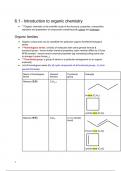
6.1 - Introduction to organic chemistry
● ***Organic chemistry is the scientific study of the structure, properties, composition,
reactions and preparation of compounds containing both carbon and hydrogen
Organic families
● Organic compounds can be classified into particular organic families/homologous
series
● ***Homologous series: a family of molecules with same general formula &
functional group - hence similar chemical properties; each member differs by CH2/an
RFM constant - hence trend in physical properties (eg increasing boiling points due
to stronger London forces...)
● ***Functional group: a group of atoms in a particular arrangement (in an organic
molecule)
● List of homologous series {for all cyclic compounds of all functional groups, -H2 from
general formulae}:
Name of homologous General Functional Example
series formula group
Alkanes (烷烴) CnH2n+2 -
butane (C4H10)
cyclobutane (C4H8)
Alkenes (烯烴) CnH2n C=C (double
bond)
E-but-2-ene (C4H8)
cyclobutene (C4H6)
1
, Alkynes (炔烴) CnH2n-2 C☰C (triple
bond)
but-2-yne (C4H6)
cyclobutyne (C4H4)
Alcohols (醇) CnH2n+1OH —OH (hydroxyl
group [羥基])
2-methylpropan-2-ol (C4H9OH)
Ethers (醚) CnH2n+2O —O—
(CANNOT be
carbonyl group)
methoxymethane (CH3OCH3)
Aldehydes (醛) CnH2n+1CHO
propanal (C2H5CHO)
(formyl group
[甲酰基])
Ketones (酮) CnH2nO
(carbonyl group
[羰基])
pentan-3-one (C5H10O)
2
, Arenes (芳香烴) CnH2n-6m (where (aryl group [芳
m is number of 基])
rings)
benzene (C6H6)
Carboxylic acids (羧酸) Cn-1H2n-1COOH
(carboxyl group
[羧基])
ethanoic acid
Esters (酯) RCOOR’
(where R is an
alcohol, R’ is a
carboxylic
acid)
propyl butanoate
Halogenoalkanes (鹵代 CnH2n+2-qXq —X (where X is
烷烴) (where q is a hydrogen
number of atom replaced
substitutions) by a halogen
atom)
chloroethane (C2H5Cl)
3
● ***Organic chemistry is the scientific study of the structure, properties, composition,
reactions and preparation of compounds containing both carbon and hydrogen
Organic families
● Organic compounds can be classified into particular organic families/homologous
series
● ***Homologous series: a family of molecules with same general formula &
functional group - hence similar chemical properties; each member differs by CH2/an
RFM constant - hence trend in physical properties (eg increasing boiling points due
to stronger London forces...)
● ***Functional group: a group of atoms in a particular arrangement (in an organic
molecule)
● List of homologous series {for all cyclic compounds of all functional groups, -H2 from
general formulae}:
Name of homologous General Functional Example
series formula group
Alkanes (烷烴) CnH2n+2 -
butane (C4H10)
cyclobutane (C4H8)
Alkenes (烯烴) CnH2n C=C (double
bond)
E-but-2-ene (C4H8)
cyclobutene (C4H6)
1
, Alkynes (炔烴) CnH2n-2 C☰C (triple
bond)
but-2-yne (C4H6)
cyclobutyne (C4H4)
Alcohols (醇) CnH2n+1OH —OH (hydroxyl
group [羥基])
2-methylpropan-2-ol (C4H9OH)
Ethers (醚) CnH2n+2O —O—
(CANNOT be
carbonyl group)
methoxymethane (CH3OCH3)
Aldehydes (醛) CnH2n+1CHO
propanal (C2H5CHO)
(formyl group
[甲酰基])
Ketones (酮) CnH2nO
(carbonyl group
[羰基])
pentan-3-one (C5H10O)
2
, Arenes (芳香烴) CnH2n-6m (where (aryl group [芳
m is number of 基])
rings)
benzene (C6H6)
Carboxylic acids (羧酸) Cn-1H2n-1COOH
(carboxyl group
[羧基])
ethanoic acid
Esters (酯) RCOOR’
(where R is an
alcohol, R’ is a
carboxylic
acid)
propyl butanoate
Halogenoalkanes (鹵代 CnH2n+2-qXq —X (where X is
烷烴) (where q is a hydrogen
number of atom replaced
substitutions) by a halogen
atom)
chloroethane (C2H5Cl)
3