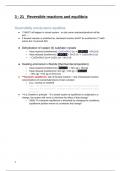
3 - 21 Reversible reactions and equilibria
Reversibility and dynamic equilibria
● ***MUST all happen in closed system - or else some reactants/products will be
lost......
● If forward reaction is endothermic, backward reaction MUST be exothermic (***with
same but reversed ∆H)
● Dehydration of copper (II) sulphate crystals
○ Heat required (endothermic): CuSO4•5H2O (s) → CuSO4 (s) + 5H2O (l)
○ Heat released (exothermic): CuSO4 (s) + 5H2O (l) → CuSO4•5H2O (s)
○ ∴ CuSO4•5H2O (s) ⇌ CuSO4 (s) + 5H2O (l)
● Heating ammonium chloride {thermal decomposition}
○ Heat required (endothermic): NH4Cl (s) → NH3 (g) + HCl (g)
○ Heat released (exothermic): NH3 (g) + HCl (g) → NH4Cl (s)
○ ∴ NH3 (g) + HCl (g) ⇌ NH4Cl (s)
● ***Dynamic equilibrium: rate of forward reaction = rate of backward reaction,
concentrations of reactants/products remain constant
○ E.g.: running on treadmill
○ SBA - “An equilibrium occurs when we have both product and reactant
present at the same time in constant amounts (NOT necessarily equal
amounts)”
● ***Le Chatelier’s principle - “if a closed system at equilibrium is subjected to a
change, the system will move to minimise the effect of that change”
○ (SBA) “If a dynamic equilibrium is disturbed by changing the conditions,
equilibrium position moves to counteract that change”
1
, Equilibrium***
●
2
Reversibility and dynamic equilibria
● ***MUST all happen in closed system - or else some reactants/products will be
lost......
● If forward reaction is endothermic, backward reaction MUST be exothermic (***with
same but reversed ∆H)
● Dehydration of copper (II) sulphate crystals
○ Heat required (endothermic): CuSO4•5H2O (s) → CuSO4 (s) + 5H2O (l)
○ Heat released (exothermic): CuSO4 (s) + 5H2O (l) → CuSO4•5H2O (s)
○ ∴ CuSO4•5H2O (s) ⇌ CuSO4 (s) + 5H2O (l)
● Heating ammonium chloride {thermal decomposition}
○ Heat required (endothermic): NH4Cl (s) → NH3 (g) + HCl (g)
○ Heat released (exothermic): NH3 (g) + HCl (g) → NH4Cl (s)
○ ∴ NH3 (g) + HCl (g) ⇌ NH4Cl (s)
● ***Dynamic equilibrium: rate of forward reaction = rate of backward reaction,
concentrations of reactants/products remain constant
○ E.g.: running on treadmill
○ SBA - “An equilibrium occurs when we have both product and reactant
present at the same time in constant amounts (NOT necessarily equal
amounts)”
● ***Le Chatelier’s principle - “if a closed system at equilibrium is subjected to a
change, the system will move to minimise the effect of that change”
○ (SBA) “If a dynamic equilibrium is disturbed by changing the conditions,
equilibrium position moves to counteract that change”
1
, Equilibrium***
●
2