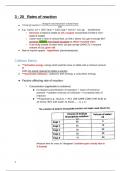
3 - 20 Rates of reaction
change∈concentration/ volume/mass
● ***rate of reaction=
time
● E.g.: CaCO3 (s) + 2HCl (aq) → CaCl2 (aq) + H2O (l) + CO2 (g) (exothermic)
○ Decrease in balance weight as CO2 escapes conical flask (if initial 0, final -
balance weight)
○ Cotton wool in neck of conical flask, as ONLY allows CO2 gas to escape BUT
prevents SPRAY from liquid escaping as affect recorded mass
○ If use bung instead of cotton wool, use gas syringe (DIRECTLY measure
volume of CO2 given off)
● Rate of reaction graphs - logarithmic (decelerating\rate)
Collision theory
● ***Activation energy: energy which particles have to collide with a minimum amount
of
(self) min energy required to initiate a reaction
● ***Successful collisions: collisions with energy ≥ activation energy
● Factors affecting rate of reaction:
○ Concentration (applicable to solutions)
■ Increased concentration of reactant → more of chemical
present → greater chances of collisions → increased rate of
reaction
■ ***Experiment e.g.: Na2S2O3 + HCl; USE SAME CONC FOR ACID at
all times, BUT add water to dilute...... (↓↓↓)
Measure time for cross to “disappear” (solution goes cloudy due to
S formed)
1
change∈concentration/ volume/mass
● ***rate of reaction=
time
● E.g.: CaCO3 (s) + 2HCl (aq) → CaCl2 (aq) + H2O (l) + CO2 (g) (exothermic)
○ Decrease in balance weight as CO2 escapes conical flask (if initial 0, final -
balance weight)
○ Cotton wool in neck of conical flask, as ONLY allows CO2 gas to escape BUT
prevents SPRAY from liquid escaping as affect recorded mass
○ If use bung instead of cotton wool, use gas syringe (DIRECTLY measure
volume of CO2 given off)
● Rate of reaction graphs - logarithmic (decelerating\rate)
Collision theory
● ***Activation energy: energy which particles have to collide with a minimum amount
of
(self) min energy required to initiate a reaction
● ***Successful collisions: collisions with energy ≥ activation energy
● Factors affecting rate of reaction:
○ Concentration (applicable to solutions)
■ Increased concentration of reactant → more of chemical
present → greater chances of collisions → increased rate of
reaction
■ ***Experiment e.g.: Na2S2O3 + HCl; USE SAME CONC FOR ACID at
all times, BUT add water to dilute...... (↓↓↓)
Measure time for cross to “disappear” (solution goes cloudy due to
S formed)
1