1.4 Biological molecules
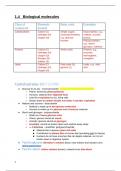
Class of Elements Basic units Examples
compound present
Carbohydrates Carbon (C) Simple sugars Disaccharides, e.g.:
Hydrogen (H) (monosaccharides), maltose, sucrose,
Oxygen (O) e.g.: glucose, lactose
fructose Polysaccharides,
e.g.: starch,
glycogen, cellulose
Proteins Carbon (C) Amino acids Proteins, e.g.:
Hydrogen (H) enzymes,
Oxygen (O) haemoglobin,
Nitrogen (N) myoglobin
Sulphur (S)
Lipids Carbon (C) Fatty acids (3), Lipids, e.g.: oleic
Hydrogen (H) glycerol (1) acid
Oxygen (O)
Carbohydrates (碳水化合物)
● Glucose (C6H12O6) - monosaccharide; ALSO fructose {isomer of glucose}
○ Plants: formed by photosynthesis
○ Humans: obtained from digested food
○ Used for respiration by ALL living cells
○ Broken down to carbon dioxide and water in aerobic respiration
● Maltose and sucrose - disaccharide
○ Maltose is made up of two glucose molecules
○ Sucrose is made up of a glucose and a fructose molecule
● Starch and glycogen - polysaccharide
○ Made up of many glucose units
○ Plants: glucose stored as starch
○ Animals: glucose stored as glycogen
○ Insoluble, cannot be broken down and washed away easily
○ → Cellulose - another polysaccharide
■ Material that composes plant cell walls
■ Contribution to dietary fibre in human diet (providing bulk for faeces)
■ Humans do not have enzymes that can digest cellulose, so it is not
broken down in digestive system
● Test for glucose: Benedict’s solution (blue), heat solution and solution turns
red/orange/yellow
● Test for starch: Iodine solution (brown), material turns blue-black
1
, Proteins (蛋白質)
● A chain of amino acids
● Each different protein is made of a unique sequence of amino acids
○ May be an enzyme, e.g.: amylase (澱粉酶)
○ May be a structural substance, e.g.: collagen (膠原) in bones
● Green plants make amino acids by using the nitrate (NO3-)/ammonium (NH4+) ions
that they absorb from the soil
● Amino acids are not stored in human body, so we must eat at least 4 g of protein
in our diet every day in order to replace lost proteins by processes such as shedding
skin flakes
● Test for protein: Biuret reagent (blue), solution turns purple
Lipids (脂質)
● A glycerol molecule plus 3 attached fatty acids
● Insoluble in water (hydrophobic [疏水])
● Compose cell membranes
● Storing of chemical energy
● When human body needs to use stored energy, lipids in adipose tissue are broken
down to glycerol and fatty acids
○ The fatty acids are then transported in the blood from adipose tissue to
respiring tissues in body
● Humans: adipose cells are found just under the skin, provides insulation,
conserve body heat; also “shock absorber”
● Test for lipids: Emulsion (乳液) test - Ethanol solution (transparent), solution
turns cloudy white
Summary***
● Structure of carbohydrates, proteins and lipids as large molecules made up from
smaller basic units:
○ ***↓↓↓
○ starch & glycogen from simple sugars
○ protein from amino acids
○ lipid from fatty acids + glycerol
● ***Basic formulae:
○ Carbohydrates
■ Monosaccharides: glucose (葡萄糖), fructose (果糖), galactose
(半乳糖) - C6H12O6
■ Disaccharides: maltose (麥芽糖) {glucose x2}, sucrose (蔗糖)
{glucose + fructose}, lactose (乳糖) {glucose + galactose} -
C12H22O11
2
Class of Elements Basic units Examples
compound present
Carbohydrates Carbon (C) Simple sugars Disaccharides, e.g.:
Hydrogen (H) (monosaccharides), maltose, sucrose,
Oxygen (O) e.g.: glucose, lactose
fructose Polysaccharides,
e.g.: starch,
glycogen, cellulose
Proteins Carbon (C) Amino acids Proteins, e.g.:
Hydrogen (H) enzymes,
Oxygen (O) haemoglobin,
Nitrogen (N) myoglobin
Sulphur (S)
Lipids Carbon (C) Fatty acids (3), Lipids, e.g.: oleic
Hydrogen (H) glycerol (1) acid
Oxygen (O)
Carbohydrates (碳水化合物)
● Glucose (C6H12O6) - monosaccharide; ALSO fructose {isomer of glucose}
○ Plants: formed by photosynthesis
○ Humans: obtained from digested food
○ Used for respiration by ALL living cells
○ Broken down to carbon dioxide and water in aerobic respiration
● Maltose and sucrose - disaccharide
○ Maltose is made up of two glucose molecules
○ Sucrose is made up of a glucose and a fructose molecule
● Starch and glycogen - polysaccharide
○ Made up of many glucose units
○ Plants: glucose stored as starch
○ Animals: glucose stored as glycogen
○ Insoluble, cannot be broken down and washed away easily
○ → Cellulose - another polysaccharide
■ Material that composes plant cell walls
■ Contribution to dietary fibre in human diet (providing bulk for faeces)
■ Humans do not have enzymes that can digest cellulose, so it is not
broken down in digestive system
● Test for glucose: Benedict’s solution (blue), heat solution and solution turns
red/orange/yellow
● Test for starch: Iodine solution (brown), material turns blue-black
1
, Proteins (蛋白質)
● A chain of amino acids
● Each different protein is made of a unique sequence of amino acids
○ May be an enzyme, e.g.: amylase (澱粉酶)
○ May be a structural substance, e.g.: collagen (膠原) in bones
● Green plants make amino acids by using the nitrate (NO3-)/ammonium (NH4+) ions
that they absorb from the soil
● Amino acids are not stored in human body, so we must eat at least 4 g of protein
in our diet every day in order to replace lost proteins by processes such as shedding
skin flakes
● Test for protein: Biuret reagent (blue), solution turns purple
Lipids (脂質)
● A glycerol molecule plus 3 attached fatty acids
● Insoluble in water (hydrophobic [疏水])
● Compose cell membranes
● Storing of chemical energy
● When human body needs to use stored energy, lipids in adipose tissue are broken
down to glycerol and fatty acids
○ The fatty acids are then transported in the blood from adipose tissue to
respiring tissues in body
● Humans: adipose cells are found just under the skin, provides insulation,
conserve body heat; also “shock absorber”
● Test for lipids: Emulsion (乳液) test - Ethanol solution (transparent), solution
turns cloudy white
Summary***
● Structure of carbohydrates, proteins and lipids as large molecules made up from
smaller basic units:
○ ***↓↓↓
○ starch & glycogen from simple sugars
○ protein from amino acids
○ lipid from fatty acids + glycerol
● ***Basic formulae:
○ Carbohydrates
■ Monosaccharides: glucose (葡萄糖), fructose (果糖), galactose
(半乳糖) - C6H12O6
■ Disaccharides: maltose (麥芽糖) {glucose x2}, sucrose (蔗糖)
{glucose + fructose}, lactose (乳糖) {glucose + galactose} -
C12H22O11
2