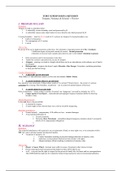
TORT SUPERVISION 6 REVISION
Trespass, Nuisance & Rylands v Fletcher
I. TRESPASS TO LAND
Definition
Trespass to land is committed when:
1. A unlawfully crosses boundary onto land possessed by B
2. A unlawfully causes some object/matter to move directly onto land possessed by B
Crossing boundary – must be direct result of A’s actions; no trespass if crossing boundary was:
Indirect consequence
No consequence of A’s action
Lawful
Title to Sue
B can sue if he was in legal possession at the time. Two elements to legal possession (J A Pye v Graham) :
1.Sufficient degree of physical custody & control – factual possession
2.Intention to exercise such custody and control on one’s own behald– intention to possess
Only one person can be in possession at one time
Tenant has exclusive possession & can sue for trespass
Airspace – passing over land at a height which there can be no intereference with ordinary use of land is
not trespass
Belowground – airspace rule doesn’t apply (Bocardo v Star Energy). Exception: exploiting petroleum
or deep geo-thermal energy
Conduct Requirements
1. A physically moved onto land
Only liable if A had sufficient control over his own movements (Smith v Stone)
2. A caused inanimate object to go onto land
Key question; was movement of object direct result of A’s actions? Primary factor – the extent A’s actions
controlled the crossing of the boundary. Landowner – not in control of natural features of his land
3. A caused animal to go onto land
Only circumstance – where animal is neither ‘livestock’ nor ‘dangerous’ (covered by Animals Act 1971)
League against Cruel Sports – unintentional and negligent trespass; huntsman liable for allowing
hounds to stray
Mental Requirements
It does not have to be proved that
1. A intended to trespass
2. A knew/ought to have known there was a risk he would be trespassing
Remedies & Defences
Normal remedy – compensatory. If B suffers no loss – nominal damages
A has lawful justification if:
1. License (consent)
2. Necessity (Esso Petroleum) – immediate danger/emergency situation; doesn’t necessarily
absolve D of compensation obligations
3.
II. NUISANCE
Definition
The unlawful interference with a person’s use or enjoyment of land, or some right over, or in connection with it.
NB: can’t sue in private nuisance for physical injuries
Variations of nuisance; D:
i. Creates Emanation resulting in physical damage/reduction of amenity value
ii. Authorises enchoarchment/obstruction that interfers with rights
iii. Adopts/continues affront resulting in reduction of amenity value
Title to Sue
Hunter v Canary Wharf– claimant must suffer invasion of proprierty/other interest in land
Person enjoying de facto possession (but defective title) will be able to sue
Art.8 – everyone has the right to respect for his private & family life, his home and his correspondence.
The ECHR held this right can be violated by homes being exposed to noise/environmental pollution.
Trespass, Nuisance & Rylands v Fletcher
I. TRESPASS TO LAND
Definition
Trespass to land is committed when:
1. A unlawfully crosses boundary onto land possessed by B
2. A unlawfully causes some object/matter to move directly onto land possessed by B
Crossing boundary – must be direct result of A’s actions; no trespass if crossing boundary was:
Indirect consequence
No consequence of A’s action
Lawful
Title to Sue
B can sue if he was in legal possession at the time. Two elements to legal possession (J A Pye v Graham) :
1.Sufficient degree of physical custody & control – factual possession
2.Intention to exercise such custody and control on one’s own behald– intention to possess
Only one person can be in possession at one time
Tenant has exclusive possession & can sue for trespass
Airspace – passing over land at a height which there can be no intereference with ordinary use of land is
not trespass
Belowground – airspace rule doesn’t apply (Bocardo v Star Energy). Exception: exploiting petroleum
or deep geo-thermal energy
Conduct Requirements
1. A physically moved onto land
Only liable if A had sufficient control over his own movements (Smith v Stone)
2. A caused inanimate object to go onto land
Key question; was movement of object direct result of A’s actions? Primary factor – the extent A’s actions
controlled the crossing of the boundary. Landowner – not in control of natural features of his land
3. A caused animal to go onto land
Only circumstance – where animal is neither ‘livestock’ nor ‘dangerous’ (covered by Animals Act 1971)
League against Cruel Sports – unintentional and negligent trespass; huntsman liable for allowing
hounds to stray
Mental Requirements
It does not have to be proved that
1. A intended to trespass
2. A knew/ought to have known there was a risk he would be trespassing
Remedies & Defences
Normal remedy – compensatory. If B suffers no loss – nominal damages
A has lawful justification if:
1. License (consent)
2. Necessity (Esso Petroleum) – immediate danger/emergency situation; doesn’t necessarily
absolve D of compensation obligations
3.
II. NUISANCE
Definition
The unlawful interference with a person’s use or enjoyment of land, or some right over, or in connection with it.
NB: can’t sue in private nuisance for physical injuries
Variations of nuisance; D:
i. Creates Emanation resulting in physical damage/reduction of amenity value
ii. Authorises enchoarchment/obstruction that interfers with rights
iii. Adopts/continues affront resulting in reduction of amenity value
Title to Sue
Hunter v Canary Wharf– claimant must suffer invasion of proprierty/other interest in land
Person enjoying de facto possession (but defective title) will be able to sue
Art.8 – everyone has the right to respect for his private & family life, his home and his correspondence.
The ECHR held this right can be violated by homes being exposed to noise/environmental pollution.