
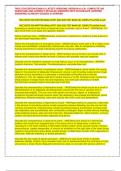
TNCC 8TH EDITION EXAM 10 LATEST VERSIONS (VERSION A & B) COMPLETE 300
QUESTIONS AND CORRECT DETAILED ANSWERS WITH RATIONALES (VERIFIED
ANSWERS) |ALREADY GRADED A+VERIFIED
TNCC NOTES FOR WRITTEN EXAM LATEST 2024-2025 TEST BANK 100- COMPLETE verified A+.pdf
TNCC NOTES FOR WRITTEN EXAM LATEST 2024-2025 TEST BANK 100- COMPLETE verified A+.pdf
According to newtons law which of these two force is greater: size or force? - ANSNeither. For
each force there is an equal and opposite reaction.
Define Cushing's triad - ANSBradycardia, progressive hypertension (widening pulse pressure),
and decreased respiratory effort
Define the characteristics of neurogenic shock - ANSDistributive shock with a T6 or higher injury
results and vasodilation, bradycardia, flushed warm dry skin. Risk for temperature instability.
Nursing interventions include maintaining warmth and spinal stabilization.
Define the characteristics of spinal shock - ANSTransient loss of function can include loss of
reflexes and muscle tone below the level of industry with possible vascular response.
Describe one fat embolism syndrome is most likely to occur in its characteristics - ANSWith
longform fractures. Tachycardia, Thrombocytopenia, and petechiae rash.
Describe the characteristics of cardiogenic shock - ANSCardiogenic shock results from pump
failure in the presence of adequate intravascular volume. Lack of cardiac output and an organ
perfusion occurs secondary to a decrease in myocardial contractility and or valvular
insufficiency. This can happen with blunt cardiac trauma or an MI. Symptoms can include low
blood pressure increase heart rate and respiratory rate chest pain shortness of breath
dysrhythmias increase troponin and pale cool moist skin
Describe the characteristics of distributive shock. - ANSDistributive shock occurs as a result of
Mel distribution of an adequate circulating blood volume with the loss of vascular tone or
increased permeability. This can occur with spinal cord injuries, sepsis, or anaphylaxis.
Symptoms include low blood pressure heart rate respiratory rate preload and afterload, spinal
tenderness, difficulty breathing, warm pink and dry skin with a cool core temperature.
Describe the characteristics of hypovolemic shock - ANSHypovolemia is caused by a decrease
in the amount of circulating volume usually caused by massive bleeding, but also can be from
vomiting and diarrhea. Characteristics include low blood pressure and preload, increase heart
rate respiratory rate and afterload, with contractility unchanged. Signs include obvious bleeding,
weak peripheral pulses, pale cool and moist skin, distended abdomen, pelvic fracture, or bruise
swollen and deformed extremities especially long bones.
Describe the characteristics of obstructive shock - ANSObstructive shock is it mechanical
problem that results from hypoperfusion of the tissue due to an obstruction in either the
vasculature or the heart resulting in decreased cardiac output. Some causes include a tension
pneumothorax, cardiac tamponade, or venous air embolism on the right side of the heart during
systole in the pulmonary artery.Signs include anxiety, muffled heart sounds, JVD, hypertension,
chest pain, difficulty breathing, or pulses paradoxes.
Describe the four types of spinal cord injury - ANSCentral cord injury results in greater
weakness distally, anterior injury includes motor loss or weakness below the cord level of injury
yet sensory is intact, Brown-Sequard (hemicord) is weak on one side with sensory deficit on
,TNCC 8TH EDITION EXAM 10 LATEST VERSIONS (VERSION A & B) COMPLETE 300
QUESTIONS AND CORRECT DETAILED ANSWERS WITH RATIONALES (VERIFIED
ANSWERS) |ALREADY GRADED A+VERIFIED
opposite side, posterior cord syndrome although rare is when the patient is unable to use sense
vibration in proprioception
Describe the measurement of an NPA - ANSMeasure from the tip of the patient's nose to the tip
of the patients earlobe.
Differentiate between the three impacts of motor vehicle impact sequence. - ANSThe first
impact occurs when the vehicle collided with another object. The second impact occurs after the
initial impact when the occupant continues to move in the original direction of travel until they
collide with the interior of the vehicle or meet resistance. The third impact occurs when internal
structures collide within the body cavity.
Measurement of an OPA - ANSPlace the proximal end or flange of the airway adjunct at the
corner of the mouth to the tip of the mandibular angle.
Name the three ways to confirm ETT placement - ANSPlacement of a CO2 monitoring device,
Assessing for equal chest rise and fall, and listening at the epigastrium and four lung fields for
equal breath sounds.
True or false: NPAs and OPAs are definitive airways. - ANSFalse. When placing one of these?
One should consider the potential need for a definitive airway.
What are contributing factors to injuries related to blunt traumas? - ANSThe point of impact on
the patient's body, the type of surface that is hit, the tissues ability to resist (bone versus soft
tissue, air-filled versus solid organs), and the trajectory of force.
What are the early signs of increased Intracranial pressure - ANSheadache, vomiting,
behavioral changes that begin with restlessness and may progress to confusion, drowsiness, or
impaired judgment
What are the four types of shock? - ANSHypovolemic, Cardiogenic, Obstructive, & Distributive
What are the four types of trauma related injuries? - ANSBlunt, penetrating, thermal, or blast.
What are the greatest risks for transport? - ANSLoss of airway patency, displaced obstructive
tubes lines or catheters, dislodge splinting devices, need to replace or reinforce dressings,
deterioration in patient status change in vital signs or level of consciousness, injury to the
patient and/or team members
What are the late signs of Increased intracranial pressure - ANSdilated, non-reactive pupil(s);
abnormal motor posturing (flexion, extension, flaccidity); Cushing's triad, Unresponsive to per
verbal and painful stimuli, bradycardia and decreased respiratory effort
What are the seven patterns of pathway injuries related to motor vehicle accidents? - ANSUp
and over, down and under, lateral, rotational, rear, roll over, and ejection.
What are the signs and symptoms of decompensated shock? - ANSDecreased level of
consciousness, hypertension, narrow pulse pressure, tachycardia with weak pulses, tachypnea,
,TNCC 8TH EDITION EXAM 10 LATEST VERSIONS (VERSION A & B) COMPLETE 300
QUESTIONS AND CORRECT DETAILED ANSWERS WITH RATIONALES (VERIFIED
ANSWERS) |ALREADY GRADED A+VERIFIED
skin that is cool clammy and cyanotic, base access outside the normal range, and serum lactate
levels greater than two to 4MMOL/L.
What are the signs and symptoms of irreversible shock? - ANSObtunded stuporous or
comatose state, marked hypertension and heart failure, bradycardia with possible dysrhythmias,
decreased and shallow respiratory rate, pale cool and clammy skin, kidney liver and other organ
failure, severe acidosis, elevated lactic acid levels, worsening base access on ABGs,
coagulopathies with petechiae purpura or bleeding.
What are the signs of compensated shock? - ANSAnxiety, confusion, restlessness, increased
respiratory rate, narrowing pulse pressure were diastolic increases yet systolic remains
unchanged, tachycardia with bounding pulses, and decreased urinary output
What are the symptoms of a subdural hematoma? - ANSDecreased LOC, nausea vomiting
headache and ipsilateral pupillary changes
What are the three factors that contribute to the damage caused by penetrating trauma's? -
ANSThe point of impact, the velocity and speed of impact, and the proximity to the object.
What are the three processes that transfer oxygen from the air to the lungs and blood stream -
ANSVentilation: the active mechanical movement of air into and out of the lungs; diffusion: the
passive movement of gases from an area of higher concentration to an area of lower
concentration; and perfusion: the movement of blood to and from the lungs as a delivery
medium of oxygen to the entire body.
What are the three stages of shock - ANSCompensated, decompensated or progressive, and
irreversible.
What are the treatment goals for a TBI? - ANSO2 saturation > or equal to 95%, systolic blood
pressure > or equal to 100 MMHG, ICP < 15 MMHG, CPP > or equal to 60 MMHG, normal
glycemia, hemoglobin > or equal to 7 g/DL, sodium 135-145, osmotic diuretics, anti-emetics,
sedatives, anticonvulsants, head of bed at 30°, and neck at midline
What causes quarternary effects of blast traumas? - ANSAll explosion related injuries, illnesses,
or diseases not due to the first three mechanisms. Injuries include external and internal burns,
crush injuries, closed and open brain injuries, asthmatic or breathing problems from dust smoke
or toxic fumes, angina, or hyper glycemia and hypertension.
What causes quinary effects of blasts traumas? - ANSThose associated with exposure to
hazardous materials from radioactive, biologic, or chemical components of a blast. Injuries
include a variety of health effects depending on agent.
What causes the primary effects of blast traumas? - ANSThe direct blast effects. Types of
injuries include last long, tympanic membrane rupture and middle ear damage, abdominal
hemorrhage and perforation, global rupture, mild Trumatic brain injury.
What causes the secondary effects of blast traumas? - ANSProjectiles propelled by the
explosion. Injuries include penetrating or blunt injuries or I penetration.
, TNCC 8TH EDITION EXAM 10 LATEST VERSIONS (VERSION A & B) COMPLETE 300
QUESTIONS AND CORRECT DETAILED ANSWERS WITH RATIONALES (VERIFIED
ANSWERS) |ALREADY GRADED A+VERIFIED
What causes the tertiary effects of blast traumas? - ANSResults from individuals being thrown
by the blast wind. Injuries include hole or partial body translocation from being thrown against a
hard service: blunt or penetrating trauma's, fractures, traumatic amputations.
What is a trademark symptom of an epidural hematoma - ANSLoss of consciousness then
awake and alert then loss of consciousness
What is bending? - ANSLoading about an axis. Bending causes compression on the side the
person is bending toward intention to the opposite side
What is combined loading? - ANSAny combination of tension compression torsion bending
and/or shear.
What is compression? - ANSCrushing by squeezing together
What is Cullen's sign and its significance? - ANSCullens sign is periumbilical bruising and is
indicative of intraperitoneal bleeding
What is shearing? - ANSDamage by tearing or bending by exerting faucet different parts in
opposite directions at the same time.
What is tension? - ANSstretching force by pulling at opposite ends
What is the minimum permissive hypertension and a trauma patient? - ANSA systolic of greater
than or equal to 90 MMHG
What is the minimum permissive oxygenation level of a trauma patient? - ANSGreater than or
equal to 94%
What is the Munro-Kellie doctrine? - ANSWithin the skull 80% his brain, 10% is blood, and 10%
is CSF. Any increase of any of the products results in increased intracranial pressure.
What is the recommended fluid bolus for a trauma? - ANS500 ML's of warmed isotonic
crystalloid. Ongoing fluid boluses of 500 ML's should be given judiciously with constant
reassessments after administration.
What is the relationship between mass and velocity to kinetic energy? - ANSKinetic energy is
equal to 1/2 the mass multiplied the square of its velocity therefore when mass is doubled so is
the net energy, however, when velocity is doubled energy is quadrupled.
What is the trauma triad of death? - ANShypothermia, acidosis, coagulopathy
What is torsion? - ANSTorsion forces twist ends in opposite directions.
When capnography measurement reads greater than 45MMHG, the nurse should consider
increasing or decreasing the ventilation rate? - ANSIncreasing the ventilation rate. Doing so
would allow the patient to blow off retained CO2.
QUESTIONS AND CORRECT DETAILED ANSWERS WITH RATIONALES (VERIFIED
ANSWERS) |ALREADY GRADED A+VERIFIED
TNCC NOTES FOR WRITTEN EXAM LATEST 2024-2025 TEST BANK 100- COMPLETE verified A+.pdf
TNCC NOTES FOR WRITTEN EXAM LATEST 2024-2025 TEST BANK 100- COMPLETE verified A+.pdf
According to newtons law which of these two force is greater: size or force? - ANSNeither. For
each force there is an equal and opposite reaction.
Define Cushing's triad - ANSBradycardia, progressive hypertension (widening pulse pressure),
and decreased respiratory effort
Define the characteristics of neurogenic shock - ANSDistributive shock with a T6 or higher injury
results and vasodilation, bradycardia, flushed warm dry skin. Risk for temperature instability.
Nursing interventions include maintaining warmth and spinal stabilization.
Define the characteristics of spinal shock - ANSTransient loss of function can include loss of
reflexes and muscle tone below the level of industry with possible vascular response.
Describe one fat embolism syndrome is most likely to occur in its characteristics - ANSWith
longform fractures. Tachycardia, Thrombocytopenia, and petechiae rash.
Describe the characteristics of cardiogenic shock - ANSCardiogenic shock results from pump
failure in the presence of adequate intravascular volume. Lack of cardiac output and an organ
perfusion occurs secondary to a decrease in myocardial contractility and or valvular
insufficiency. This can happen with blunt cardiac trauma or an MI. Symptoms can include low
blood pressure increase heart rate and respiratory rate chest pain shortness of breath
dysrhythmias increase troponin and pale cool moist skin
Describe the characteristics of distributive shock. - ANSDistributive shock occurs as a result of
Mel distribution of an adequate circulating blood volume with the loss of vascular tone or
increased permeability. This can occur with spinal cord injuries, sepsis, or anaphylaxis.
Symptoms include low blood pressure heart rate respiratory rate preload and afterload, spinal
tenderness, difficulty breathing, warm pink and dry skin with a cool core temperature.
Describe the characteristics of hypovolemic shock - ANSHypovolemia is caused by a decrease
in the amount of circulating volume usually caused by massive bleeding, but also can be from
vomiting and diarrhea. Characteristics include low blood pressure and preload, increase heart
rate respiratory rate and afterload, with contractility unchanged. Signs include obvious bleeding,
weak peripheral pulses, pale cool and moist skin, distended abdomen, pelvic fracture, or bruise
swollen and deformed extremities especially long bones.
Describe the characteristics of obstructive shock - ANSObstructive shock is it mechanical
problem that results from hypoperfusion of the tissue due to an obstruction in either the
vasculature or the heart resulting in decreased cardiac output. Some causes include a tension
pneumothorax, cardiac tamponade, or venous air embolism on the right side of the heart during
systole in the pulmonary artery.Signs include anxiety, muffled heart sounds, JVD, hypertension,
chest pain, difficulty breathing, or pulses paradoxes.
Describe the four types of spinal cord injury - ANSCentral cord injury results in greater
weakness distally, anterior injury includes motor loss or weakness below the cord level of injury
yet sensory is intact, Brown-Sequard (hemicord) is weak on one side with sensory deficit on
,TNCC 8TH EDITION EXAM 10 LATEST VERSIONS (VERSION A & B) COMPLETE 300
QUESTIONS AND CORRECT DETAILED ANSWERS WITH RATIONALES (VERIFIED
ANSWERS) |ALREADY GRADED A+VERIFIED
opposite side, posterior cord syndrome although rare is when the patient is unable to use sense
vibration in proprioception
Describe the measurement of an NPA - ANSMeasure from the tip of the patient's nose to the tip
of the patients earlobe.
Differentiate between the three impacts of motor vehicle impact sequence. - ANSThe first
impact occurs when the vehicle collided with another object. The second impact occurs after the
initial impact when the occupant continues to move in the original direction of travel until they
collide with the interior of the vehicle or meet resistance. The third impact occurs when internal
structures collide within the body cavity.
Measurement of an OPA - ANSPlace the proximal end or flange of the airway adjunct at the
corner of the mouth to the tip of the mandibular angle.
Name the three ways to confirm ETT placement - ANSPlacement of a CO2 monitoring device,
Assessing for equal chest rise and fall, and listening at the epigastrium and four lung fields for
equal breath sounds.
True or false: NPAs and OPAs are definitive airways. - ANSFalse. When placing one of these?
One should consider the potential need for a definitive airway.
What are contributing factors to injuries related to blunt traumas? - ANSThe point of impact on
the patient's body, the type of surface that is hit, the tissues ability to resist (bone versus soft
tissue, air-filled versus solid organs), and the trajectory of force.
What are the early signs of increased Intracranial pressure - ANSheadache, vomiting,
behavioral changes that begin with restlessness and may progress to confusion, drowsiness, or
impaired judgment
What are the four types of shock? - ANSHypovolemic, Cardiogenic, Obstructive, & Distributive
What are the four types of trauma related injuries? - ANSBlunt, penetrating, thermal, or blast.
What are the greatest risks for transport? - ANSLoss of airway patency, displaced obstructive
tubes lines or catheters, dislodge splinting devices, need to replace or reinforce dressings,
deterioration in patient status change in vital signs or level of consciousness, injury to the
patient and/or team members
What are the late signs of Increased intracranial pressure - ANSdilated, non-reactive pupil(s);
abnormal motor posturing (flexion, extension, flaccidity); Cushing's triad, Unresponsive to per
verbal and painful stimuli, bradycardia and decreased respiratory effort
What are the seven patterns of pathway injuries related to motor vehicle accidents? - ANSUp
and over, down and under, lateral, rotational, rear, roll over, and ejection.
What are the signs and symptoms of decompensated shock? - ANSDecreased level of
consciousness, hypertension, narrow pulse pressure, tachycardia with weak pulses, tachypnea,
,TNCC 8TH EDITION EXAM 10 LATEST VERSIONS (VERSION A & B) COMPLETE 300
QUESTIONS AND CORRECT DETAILED ANSWERS WITH RATIONALES (VERIFIED
ANSWERS) |ALREADY GRADED A+VERIFIED
skin that is cool clammy and cyanotic, base access outside the normal range, and serum lactate
levels greater than two to 4MMOL/L.
What are the signs and symptoms of irreversible shock? - ANSObtunded stuporous or
comatose state, marked hypertension and heart failure, bradycardia with possible dysrhythmias,
decreased and shallow respiratory rate, pale cool and clammy skin, kidney liver and other organ
failure, severe acidosis, elevated lactic acid levels, worsening base access on ABGs,
coagulopathies with petechiae purpura or bleeding.
What are the signs of compensated shock? - ANSAnxiety, confusion, restlessness, increased
respiratory rate, narrowing pulse pressure were diastolic increases yet systolic remains
unchanged, tachycardia with bounding pulses, and decreased urinary output
What are the symptoms of a subdural hematoma? - ANSDecreased LOC, nausea vomiting
headache and ipsilateral pupillary changes
What are the three factors that contribute to the damage caused by penetrating trauma's? -
ANSThe point of impact, the velocity and speed of impact, and the proximity to the object.
What are the three processes that transfer oxygen from the air to the lungs and blood stream -
ANSVentilation: the active mechanical movement of air into and out of the lungs; diffusion: the
passive movement of gases from an area of higher concentration to an area of lower
concentration; and perfusion: the movement of blood to and from the lungs as a delivery
medium of oxygen to the entire body.
What are the three stages of shock - ANSCompensated, decompensated or progressive, and
irreversible.
What are the treatment goals for a TBI? - ANSO2 saturation > or equal to 95%, systolic blood
pressure > or equal to 100 MMHG, ICP < 15 MMHG, CPP > or equal to 60 MMHG, normal
glycemia, hemoglobin > or equal to 7 g/DL, sodium 135-145, osmotic diuretics, anti-emetics,
sedatives, anticonvulsants, head of bed at 30°, and neck at midline
What causes quarternary effects of blast traumas? - ANSAll explosion related injuries, illnesses,
or diseases not due to the first three mechanisms. Injuries include external and internal burns,
crush injuries, closed and open brain injuries, asthmatic or breathing problems from dust smoke
or toxic fumes, angina, or hyper glycemia and hypertension.
What causes quinary effects of blasts traumas? - ANSThose associated with exposure to
hazardous materials from radioactive, biologic, or chemical components of a blast. Injuries
include a variety of health effects depending on agent.
What causes the primary effects of blast traumas? - ANSThe direct blast effects. Types of
injuries include last long, tympanic membrane rupture and middle ear damage, abdominal
hemorrhage and perforation, global rupture, mild Trumatic brain injury.
What causes the secondary effects of blast traumas? - ANSProjectiles propelled by the
explosion. Injuries include penetrating or blunt injuries or I penetration.
, TNCC 8TH EDITION EXAM 10 LATEST VERSIONS (VERSION A & B) COMPLETE 300
QUESTIONS AND CORRECT DETAILED ANSWERS WITH RATIONALES (VERIFIED
ANSWERS) |ALREADY GRADED A+VERIFIED
What causes the tertiary effects of blast traumas? - ANSResults from individuals being thrown
by the blast wind. Injuries include hole or partial body translocation from being thrown against a
hard service: blunt or penetrating trauma's, fractures, traumatic amputations.
What is a trademark symptom of an epidural hematoma - ANSLoss of consciousness then
awake and alert then loss of consciousness
What is bending? - ANSLoading about an axis. Bending causes compression on the side the
person is bending toward intention to the opposite side
What is combined loading? - ANSAny combination of tension compression torsion bending
and/or shear.
What is compression? - ANSCrushing by squeezing together
What is Cullen's sign and its significance? - ANSCullens sign is periumbilical bruising and is
indicative of intraperitoneal bleeding
What is shearing? - ANSDamage by tearing or bending by exerting faucet different parts in
opposite directions at the same time.
What is tension? - ANSstretching force by pulling at opposite ends
What is the minimum permissive hypertension and a trauma patient? - ANSA systolic of greater
than or equal to 90 MMHG
What is the minimum permissive oxygenation level of a trauma patient? - ANSGreater than or
equal to 94%
What is the Munro-Kellie doctrine? - ANSWithin the skull 80% his brain, 10% is blood, and 10%
is CSF. Any increase of any of the products results in increased intracranial pressure.
What is the recommended fluid bolus for a trauma? - ANS500 ML's of warmed isotonic
crystalloid. Ongoing fluid boluses of 500 ML's should be given judiciously with constant
reassessments after administration.
What is the relationship between mass and velocity to kinetic energy? - ANSKinetic energy is
equal to 1/2 the mass multiplied the square of its velocity therefore when mass is doubled so is
the net energy, however, when velocity is doubled energy is quadrupled.
What is the trauma triad of death? - ANShypothermia, acidosis, coagulopathy
What is torsion? - ANSTorsion forces twist ends in opposite directions.
When capnography measurement reads greater than 45MMHG, the nurse should consider
increasing or decreasing the ventilation rate? - ANSIncreasing the ventilation rate. Doing so
would allow the patient to blow off retained CO2.


