6/13/25, 2:03 PM WGU D664 Learning Science OA
WGU D664 Learning Science Taken by: Wiseman
Score 181/ 181
OA
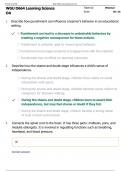
1. Describe how punishment can influence a learner's behavior in an educational
setting.
Punishment can lead to a decrease in undesirable behaviors by
creating a negative consequence for those actions.
Punishment is primarily used to reward good behavior.
Punishment encourages students to engage more with the material.
Punishment has no effect on learning outcomes.
2. Describe how the shame and doubt stage influences a child's sense of
independence.
During the shame and doubt stage, children focus solely on social
interactions with peers.
During the shame and doubt stage, children become overly reliant on
caregivers for decision-making.
During the shame and doubt stage, children learn to assert their
independence, but may feel shame or doubt if they fail.
During the shame and doubt stage, children develop a strong sense
of trust in their environment.
3. Connects the spinal cord to the brain. It has three parts: midbrain, pons, and
medulla oblongata. It is involved in regulating functions such as breathing,
heartbeat, and blood pressure.
Correct answer
,6/13/25, 2:03 PM WGU D664 Learning Science OA
Brain Stem
4. If a teacher wants to implement interleaving in a math class, which of the
following strategies would best exemplify this approach?
Focusing solely on algebra for an entire week before moving to
geometry.
Alternating between different types of math problems in each class
session.
Providing a single practice test at the end of the unit.
Reviewing only one type of problem until all students master it.
5. If a child in the Preoperational Stage is asked to share their toys, what
behavior might you expect to observe?
Ability to negotiate sharing terms effectively.
Reluctance to share due to egocentrism.
Willingness to share and understand others' needs.
Immediate understanding of fairness in sharing.
6. What is the definition of neuroplasticity?
The decline of cognitive functions with age.
The ability to memorize information quickly.
The brain's ability to reorganize itself by forming new neural
connections throughout life.
The process of learning through repetition and reinforcement.
,6/13/25, 2:03 PM WGU D664 Learning Science OA
7. What term describes the inability to see a situation from another person's
perspective in cognitive development?
Egocentrism
Conservation
Accommodation
Assimilation
8. What is it called when teachers create different educational experiences to
meet the needs of specific students?
Correct answer
Differentiated Instruction (DI)
9. Metacognition is important because:
It allows students the opportunity to work independently
It develops background schema which helps the student learn new
information
Teachers are required to assess metacognition
It helps students learn how they learn and what they need to
understand at a higher level
10. Describe the role of retrieval in the context of learning and memory.
Retrieval refers to the ability to forget irrelevant information in
memory.
, 6/13/25, 2:03 PM WGU D664 Learning Science OA
Retrieval is the process of organizing information into meaningful
categories.
Retrieval is the initial stage of memory formation where information is
first learned.
Retrieval is the process of accessing and bringing to consciousness
information that has been previously encoded and stored in
memory.
11. What term describes the inability to adapt one's thinking to new information
or experiences?
Cognitive flexibility
Cognitive load
Cognitive dissonance
Cognitive rigidity
12. Why is metacognition so important for learning and memory?
People who have good metacognition are able to adjust their
learning strategies when they are not effective.
People who have good metacognition also tend to have higher
working memory capacities.
People who have good metacognition choose reasonable strategies
and stick with them regardless of their successes and failures.
People who have good metacognition always use effective learning
strategies.
13. During the _____ process, info is transformed into a storable form, neural
activity, in the brain.
encoding
WGU D664 Learning Science Taken by: Wiseman
Score 181/ 181
OA
1. Describe how punishment can influence a learner's behavior in an educational
setting.
Punishment can lead to a decrease in undesirable behaviors by
creating a negative consequence for those actions.
Punishment is primarily used to reward good behavior.
Punishment encourages students to engage more with the material.
Punishment has no effect on learning outcomes.
2. Describe how the shame and doubt stage influences a child's sense of
independence.
During the shame and doubt stage, children focus solely on social
interactions with peers.
During the shame and doubt stage, children become overly reliant on
caregivers for decision-making.
During the shame and doubt stage, children learn to assert their
independence, but may feel shame or doubt if they fail.
During the shame and doubt stage, children develop a strong sense
of trust in their environment.
3. Connects the spinal cord to the brain. It has three parts: midbrain, pons, and
medulla oblongata. It is involved in regulating functions such as breathing,
heartbeat, and blood pressure.
Correct answer
,6/13/25, 2:03 PM WGU D664 Learning Science OA
Brain Stem
4. If a teacher wants to implement interleaving in a math class, which of the
following strategies would best exemplify this approach?
Focusing solely on algebra for an entire week before moving to
geometry.
Alternating between different types of math problems in each class
session.
Providing a single practice test at the end of the unit.
Reviewing only one type of problem until all students master it.
5. If a child in the Preoperational Stage is asked to share their toys, what
behavior might you expect to observe?
Ability to negotiate sharing terms effectively.
Reluctance to share due to egocentrism.
Willingness to share and understand others' needs.
Immediate understanding of fairness in sharing.
6. What is the definition of neuroplasticity?
The decline of cognitive functions with age.
The ability to memorize information quickly.
The brain's ability to reorganize itself by forming new neural
connections throughout life.
The process of learning through repetition and reinforcement.
,6/13/25, 2:03 PM WGU D664 Learning Science OA
7. What term describes the inability to see a situation from another person's
perspective in cognitive development?
Egocentrism
Conservation
Accommodation
Assimilation
8. What is it called when teachers create different educational experiences to
meet the needs of specific students?
Correct answer
Differentiated Instruction (DI)
9. Metacognition is important because:
It allows students the opportunity to work independently
It develops background schema which helps the student learn new
information
Teachers are required to assess metacognition
It helps students learn how they learn and what they need to
understand at a higher level
10. Describe the role of retrieval in the context of learning and memory.
Retrieval refers to the ability to forget irrelevant information in
memory.
, 6/13/25, 2:03 PM WGU D664 Learning Science OA
Retrieval is the process of organizing information into meaningful
categories.
Retrieval is the initial stage of memory formation where information is
first learned.
Retrieval is the process of accessing and bringing to consciousness
information that has been previously encoded and stored in
memory.
11. What term describes the inability to adapt one's thinking to new information
or experiences?
Cognitive flexibility
Cognitive load
Cognitive dissonance
Cognitive rigidity
12. Why is metacognition so important for learning and memory?
People who have good metacognition are able to adjust their
learning strategies when they are not effective.
People who have good metacognition also tend to have higher
working memory capacities.
People who have good metacognition choose reasonable strategies
and stick with them regardless of their successes and failures.
People who have good metacognition always use effective learning
strategies.
13. During the _____ process, info is transformed into a storable form, neural
activity, in the brain.
encoding