
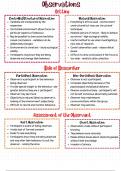
Observations
Setting
Controlled/Structured Observation: Natural Observation:
Variables are manipulated by the Everything is left as usual - environment
researcher. unstructured but may use ‘structured’
Controlled environment allows focus on techniques.
particular aspects of behaviour. Realistic picture of nature - likely to behave
May be possible to draw some tentative as normal - high ecological validity.
casual conclusions - variables can be Useful method to use when investigating a
deliberately changed. new area of research.
Environment is unnatural - lacks ecological Covert observation used - raises ethical
validity. issues.
Participants may know they are being Difficult to draw conclusions if the focus is
observed and change their behaviour. too wide - restricts data collection.
Role of Researcher
Participant Observation: Non-Participant Observation:
Observer is a participant in the behaviour Observer is not a participant.
being observed. Increases objectivity because of the
Provide special insight to the behaviour; see psychological and physical distance.
greater detail as they are a ‘participant’. Observe unobstructively - participants will
Observer may see more. not be self conscious about being watched.
Objectivity is reduced (bias) as observer is Observer may misinterpret
looking at the environment subjectively. communications within the group.
Difficult to record and monitor behaviour. Observer may see less.
Assessment of the Observant
Overt Observation: Covert Observation:
Participant is aware of being observed. Observation made without participant
Avoids lack of formed consent. knowing.
Easier to see everything. They behave more naturally.
Participants know they are being observed Raises ethical issues about observing people
and may alter their behaviour to suit the without their knowledge.
observer - ruining the aims. Invasion of privacy.
Setting
Controlled/Structured Observation: Natural Observation:
Variables are manipulated by the Everything is left as usual - environment
researcher. unstructured but may use ‘structured’
Controlled environment allows focus on techniques.
particular aspects of behaviour. Realistic picture of nature - likely to behave
May be possible to draw some tentative as normal - high ecological validity.
casual conclusions - variables can be Useful method to use when investigating a
deliberately changed. new area of research.
Environment is unnatural - lacks ecological Covert observation used - raises ethical
validity. issues.
Participants may know they are being Difficult to draw conclusions if the focus is
observed and change their behaviour. too wide - restricts data collection.
Role of Researcher
Participant Observation: Non-Participant Observation:
Observer is a participant in the behaviour Observer is not a participant.
being observed. Increases objectivity because of the
Provide special insight to the behaviour; see psychological and physical distance.
greater detail as they are a ‘participant’. Observe unobstructively - participants will
Observer may see more. not be self conscious about being watched.
Objectivity is reduced (bias) as observer is Observer may misinterpret
looking at the environment subjectively. communications within the group.
Difficult to record and monitor behaviour. Observer may see less.
Assessment of the Observant
Overt Observation: Covert Observation:
Participant is aware of being observed. Observation made without participant
Avoids lack of formed consent. knowing.
Easier to see everything. They behave more naturally.
Participants know they are being observed Raises ethical issues about observing people
and may alter their behaviour to suit the without their knowledge.
observer - ruining the aims. Invasion of privacy.


