
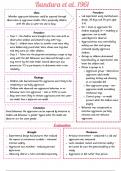
Bandura et al. 1961
Aims: Procedure:
Whether aggressive behaviour could be acquired through Lab experiment using matched pairs
observation of aggressive models. More specifically children design. 36 boys and 36 girls aged
with the idea of same-sex and so boys. 3-6.
DV = levels of aggression the
children displayed. IV = modelling of
Procedure:
aggression, sex of model
Step 1 - the children were brought into the room with an
same/different, observer.
observation window and allowed to play with toys.
Aggressiveness was controlled by
Step 2 - children were taken to another room were they
making use that each group
were deliberately frustrated. Were shown new toys but
contained equally aggressive
told they were for other children.
children.
Step 3 - Taken into the playroom containing a range of toys
Ratings of children determined
along with the doll. Behaviour was observed through a one-
beforehand by an experimenter who
way mirror by the male model. Second observant was
knew the children well.
present for 1/2 of participants to determine inter-rater
Places in groups of 3:
reliability.
Aggression group - observed an
aggressive adult model
Findings: punching, kicking and shouting
Children who had witnessed the aggression were likely to be at an inflatable doll.
completely or partially aggressive. Non-aggression group - non-
Children who observed non-aggressive behaviour or no aggressive model assembling
behaviour were not aggressive - seen in 70% of cases. mechanical toys.
Boys were more likely to imitate aggression from the same- Control group - no model
sex model than a different-sex model. present while the children were
playing.
Conclusion: Behaviour was categorised as
Social behaviour like aggression can be acquired by imitation of imitative aggression, partially
models and behaviour is gender-typical when the model and imitative and non-imitative
observer are the same gender. aggression.
Evaluation
Strength: Weakness:
Experimental design had features that reduced Artificial environment - conducted in a lab and
the impact of extraneous variables - enhanced aggression was measured.
internal validity. Lacks mundane realism and external validity -
Aggression was matched - reducing personal we cannot be sure the generalisability of the
differences. study.
Observing child at a time controlled conformity. Aggression on doll rather than person.
Aims: Procedure:
Whether aggressive behaviour could be acquired through Lab experiment using matched pairs
observation of aggressive models. More specifically children design. 36 boys and 36 girls aged
with the idea of same-sex and so boys. 3-6.
DV = levels of aggression the
children displayed. IV = modelling of
Procedure:
aggression, sex of model
Step 1 - the children were brought into the room with an
same/different, observer.
observation window and allowed to play with toys.
Aggressiveness was controlled by
Step 2 - children were taken to another room were they
making use that each group
were deliberately frustrated. Were shown new toys but
contained equally aggressive
told they were for other children.
children.
Step 3 - Taken into the playroom containing a range of toys
Ratings of children determined
along with the doll. Behaviour was observed through a one-
beforehand by an experimenter who
way mirror by the male model. Second observant was
knew the children well.
present for 1/2 of participants to determine inter-rater
Places in groups of 3:
reliability.
Aggression group - observed an
aggressive adult model
Findings: punching, kicking and shouting
Children who had witnessed the aggression were likely to be at an inflatable doll.
completely or partially aggressive. Non-aggression group - non-
Children who observed non-aggressive behaviour or no aggressive model assembling
behaviour were not aggressive - seen in 70% of cases. mechanical toys.
Boys were more likely to imitate aggression from the same- Control group - no model
sex model than a different-sex model. present while the children were
playing.
Conclusion: Behaviour was categorised as
Social behaviour like aggression can be acquired by imitation of imitative aggression, partially
models and behaviour is gender-typical when the model and imitative and non-imitative
observer are the same gender. aggression.
Evaluation
Strength: Weakness:
Experimental design had features that reduced Artificial environment - conducted in a lab and
the impact of extraneous variables - enhanced aggression was measured.
internal validity. Lacks mundane realism and external validity -
Aggression was matched - reducing personal we cannot be sure the generalisability of the
differences. study.
Observing child at a time controlled conformity. Aggression on doll rather than person.


