

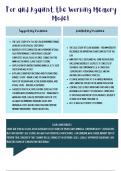
For and Against the Working Memory
Model
Supporting Evidence Conflicting Evidence
The case study of K.f as he could remember things
using his Visio spacial sketchpad.
The case study of Clive Wearing - the wmm doesn’t
Baddeley (1975) conducted an experiment of dual
recognise the importance and complexity of the
task performance. Participants couldn’t
ltm.
complete 2 visual tasks at once. Shows that the
wmm isn’t fully explained as some researchers
wmm has separate slave subset systems.
(including Baddeley) suspects it consists of
Application of understanding amnesia, K.f’s Visio
separate sub components e.g. a conscious
sketchpad was in tact.
‘supervisory’ attentional process and an
Explains cognitive functions and dysfunctions -
unconscious automatic process.
Bunge’s study. brain scans to show different
It can be argued that K.f is a unique individual
parts of the brain are active during verbal and
and cannot be applied to the wider population.
visual tasks - biological evidence.
Central exec is most important part and is one
Suggests practical applications especially for
we know least about. Psychologists complain it
children with learning difficulties - know how to
is too vague and doesn't explain much, believe it
work with them, can use different parts of STM.
is made up of more than one CE.
Alloway recommends breaking tasks into
BUT, is basically perfect STM model.
individual steps rather than coaching them on
memory improvemnt - model helped this.
Issues and debates:
There are ethical issues associated with case studies of people with amnesia. Confidentiality - researches
must not report case studies in a way that identifies participants. Can someone with severe memory deficit
provide true consent if they cannot recall doing so? In extreme cases, legally appointed guardians can
make decisions of consent on their behalf.
Model
Supporting Evidence Conflicting Evidence
The case study of K.f as he could remember things
using his Visio spacial sketchpad.
The case study of Clive Wearing - the wmm doesn’t
Baddeley (1975) conducted an experiment of dual
recognise the importance and complexity of the
task performance. Participants couldn’t
ltm.
complete 2 visual tasks at once. Shows that the
wmm isn’t fully explained as some researchers
wmm has separate slave subset systems.
(including Baddeley) suspects it consists of
Application of understanding amnesia, K.f’s Visio
separate sub components e.g. a conscious
sketchpad was in tact.
‘supervisory’ attentional process and an
Explains cognitive functions and dysfunctions -
unconscious automatic process.
Bunge’s study. brain scans to show different
It can be argued that K.f is a unique individual
parts of the brain are active during verbal and
and cannot be applied to the wider population.
visual tasks - biological evidence.
Central exec is most important part and is one
Suggests practical applications especially for
we know least about. Psychologists complain it
children with learning difficulties - know how to
is too vague and doesn't explain much, believe it
work with them, can use different parts of STM.
is made up of more than one CE.
Alloway recommends breaking tasks into
BUT, is basically perfect STM model.
individual steps rather than coaching them on
memory improvemnt - model helped this.
Issues and debates:
There are ethical issues associated with case studies of people with amnesia. Confidentiality - researches
must not report case studies in a way that identifies participants. Can someone with severe memory deficit
provide true consent if they cannot recall doing so? In extreme cases, legally appointed guardians can
make decisions of consent on their behalf.


