Social Impact Theory
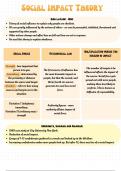
Bibb Latane - 1981:
Theory of social influence to explain why people are obedient.
We are greatly influenced by the actions of others - we can be persuaded, inhibited, threatened and
supported by other people.
Other actions change and affect how we fell and how we act in response.
He used this theory to explain obedience.
Multiplication versus the
Social Forces Psychosocial Law
division of impact
Strength - how important that
The number of targets to be
person is to you. The first source of influence has
influenced affects the impact of
Immediacy - determined by the most dramatic impact on
the source. Social force gets
the proximity or distance people, but that the second, and
spread out with more people,
between the source and target. third, fourth etc sources
making them less likely to
Numbers - refers to how many generate less and less social
conform. This is known as
sources and targets are in the force.
diffusion of responsibility.
situation.
Variation 7 (telephone)
Authority figures - more
immediacy
authority dilutes impact of
Variation 13 (ordinary man) -
social force.
strength
Berkowitz, Bickman and Milgram:
1969 case study at City University New York.
Reduction of social impact.
Groups of 1-15 confederates gathered in crowds and looked up at the 6th floor.
Increasing confederates makes more people look up. But after 13, there was less of a social impact.
Bibb Latane - 1981:
Theory of social influence to explain why people are obedient.
We are greatly influenced by the actions of others - we can be persuaded, inhibited, threatened and
supported by other people.
Other actions change and affect how we fell and how we act in response.
He used this theory to explain obedience.
Multiplication versus the
Social Forces Psychosocial Law
division of impact
Strength - how important that
The number of targets to be
person is to you. The first source of influence has
influenced affects the impact of
Immediacy - determined by the most dramatic impact on
the source. Social force gets
the proximity or distance people, but that the second, and
spread out with more people,
between the source and target. third, fourth etc sources
making them less likely to
Numbers - refers to how many generate less and less social
conform. This is known as
sources and targets are in the force.
diffusion of responsibility.
situation.
Variation 7 (telephone)
Authority figures - more
immediacy
authority dilutes impact of
Variation 13 (ordinary man) -
social force.
strength
Berkowitz, Bickman and Milgram:
1969 case study at City University New York.
Reduction of social impact.
Groups of 1-15 confederates gathered in crowds and looked up at the 6th floor.
Increasing confederates makes more people look up. But after 13, there was less of a social impact.