Intermediate Quiz 2
Thursday 28th of october 2024
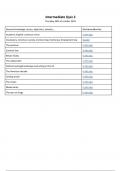
General knowledge, tenses, adjectives, adverbs,... Blackboard&online
Academic English: common errors In this doc
Vocabulary: American society, Contract law, Family law, Employment law Quizlet
The passieve In this doc
Contract law In this doc
Britain Today In this doc
The subjunctive In this doc
Political and legal landscape and voting in the US In this doc
The American decade In this doc
Linking words In this doc
The sixties In this doc
Modal verbs In this doc
The war on drugs In this doc
, 1. The passieve
-> Used when the action is more important than the person doing the action
-> When A does something to B, there are often two ways to talk about it:
-> If we want A to be the subject (you), we use active verbs
-> If we want B to be the subject (the cookie), we use passive verbs
NOT a tense (e.g., simple present, past continuous)
My car is being serviced this week.
NOT a mood (e.g., imperative, indicative, subjunctive)
I demand that the animal be moved to a better environment.
NOT modality (e.g., may, might, should)
By the time we get there, he should have been interrogated.
The passive is a ‘VOICE’
Requirements:
- The verb that undergoes passivation must be transitive.
- Reminder: Clause elements
subject, S
predicate (everything that is not the subject)
Verb, V (active) / V (passive)
direct object, DO (undergoes the action of the verb)
indirect object, IO (beneficiary of the action of theverb)
subject complement*, SC (adds information aboutthe subject)
object complement*, OC (adds information about theobject)
* also known as subject attribute (SA) or object attribute(OA)
,When turning a sentence into passive:
- the tense is not affected
- the subject of the active is either not mentioned or referred to by ‘by + agent’
1. They killed thousands of people in the civil war.
Thousands of people were killed in the civil war.
2. Our supplier in China is shipping the goods next week.
The goods are being shipped by our supplier in China next week.
Modal auxiliaries can also be put in the passive:
- the auxiliary remains unchanged, only the infinitive is passivized.
- Present = modal auxiliary + be + past participle
We can use the passive in all forms.
The passive can be used in all forms.
- Past = modal auxiliary + have been + past participle
They might have avoided the accident.
That accident might have been avoided.
!! there is no passive sentence when the sentence contains no object
I was swimming in the sea
Usage:
1. Information order
2. Unimportant/unknown agent
3. Not mentioned agent
4. Focus (formal English)
, 2. Contract law
- Heading
- Commencement, date
- Parties involved
- Recitals (background entry into contract)
- Operative provisions (agreements stated)
- Definitions
- Interpretation (refers to specific use)
- Conditions precedent clause (obligations)
- Consideration (“tegenprestatie”)
- Other operative clauses (e.g. warranties)
- Schedule
Enforceable contract
A valid contract that can be enforced in a court of law, because it has all the necessary
contractual elements. (agreements, consideration, capacity,...)
Voidable contract
A contract which either party can legally cancel.
(ex.: a contract between minors)
Unenforceable contract
A contract that is valid but will not hold up in court, because of a rule of law.
(ex.: waiting too long to sue someone for breach of contract)
Specific contract language:
1. Here/there- + preposition
a) Herewith
b) Hereafter
c) Hereinbefore
d) Hereunder
e) Heretofore
f) Hereinafter
g) Herein
h) Hereby
2. Use of “shall”: ≠ future, = obligation
3. Zero conditional: If you heat water to 100 degrees, it boils.
Thursday 28th of october 2024
General knowledge, tenses, adjectives, adverbs,... Blackboard&online
Academic English: common errors In this doc
Vocabulary: American society, Contract law, Family law, Employment law Quizlet
The passieve In this doc
Contract law In this doc
Britain Today In this doc
The subjunctive In this doc
Political and legal landscape and voting in the US In this doc
The American decade In this doc
Linking words In this doc
The sixties In this doc
Modal verbs In this doc
The war on drugs In this doc
, 1. The passieve
-> Used when the action is more important than the person doing the action
-> When A does something to B, there are often two ways to talk about it:
-> If we want A to be the subject (you), we use active verbs
-> If we want B to be the subject (the cookie), we use passive verbs
NOT a tense (e.g., simple present, past continuous)
My car is being serviced this week.
NOT a mood (e.g., imperative, indicative, subjunctive)
I demand that the animal be moved to a better environment.
NOT modality (e.g., may, might, should)
By the time we get there, he should have been interrogated.
The passive is a ‘VOICE’
Requirements:
- The verb that undergoes passivation must be transitive.
- Reminder: Clause elements
subject, S
predicate (everything that is not the subject)
Verb, V (active) / V (passive)
direct object, DO (undergoes the action of the verb)
indirect object, IO (beneficiary of the action of theverb)
subject complement*, SC (adds information aboutthe subject)
object complement*, OC (adds information about theobject)
* also known as subject attribute (SA) or object attribute(OA)
,When turning a sentence into passive:
- the tense is not affected
- the subject of the active is either not mentioned or referred to by ‘by + agent’
1. They killed thousands of people in the civil war.
Thousands of people were killed in the civil war.
2. Our supplier in China is shipping the goods next week.
The goods are being shipped by our supplier in China next week.
Modal auxiliaries can also be put in the passive:
- the auxiliary remains unchanged, only the infinitive is passivized.
- Present = modal auxiliary + be + past participle
We can use the passive in all forms.
The passive can be used in all forms.
- Past = modal auxiliary + have been + past participle
They might have avoided the accident.
That accident might have been avoided.
!! there is no passive sentence when the sentence contains no object
I was swimming in the sea
Usage:
1. Information order
2. Unimportant/unknown agent
3. Not mentioned agent
4. Focus (formal English)
, 2. Contract law
- Heading
- Commencement, date
- Parties involved
- Recitals (background entry into contract)
- Operative provisions (agreements stated)
- Definitions
- Interpretation (refers to specific use)
- Conditions precedent clause (obligations)
- Consideration (“tegenprestatie”)
- Other operative clauses (e.g. warranties)
- Schedule
Enforceable contract
A valid contract that can be enforced in a court of law, because it has all the necessary
contractual elements. (agreements, consideration, capacity,...)
Voidable contract
A contract which either party can legally cancel.
(ex.: a contract between minors)
Unenforceable contract
A contract that is valid but will not hold up in court, because of a rule of law.
(ex.: waiting too long to sue someone for breach of contract)
Specific contract language:
1. Here/there- + preposition
a) Herewith
b) Hereafter
c) Hereinbefore
d) Hereunder
e) Heretofore
f) Hereinafter
g) Herein
h) Hereby
2. Use of “shall”: ≠ future, = obligation
3. Zero conditional: If you heat water to 100 degrees, it boils.