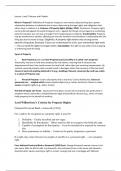
Lecture 1 and 2 Fixtures and Chattels
What is ‘Property’? Definition of Property: Property is not merely a physical thing but a power
relationship between an individual and an item, determining the legal rights and obligations that
others have in relation to it. Features of Property Rights (Bridge, 2015) Persistence: Property rights
can be enforced against the world at large (in rem = against the thing), not just against a contracting
party.For example, you can stop a stranger from trespassing your property. Transferability: Property
may be transferred to another, affecting not only the transferor and transferee’s relationship with the
thing but also the world at large. Exigibility: A property right exists only as long as the
specific thing does.Example: If your car is destroyed in a fire, your ownership right ends
— the car (and the right) no longer exists. Excludability: The right to stop others from enjoying
or interfering with the thing.
Types of Property
1. Real Property (Land Law) Real Property (Land Law) Why is it called ‘real’ property?
Historically, interests in land were protected by real actions, meaning that if someone was
dispossessed of land, they could recover the land itself, rather than just receiving compensation. By
contrast, personal property claims usually result in damages rather than recovery of the item itself.
Concerns land and anything attached to it (e.g., buildings, fixtures). Governed by Land Law, which
is a subset of Property Law.
2. Personal Property - Covers all property that is not land. Can be divided into: Choses in
possession are – tangible which means physical objects (e.g., books, furniture). Choses in action
means intangible rights (e.g., debts, shares).
The Role of Equity and Trusts- Equity and Trusts play a crucial role in property law, particularly in
situations where ownership is divided between legal and beneficial interests (e.g., when a trustee
holds property for the benefit of another).
Lord Wilberforce’s Criteria for Property Rights
(National Provincial Bank v Ainsworth [1965])
For a right to be recognised as a property right, it must be:
1. Definable – Clearly described and not vague.
2. Identifiable by third parties – Others must be able to recognise who holds the right.
3. Capable of assumption by third parties – It can be transferred or acquired by someone
else.
4. Have permanence or stability – It must not be purely temporary or personal.
If a right only exists between two people (A and B), it is a personal right — not a property
right.
Case: National Provincial Bank v Ainsworth [1965] Facts: George Ainsworth owned a house in his
sole name. After he left his wife, Ivy Ainsworth, she continued to live in the house and claimed a
deserted wife’s equity, asserting a right to remain. George took out a mortgage with National
, Provincial Bank without informing the bank of Ivy’s claim. When George defaulted, the bank sought
to repossess the house, and Ivy argued her right to reside should bind the bank as a property right.
Held (House of Lords): Ivy’s deserted wife’s equity was not a property right but a personal right
enforceable only against George. Because it did not meet Lord Wilberforce’s criteria for property
rights (definable, identifiable by third parties, transferable, and permanent), it could not bind the
bank. The bank was therefore not bound by Ivy’s claim and was entitled to repossess the house.
• The Doctrine of Estates (to be explored later) - Land law operates through estates rather than
outright ownership.• Property rights in land persist over time, allowing multiple interests to exist
over the same land..
A Question of Priorities: The Function of Land Law Land law is concerned with layers of rights over
the same property. It regulates competing rights to determine which takes priority and ensures the
appropriate level of protection for each interest.
Choses in Possession vs. Choses in Action - Choses in Possession Definition: Tangible (corporeal)
items that can be physically possessed.
• Key Features: Movable – Can be transported or transferred. No size limit – Includes small
items (jewellery) and large ones (vehicles, furniture).
• Also called ‘chattels’. Special Exceptions: Documents of title to land – These can be so
closely connected to land that they are considered part of it.• Fixtures – Items that become part of
the land when sufficiently attached (e.g., a fitted kitchen), but may become chattels again if
removed.
Choses in Action Definition: Intangible rights that cannot be physically possessed but can be legally
enforced. Key Features: Includes goodwill, shares, intellectual property, copyright, trademarks, trade
secrets, and know-how. A rapidly growing and evolving area of law. Crucial Point: Not everything
intangible qualifies as property.
: Dobson v North Tyneside Health Authority [1997] Facts:• A woman died due to medical
negligence. Her family sued for damages, arguing that they had a property right in her body after
death.Held: • There is no property in a corpse unless it has undergone lawful work or skill (e.g.,
embalming, dissection for medical purposes). The family had no property rights over the deceased’s
body.
What is ‘Land’, Anyway? Land is conceptually distinct from other types of property due to its unique
characteristics:
1. Permanence – Land endures over time, unlike personal property.
2. Uniqueness – No two pieces of land are identical.
3. Limited Supply – Unlike personal property, land is finite.
4. Remedies – The legal system treats land disputes differently, often preferring specific performance
(return of land) rather than damages.
What is ‘Property’? Definition of Property: Property is not merely a physical thing but a power
relationship between an individual and an item, determining the legal rights and obligations that
others have in relation to it. Features of Property Rights (Bridge, 2015) Persistence: Property rights
can be enforced against the world at large (in rem = against the thing), not just against a contracting
party.For example, you can stop a stranger from trespassing your property. Transferability: Property
may be transferred to another, affecting not only the transferor and transferee’s relationship with the
thing but also the world at large. Exigibility: A property right exists only as long as the
specific thing does.Example: If your car is destroyed in a fire, your ownership right ends
— the car (and the right) no longer exists. Excludability: The right to stop others from enjoying
or interfering with the thing.
Types of Property
1. Real Property (Land Law) Real Property (Land Law) Why is it called ‘real’ property?
Historically, interests in land were protected by real actions, meaning that if someone was
dispossessed of land, they could recover the land itself, rather than just receiving compensation. By
contrast, personal property claims usually result in damages rather than recovery of the item itself.
Concerns land and anything attached to it (e.g., buildings, fixtures). Governed by Land Law, which
is a subset of Property Law.
2. Personal Property - Covers all property that is not land. Can be divided into: Choses in
possession are – tangible which means physical objects (e.g., books, furniture). Choses in action
means intangible rights (e.g., debts, shares).
The Role of Equity and Trusts- Equity and Trusts play a crucial role in property law, particularly in
situations where ownership is divided between legal and beneficial interests (e.g., when a trustee
holds property for the benefit of another).
Lord Wilberforce’s Criteria for Property Rights
(National Provincial Bank v Ainsworth [1965])
For a right to be recognised as a property right, it must be:
1. Definable – Clearly described and not vague.
2. Identifiable by third parties – Others must be able to recognise who holds the right.
3. Capable of assumption by third parties – It can be transferred or acquired by someone
else.
4. Have permanence or stability – It must not be purely temporary or personal.
If a right only exists between two people (A and B), it is a personal right — not a property
right.
Case: National Provincial Bank v Ainsworth [1965] Facts: George Ainsworth owned a house in his
sole name. After he left his wife, Ivy Ainsworth, she continued to live in the house and claimed a
deserted wife’s equity, asserting a right to remain. George took out a mortgage with National
, Provincial Bank without informing the bank of Ivy’s claim. When George defaulted, the bank sought
to repossess the house, and Ivy argued her right to reside should bind the bank as a property right.
Held (House of Lords): Ivy’s deserted wife’s equity was not a property right but a personal right
enforceable only against George. Because it did not meet Lord Wilberforce’s criteria for property
rights (definable, identifiable by third parties, transferable, and permanent), it could not bind the
bank. The bank was therefore not bound by Ivy’s claim and was entitled to repossess the house.
• The Doctrine of Estates (to be explored later) - Land law operates through estates rather than
outright ownership.• Property rights in land persist over time, allowing multiple interests to exist
over the same land..
A Question of Priorities: The Function of Land Law Land law is concerned with layers of rights over
the same property. It regulates competing rights to determine which takes priority and ensures the
appropriate level of protection for each interest.
Choses in Possession vs. Choses in Action - Choses in Possession Definition: Tangible (corporeal)
items that can be physically possessed.
• Key Features: Movable – Can be transported or transferred. No size limit – Includes small
items (jewellery) and large ones (vehicles, furniture).
• Also called ‘chattels’. Special Exceptions: Documents of title to land – These can be so
closely connected to land that they are considered part of it.• Fixtures – Items that become part of
the land when sufficiently attached (e.g., a fitted kitchen), but may become chattels again if
removed.
Choses in Action Definition: Intangible rights that cannot be physically possessed but can be legally
enforced. Key Features: Includes goodwill, shares, intellectual property, copyright, trademarks, trade
secrets, and know-how. A rapidly growing and evolving area of law. Crucial Point: Not everything
intangible qualifies as property.
: Dobson v North Tyneside Health Authority [1997] Facts:• A woman died due to medical
negligence. Her family sued for damages, arguing that they had a property right in her body after
death.Held: • There is no property in a corpse unless it has undergone lawful work or skill (e.g.,
embalming, dissection for medical purposes). The family had no property rights over the deceased’s
body.
What is ‘Land’, Anyway? Land is conceptually distinct from other types of property due to its unique
characteristics:
1. Permanence – Land endures over time, unlike personal property.
2. Uniqueness – No two pieces of land are identical.
3. Limited Supply – Unlike personal property, land is finite.
4. Remedies – The legal system treats land disputes differently, often preferring specific performance
(return of land) rather than damages.