5) Social Developments, 1871-1914
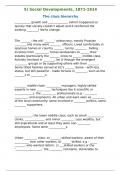
The class hierarchy
___________ growth and ______________ (which happened so
quickly that society couldn’t adjust and it reinforced the
existing ________) led to change.
The _______: the old ‘_______’ aristocracy, mostly Prussian
________ and many were ________ officers. Lived comfortably in
spacious homes or country _______ ran by ________. Falling
incomes from __________ forces landowners to ______ their
estates (particularly the _______ ones) to ______ middle-class.
Actively involved in ________, be it through the emergent
_________ groups or by supporting others with their _______.
Some titled families served at K2’s ______. Some – with less
status, but still powerful - made fortune in ________, such as the
_______s or __________s.
________ middle class: __________ managers, highly-skilled
experts in new __________ techniques (be it scientific or
_____________), the __________ professionals (e.g - ________,
_________, and engineers). All urban and were seen as _________
of the local community: some involved in ________ politics, some
________ supporters.
____________: the lower middle class, such as small ___________,
clerks, ______________ and minor _________. Less wealthy, but
still aspirational and at least they were non-_________
employees. Some were ____________s.
Urban _________ class: a) _______-skilled workers, aware of their
__________ over other workers. b) ______-skilled, e.g - _____
_______, who wanted reform. c) ___skilled workers or the
‘__________________,’ the _________ nickname. Vulnerable to
, ________ fluctuations or ___-____s (when the employer doesn’t
have enough _____ so employees ___ ______); mostly a________.
Rural _________ class: some peasants owned ____ and employed
others, but some were _______, and __________, seeking seasonal
employment. Peasants were surprisingly __________ in outlook.
The growing __________ and practice of _________ estate
between sons forced them to ‘______ to the towns,’ and work.
Women
Top: leisurely life, maybe ________ work, if they could leave the
kids to ________.
Upper Middle: more involved in running ______, household
_________, but still dependant on husband for both ________ and
________.
Lower Middle: by 19____, broke conventions a bit and seized
opportunities of _______ work, but still not many.
Working: _______ labourers: for urban, worked in __________s to
make goods for ________ trade, but also new jobs in _________.
However, this led to more __________ children in cities, and
______________. Rural, stayed same.
The Federation of _________ __________’s _____________s (______)
established in ______, campaigned for women’s rights and
increased opportunities in __________. _______ wrote tracts on
female equality and the SPD campaigned for women to get the
______. Women’s _______ became their husband’s on marriage
and they still had a restrictive legal status.
Elitism and Militarism
Especially under ________ and the new _______ Germany, the
elites wanted to extend their own ______ and ______ within it.
The class hierarchy
___________ growth and ______________ (which happened so
quickly that society couldn’t adjust and it reinforced the
existing ________) led to change.
The _______: the old ‘_______’ aristocracy, mostly Prussian
________ and many were ________ officers. Lived comfortably in
spacious homes or country _______ ran by ________. Falling
incomes from __________ forces landowners to ______ their
estates (particularly the _______ ones) to ______ middle-class.
Actively involved in ________, be it through the emergent
_________ groups or by supporting others with their _______.
Some titled families served at K2’s ______. Some – with less
status, but still powerful - made fortune in ________, such as the
_______s or __________s.
________ middle class: __________ managers, highly-skilled
experts in new __________ techniques (be it scientific or
_____________), the __________ professionals (e.g - ________,
_________, and engineers). All urban and were seen as _________
of the local community: some involved in ________ politics, some
________ supporters.
____________: the lower middle class, such as small ___________,
clerks, ______________ and minor _________. Less wealthy, but
still aspirational and at least they were non-_________
employees. Some were ____________s.
Urban _________ class: a) _______-skilled workers, aware of their
__________ over other workers. b) ______-skilled, e.g - _____
_______, who wanted reform. c) ___skilled workers or the
‘__________________,’ the _________ nickname. Vulnerable to
, ________ fluctuations or ___-____s (when the employer doesn’t
have enough _____ so employees ___ ______); mostly a________.
Rural _________ class: some peasants owned ____ and employed
others, but some were _______, and __________, seeking seasonal
employment. Peasants were surprisingly __________ in outlook.
The growing __________ and practice of _________ estate
between sons forced them to ‘______ to the towns,’ and work.
Women
Top: leisurely life, maybe ________ work, if they could leave the
kids to ________.
Upper Middle: more involved in running ______, household
_________, but still dependant on husband for both ________ and
________.
Lower Middle: by 19____, broke conventions a bit and seized
opportunities of _______ work, but still not many.
Working: _______ labourers: for urban, worked in __________s to
make goods for ________ trade, but also new jobs in _________.
However, this led to more __________ children in cities, and
______________. Rural, stayed same.
The Federation of _________ __________’s _____________s (______)
established in ______, campaigned for women’s rights and
increased opportunities in __________. _______ wrote tracts on
female equality and the SPD campaigned for women to get the
______. Women’s _______ became their husband’s on marriage
and they still had a restrictive legal status.
Elitism and Militarism
Especially under ________ and the new _______ Germany, the
elites wanted to extend their own ______ and ______ within it.