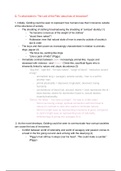
Q. To what extent is ‘The Lord of the Flies’ about loss of innocence?
1. Initially, Golding could be seen to represent how humans lose their innocence outside
of the structures of society.
- The shedding of clothing foreshadowing the shedding of ‘civilized’ identity (1)
- “he became conscious of the weight of his clothes”
- “stood there naked”1
- Hobbesian view that natural state of man is anarchy outside of society’s
law & order
- The boys and their power as increasingly characterised in relation to animals:
dogs, jaguar (2)
- “the boys lay, panting like dogs.
- “Like a pack of kids!” (Piggy)
- Immediate contrast between Jack - increasingly animal-like, myopic and
obsessed with violence - and Simon - Christ-like, sacrificial figure who is
inherently linked to nature and utopic abundance (3)
- “dog-like”, “ape-like”, “he was naked”, “surge of blood”, “seductive (sound
of pig)”
- animalistic lang = savagery outside society, ‘man is a wolf to
another man
- primal physicality = depraved, troglodytic, devolved, losing
humanity
- connotations of blood lust, arousal, desire = Jack represents the id -
base desires, desire for domination fused w. sexual desires,
insanity/irrationality.
- “Simon. He helps.”, “his eyes so bright”, “he was in a little cabin”
- Simon as having a deep, spiritual connection with the forest &
nature (in contrast to Jack who wants to dominate nature)
- Simon’s bright eyes as representing innocence & good, compared
to Jack’s bright eyes as representing loss of rationality,
inhibition/ego & giving into savagery & id.
2. As the novel develops, Golding could be seen to communicate how corrupt societies
can cause the loss of innocence.
- Conflict between world of rationality and world of savagery and passion comes to
a head in the fire going out and Jack arriving with the dead pig (4)
- “Piggy’s hair still lay in wisps over his head”, “We could make a sundial.”
(Piggy)
1. Initially, Golding could be seen to represent how humans lose their innocence outside
of the structures of society.
- The shedding of clothing foreshadowing the shedding of ‘civilized’ identity (1)
- “he became conscious of the weight of his clothes”
- “stood there naked”1
- Hobbesian view that natural state of man is anarchy outside of society’s
law & order
- The boys and their power as increasingly characterised in relation to animals:
dogs, jaguar (2)
- “the boys lay, panting like dogs.
- “Like a pack of kids!” (Piggy)
- Immediate contrast between Jack - increasingly animal-like, myopic and
obsessed with violence - and Simon - Christ-like, sacrificial figure who is
inherently linked to nature and utopic abundance (3)
- “dog-like”, “ape-like”, “he was naked”, “surge of blood”, “seductive (sound
of pig)”
- animalistic lang = savagery outside society, ‘man is a wolf to
another man
- primal physicality = depraved, troglodytic, devolved, losing
humanity
- connotations of blood lust, arousal, desire = Jack represents the id -
base desires, desire for domination fused w. sexual desires,
insanity/irrationality.
- “Simon. He helps.”, “his eyes so bright”, “he was in a little cabin”
- Simon as having a deep, spiritual connection with the forest &
nature (in contrast to Jack who wants to dominate nature)
- Simon’s bright eyes as representing innocence & good, compared
to Jack’s bright eyes as representing loss of rationality,
inhibition/ego & giving into savagery & id.
2. As the novel develops, Golding could be seen to communicate how corrupt societies
can cause the loss of innocence.
- Conflict between world of rationality and world of savagery and passion comes to
a head in the fire going out and Jack arriving with the dead pig (4)
- “Piggy’s hair still lay in wisps over his head”, “We could make a sundial.”
(Piggy)