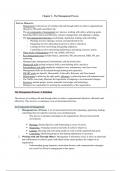
Chapter 2 - The Management Process
Facts to Memorize:
- Management is the process of working with and through others to achieve organizational
objectives efficiently and effectively.
- The six components of management are: process, working with others, achieving goals,
balancing effectiveness and efficiency, resource management, and adapting to change.
- The four management functions are planning, organizing, leading, and controlling.
- Planning involves strategic, tactical, and operational levels.
- Organizing involves allocating resources to achieve objectives.
- Leading involves motivating and guiding employees.
- Controlling involves monitoring performance and taking corrective action.
- Three levels of management exist: top, middle, and lower.
- Key management areas include finance, operations, HR, procurement, R&D, PR, and
marketing.
- Managers play interpersonal, informational, and decisional roles.
- Managerial skills include technical skills, team-building skills, and drive.
- Post-pandemic soft skills emphasize employee care, transparency, and clear vision.
- Management skills are developed through training and experience.
- SMART goals are Specific, Measurable, Achievable, Relevant, and Time-bound.
- Effectiveness is achieving the right goals; efficiency is achieving them with minimal waste.
- The Netflix case study illustrates the importance of adapting to environmental changes.
- Resources include people, money, materials, knowledge, and technology.
- Managers are responsible for ensuring the sustainability of the organization.
The Management Process: A Definition
The process of working with and through others to achieve organizational objectives efficiently and
effectively. This involves a continuous cycle of interrelated activities.
Six Components of Management:
1. Management as a Process: A set of interconnected activities (planning, organizing, leading,
controlling) that are repetitive and can occur simultaneously.
- This process is dynamic and adapts to the organization's lifecycle and external
environment.
➢ Planning: Setting objectives and determining a course of action.
➢ Organizing: Arranging resources and tasks to achieve objectives.
➢ Leading: Directing and motivating people to work towards organizational goals.
➢ Controlling: Monitoring progress and making adjustments as necessary.
2. Working with and Through Others: Management is inherently social; it relies on teamwork
and collaboration to achieve goals. Individuals alone cannot produce the outputs of an
organization.
- Understanding group dynamics, motivation theories, and communication strategies
are crucial for effective management in this aspect.
Facts to Memorize:
- Management is the process of working with and through others to achieve organizational
objectives efficiently and effectively.
- The six components of management are: process, working with others, achieving goals,
balancing effectiveness and efficiency, resource management, and adapting to change.
- The four management functions are planning, organizing, leading, and controlling.
- Planning involves strategic, tactical, and operational levels.
- Organizing involves allocating resources to achieve objectives.
- Leading involves motivating and guiding employees.
- Controlling involves monitoring performance and taking corrective action.
- Three levels of management exist: top, middle, and lower.
- Key management areas include finance, operations, HR, procurement, R&D, PR, and
marketing.
- Managers play interpersonal, informational, and decisional roles.
- Managerial skills include technical skills, team-building skills, and drive.
- Post-pandemic soft skills emphasize employee care, transparency, and clear vision.
- Management skills are developed through training and experience.
- SMART goals are Specific, Measurable, Achievable, Relevant, and Time-bound.
- Effectiveness is achieving the right goals; efficiency is achieving them with minimal waste.
- The Netflix case study illustrates the importance of adapting to environmental changes.
- Resources include people, money, materials, knowledge, and technology.
- Managers are responsible for ensuring the sustainability of the organization.
The Management Process: A Definition
The process of working with and through others to achieve organizational objectives efficiently and
effectively. This involves a continuous cycle of interrelated activities.
Six Components of Management:
1. Management as a Process: A set of interconnected activities (planning, organizing, leading,
controlling) that are repetitive and can occur simultaneously.
- This process is dynamic and adapts to the organization's lifecycle and external
environment.
➢ Planning: Setting objectives and determining a course of action.
➢ Organizing: Arranging resources and tasks to achieve objectives.
➢ Leading: Directing and motivating people to work towards organizational goals.
➢ Controlling: Monitoring progress and making adjustments as necessary.
2. Working with and Through Others: Management is inherently social; it relies on teamwork
and collaboration to achieve goals. Individuals alone cannot produce the outputs of an
organization.
- Understanding group dynamics, motivation theories, and communication strategies
are crucial for effective management in this aspect.