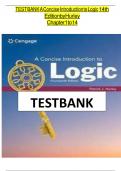
TEST BANK A Concise Introduction to Logic 14th
f f f f f f f
EditionbyHurley
f f f
Chapter1to14 f f f
TESTBANK f
,TABLE fOF fCONTENTS
Part f I: fINFORMAL fLOGIC.
1. fBasic fConcepts.
Arguments, f Premises, f and f Conclusions. f Exercise. f Recognizing f Arguments. f Exercise. f Deduction f and f Induction. f Exercise.
f Validity, fTruth, fSoundness, fStrength, fCogency. fExercise. fArgument fForms: fProving fInvalidity. fExercise. fExtended fArguments. fExercis
2. f Language: f Meaning f and f Definition.
Varieties f of f Meaning. f Exercise. f The f Intension f and f Extension f of f Terms. f Exercise. f Definitions f and f Their f Purposes.
f Exercise. fDefinitional fTechniques. fExercise. fCriteria ffor fLexical fDefinitions. fExercise.
3. fInformal fFallacies.
Fallacies fin fGeneral. fExercise. fFallacies fof fRelevance. fExercise. fFallacies fof fWeak fInduction. fExercise. fFallacies fof fPresumption,
fAmbiguity, fand fIllicit fTransference. fExercise. fFallacies fin fOrdinary fLanguage. fExercise.
Part fII: fFORMAL fLOGIC.
4. fCategorical fPropositions.
The fComponents fof fCategorical fPropositions. fExercise. fQuality, fQuantity, fand fDistribution. fExercise. fVenn fDiagrams fand
fModern fSquare fof fOpposition. fExercise. fConversion, fObversion, fand fContraposition. fExercise. fThe fTraditional fSquare
fOpposition. fExercise. fVenn fDiagrams fand fthe fTraditional fStandpoint. fExercise. fTranslating fOrdinary fLanguage fStatements fi
fCategorical fForm. fExercise.
5. fCategorical fSyllogisms.
Standard fForm, fMood, fand fFigure. fExercise. fVenn fDiagrams. fExercise. fRules fand fFallacies. fExercise. fReducing fthe fNumber fo
fTerms. fExercise. fOrdinary fLanguage fArguments. fExercise. fEnthymemes. fExercise. fSorites. fExercise.
6. fPropositional fLogic.
Symbols fand fTranslation. fExercise. fTruth fFunctions. fExercise. fTruth fTables ffor fPropositions. fExercise. fTruth fTables ffor fArguments.
f Exercise. fIndirect fTruth fTables. fExercise. fArgument fForms fand fFallacies. fExercise.
7. fNatural fDeduction fin fPropositional fLogic.
Rules f of f Implication f I. f Exercise. f Rules f of f Implication f II. f Exercise. f Rules f of f Replacement f I. f Exercise. f Rules f of f Replacement
fExercise. fConditional fProof. fExercise. fIndirect fProof. fExercise. fProving fLogical fTruths. fExercise.
8. f Predicate f Logic.
Symbols fand fTranslation. fExercise. fUsing fthe fRules fof fInference. fExercise. fQuantifier fNegation fRule. fExercise. fConditional fa
fIndirect fProof. fExercise. fProving fInvalidity. fExercise. fRelational fPredicates fand fOverlapping fQuantifiers. fExercise. fIden
fExercise.
Part fIII: fINDUCTIVE fLOGIC.
9. fAnalogy fand fLegal fand fMoral fReasoning.
Analogical f Reasoning. f Legal f Reasoning. f Moral f Reasoning. f Exercise.
10. fCausality fand fMill's fMethods.
,"Cause" f and f Necessary f and f Sufficient f Conditions. f Mill's f Five f Methods. f Mill's f Methods f and f Science. f Exercise.
11. fProbability.
Theories fof fProbability. fThe fProbability fCalculus. fExercise.
12. f Statistical f Reasoning.
Evaluating f Statistics. f Samples. f The f Meaning f of f "Average." f Dispersion. f Graphs f and f Pictograms. f Percentages. f Exercise.
13. fHypothetical/Scientific fReasoning.
The f Hypothetical f Method. f Hypothetical f Reasoning: f Four f Examples f from f Science. f The f Proof f of f Hypotheses. f The
f Tentative fAcceptance fof fHypotheses. fExercise.
14. f Science f and f Superstition.
Distinguishing fBetween fScience fand fSuperstition. fEvidentiary fSupport. fObjectivity. fIntegrity. fAbusing fScience. fExercise.
f Answers fto fSelected fExercises.
, Chapter f1 fTest fA
MULTIPLE fCHOICE
INSTRUCTIONS: fThe ffollowing fselections frelate fto fdistinguishing farguments ffrom fnonarguments
f and fidentifying fconclusions. fSelect fthe fbest fanswer ffor feach.
1. There fappears fto fbe fa fgrowing fhappiness fgap fbetween fmen fand fwomen. fWomen ftoday fare
fworking
more fand frelaxing fless, fwhile fmen fare fworking fless fand frelaxing fmore. fForty fyears fago fa
ftypical
woman fspent f40 fminutes fmore fper fweek fthan fthe ftypical fman fperforming fan factivity
fconsidered
cu.n plAeragsuamnte.fnTto;fdcoanyc,luwsitohn:mFeonrtwyoyrekianrgs flaegsso, ft.h..eagnaapctisvi9ty0fcmoinsuidtfesreadnd fgrowing.
an.fp l eAar gs au nmt e. fnt; fconclusion: fToday f... fthe fgap fis f90 fminutes fand fgrowing.
fu
bd . A Nrognuamrgeunm
t;fecnotn. clu sion: fThere fappears fto fbe f... fbetween fmen fand fwomen.
e. f AANr gSu: m De n t ; fconclusion: fWomen ftoday fare fworking fmore fand frelaxing
less. PTS: 2
2. Lead fis ftoxic, fbut fdo fyou fknow fwhy? fLead fis ftoxic fmainly fbecause fit fpreferentially freplaces fother
fmetals fin fbiochemical freactions. fIn fso fdoing fit finterferes fwith fthe fproteins fthat fregulate fblood
fpressure
(which fcan fcause fdevelopment fdelays fin fchildren fand fhigh fblood fpressure fin fadults), fheme
fproduction
(which fcan flead fto fanemia), fand fsperm fproduction. fLead falso fdisplaces fcalcium fin fthe freactions
ftah.atfArgument; fconclusion: fIt finterferes fwith fthe fproteins f... fand fsperm fproduction.
tbr.ansAmrgit ueml fecntr;ifcaolnicmlupsuiolsne: fsLeinatdheis btoraxinc., f which f diminishes f the f ability f to f think f and f recall f information.
a. Nonargument. Anne fMarie fHelmstine, f"Your fGuide fto fChemistry"
b. Argument; fconclusion: fIt fpreferentially freplaces fother fmetals fin fbiochemical
freactions.
c. Argument; f conclusion: f Lead falso fdisplaces f calcium f ... frecall f information.
ANS: f C PTS: 2
3. Aristotle ffocused fon fclarifying fthe fconcept fof fvirtue fitself. fHe fargued fthat fit fwas fvirtuous fto
fchoose fthe
proper famount fof femotion fand/or faction fcalled ffor fin fa fparticular fsituation fand fthat fextremes fof
femotion fand faction fwere fvices. fIn fall fcommunities fthere fare fsome fmen fof fpractical fwisdom fwho
fhave
thefcapacityftofjudgefwisely.fAristotlefarguedfthDa ta vthideyChoaovperth,feVaclaupe aPcliutryatl iosmfoallnodwEthheica" rl igChhtoice
frau.le"Argument; fconclusion: fIn fall fcommunities f... fcapacity fto fjudge fwisely.
w.ha Atervgeurmt ehent;sictuoan tcilounsi. on: f Aristotle ffocused fon fclarifying fthe fconcept f of f virtue
fb
itself.
a. Argument; f conclusion: f They f have f the f capacity f to f follow f ... f the f situation.
b. Argument; f conclusion: f He fargued f that f it f was f virtuous f... f were f vices
c. Nonargument.
ANS: f E PTS: 2
4. Illegal fimmigrants fpay flocal fsales ftaxes, fand fmany fof fthem falso fpay fstate, flocal, fand ffederal
fincome f tax
and fSocial fSecurity ftax. fThey falso fpurchase fitems ffrom flocal fmerchants, fincreasing fthe famount
f these
merchants fpay fin ftaxes. fIn faddition, fthey fwork ffor flow fsalaries, fwhich fincreases fthe fearnings fof
ftah.eirArgument; fconclusion: fIt fis fnot fcorrect fto fsay f... fcommunities fin fwhich fthey flive.
employers fand fthe famount fof ftaxes fthese femployers fpay. fThus, fit fis fnot fcorrect fto fsay fthat fillegal
immigrants f contribute f nothing fto f the f communities f in fwhich f they f live.
f f f f f f f
EditionbyHurley
f f f
Chapter1to14 f f f
TESTBANK f
,TABLE fOF fCONTENTS
Part f I: fINFORMAL fLOGIC.
1. fBasic fConcepts.
Arguments, f Premises, f and f Conclusions. f Exercise. f Recognizing f Arguments. f Exercise. f Deduction f and f Induction. f Exercise.
f Validity, fTruth, fSoundness, fStrength, fCogency. fExercise. fArgument fForms: fProving fInvalidity. fExercise. fExtended fArguments. fExercis
2. f Language: f Meaning f and f Definition.
Varieties f of f Meaning. f Exercise. f The f Intension f and f Extension f of f Terms. f Exercise. f Definitions f and f Their f Purposes.
f Exercise. fDefinitional fTechniques. fExercise. fCriteria ffor fLexical fDefinitions. fExercise.
3. fInformal fFallacies.
Fallacies fin fGeneral. fExercise. fFallacies fof fRelevance. fExercise. fFallacies fof fWeak fInduction. fExercise. fFallacies fof fPresumption,
fAmbiguity, fand fIllicit fTransference. fExercise. fFallacies fin fOrdinary fLanguage. fExercise.
Part fII: fFORMAL fLOGIC.
4. fCategorical fPropositions.
The fComponents fof fCategorical fPropositions. fExercise. fQuality, fQuantity, fand fDistribution. fExercise. fVenn fDiagrams fand
fModern fSquare fof fOpposition. fExercise. fConversion, fObversion, fand fContraposition. fExercise. fThe fTraditional fSquare
fOpposition. fExercise. fVenn fDiagrams fand fthe fTraditional fStandpoint. fExercise. fTranslating fOrdinary fLanguage fStatements fi
fCategorical fForm. fExercise.
5. fCategorical fSyllogisms.
Standard fForm, fMood, fand fFigure. fExercise. fVenn fDiagrams. fExercise. fRules fand fFallacies. fExercise. fReducing fthe fNumber fo
fTerms. fExercise. fOrdinary fLanguage fArguments. fExercise. fEnthymemes. fExercise. fSorites. fExercise.
6. fPropositional fLogic.
Symbols fand fTranslation. fExercise. fTruth fFunctions. fExercise. fTruth fTables ffor fPropositions. fExercise. fTruth fTables ffor fArguments.
f Exercise. fIndirect fTruth fTables. fExercise. fArgument fForms fand fFallacies. fExercise.
7. fNatural fDeduction fin fPropositional fLogic.
Rules f of f Implication f I. f Exercise. f Rules f of f Implication f II. f Exercise. f Rules f of f Replacement f I. f Exercise. f Rules f of f Replacement
fExercise. fConditional fProof. fExercise. fIndirect fProof. fExercise. fProving fLogical fTruths. fExercise.
8. f Predicate f Logic.
Symbols fand fTranslation. fExercise. fUsing fthe fRules fof fInference. fExercise. fQuantifier fNegation fRule. fExercise. fConditional fa
fIndirect fProof. fExercise. fProving fInvalidity. fExercise. fRelational fPredicates fand fOverlapping fQuantifiers. fExercise. fIden
fExercise.
Part fIII: fINDUCTIVE fLOGIC.
9. fAnalogy fand fLegal fand fMoral fReasoning.
Analogical f Reasoning. f Legal f Reasoning. f Moral f Reasoning. f Exercise.
10. fCausality fand fMill's fMethods.
,"Cause" f and f Necessary f and f Sufficient f Conditions. f Mill's f Five f Methods. f Mill's f Methods f and f Science. f Exercise.
11. fProbability.
Theories fof fProbability. fThe fProbability fCalculus. fExercise.
12. f Statistical f Reasoning.
Evaluating f Statistics. f Samples. f The f Meaning f of f "Average." f Dispersion. f Graphs f and f Pictograms. f Percentages. f Exercise.
13. fHypothetical/Scientific fReasoning.
The f Hypothetical f Method. f Hypothetical f Reasoning: f Four f Examples f from f Science. f The f Proof f of f Hypotheses. f The
f Tentative fAcceptance fof fHypotheses. fExercise.
14. f Science f and f Superstition.
Distinguishing fBetween fScience fand fSuperstition. fEvidentiary fSupport. fObjectivity. fIntegrity. fAbusing fScience. fExercise.
f Answers fto fSelected fExercises.
, Chapter f1 fTest fA
MULTIPLE fCHOICE
INSTRUCTIONS: fThe ffollowing fselections frelate fto fdistinguishing farguments ffrom fnonarguments
f and fidentifying fconclusions. fSelect fthe fbest fanswer ffor feach.
1. There fappears fto fbe fa fgrowing fhappiness fgap fbetween fmen fand fwomen. fWomen ftoday fare
fworking
more fand frelaxing fless, fwhile fmen fare fworking fless fand frelaxing fmore. fForty fyears fago fa
ftypical
woman fspent f40 fminutes fmore fper fweek fthan fthe ftypical fman fperforming fan factivity
fconsidered
cu.n plAeragsuamnte.fnTto;fdcoanyc,luwsitohn:mFeonrtwyoyrekianrgs flaegsso, ft.h..eagnaapctisvi9ty0fcmoinsuidtfesreadnd fgrowing.
an.fp l eAar gs au nmt e. fnt; fconclusion: fToday f... fthe fgap fis f90 fminutes fand fgrowing.
fu
bd . A Nrognuamrgeunm
t;fecnotn. clu sion: fThere fappears fto fbe f... fbetween fmen fand fwomen.
e. f AANr gSu: m De n t ; fconclusion: fWomen ftoday fare fworking fmore fand frelaxing
less. PTS: 2
2. Lead fis ftoxic, fbut fdo fyou fknow fwhy? fLead fis ftoxic fmainly fbecause fit fpreferentially freplaces fother
fmetals fin fbiochemical freactions. fIn fso fdoing fit finterferes fwith fthe fproteins fthat fregulate fblood
fpressure
(which fcan fcause fdevelopment fdelays fin fchildren fand fhigh fblood fpressure fin fadults), fheme
fproduction
(which fcan flead fto fanemia), fand fsperm fproduction. fLead falso fdisplaces fcalcium fin fthe freactions
ftah.atfArgument; fconclusion: fIt finterferes fwith fthe fproteins f... fand fsperm fproduction.
tbr.ansAmrgit ueml fecntr;ifcaolnicmlupsuiolsne: fsLeinatdheis btoraxinc., f which f diminishes f the f ability f to f think f and f recall f information.
a. Nonargument. Anne fMarie fHelmstine, f"Your fGuide fto fChemistry"
b. Argument; fconclusion: fIt fpreferentially freplaces fother fmetals fin fbiochemical
freactions.
c. Argument; f conclusion: f Lead falso fdisplaces f calcium f ... frecall f information.
ANS: f C PTS: 2
3. Aristotle ffocused fon fclarifying fthe fconcept fof fvirtue fitself. fHe fargued fthat fit fwas fvirtuous fto
fchoose fthe
proper famount fof femotion fand/or faction fcalled ffor fin fa fparticular fsituation fand fthat fextremes fof
femotion fand faction fwere fvices. fIn fall fcommunities fthere fare fsome fmen fof fpractical fwisdom fwho
fhave
thefcapacityftofjudgefwisely.fAristotlefarguedfthDa ta vthideyChoaovperth,feVaclaupe aPcliutryatl iosmfoallnodwEthheica" rl igChhtoice
frau.le"Argument; fconclusion: fIn fall fcommunities f... fcapacity fto fjudge fwisely.
w.ha Atervgeurmt ehent;sictuoan tcilounsi. on: f Aristotle ffocused fon fclarifying fthe fconcept f of f virtue
fb
itself.
a. Argument; f conclusion: f They f have f the f capacity f to f follow f ... f the f situation.
b. Argument; f conclusion: f He fargued f that f it f was f virtuous f... f were f vices
c. Nonargument.
ANS: f E PTS: 2
4. Illegal fimmigrants fpay flocal fsales ftaxes, fand fmany fof fthem falso fpay fstate, flocal, fand ffederal
fincome f tax
and fSocial fSecurity ftax. fThey falso fpurchase fitems ffrom flocal fmerchants, fincreasing fthe famount
f these
merchants fpay fin ftaxes. fIn faddition, fthey fwork ffor flow fsalaries, fwhich fincreases fthe fearnings fof
ftah.eirArgument; fconclusion: fIt fis fnot fcorrect fto fsay f... fcommunities fin fwhich fthey flive.
employers fand fthe famount fof ftaxes fthese femployers fpay. fThus, fit fis fnot fcorrect fto fsay fthat fillegal
immigrants f contribute f nothing fto f the f communities f in fwhich f they f live.