1
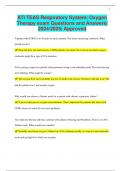
ATI TEAS Respiratory System| Oxygen
Therapy exam Questions and Answers|
2024/2025| Approved
A patient with COPD is on 4L/min via nasal cannula. You notice increasing confusion. What
should you do?
Drop the flow rate and reassess. COPD patients can retain CO₂ if given too much oxygen –
confusion might be a sign of CO₂ retention.
You're giving oxygen to a patient with pneumonia using a non-rebreathe mask. The reservoir bag
isn’t inflating. What might be wrong?
The oxygen flow rate’s probably too low. It needs to be at least 15L/min or the bag won’t fill
and the patient won’t get enough oxygen.
Why would you choose a Venturi mask for a patient with chronic respiratory failure?
It gives really precise oxygen concentrations. That’s important for patients like those with
COPD where too much O₂ can cause problems.
You walk into the bay and hear a patient with asthma wheezing and breathless. They’re on 28%
Venturi mask. What would you consider?
Probably need more oxygen. Asthma isn’t CO₂-retaining usually, so swap to a non-rebreathe
mask and go high flow while you escalate.
, 2
Patient is hypoxic on 2L/min nasal cannula. SpO₂ is 86%. What’s your next move?
Increase the flow or change the delivery method. 2L/min isn’t cutting it, so maybe switch to
a simple face mask or Venturi depending on need.
Why should you humidify oxygen for a patient on long-term therapy?
Dry oxygen can irritate the airways and cause crusting. Humidification helps keep secretions
loose and airways comfy.
You’re setting up oxygen for someone with tracheostomy. What’s the safest method?
Use a trach mask with humidified oxygen. Regular masks don’t work properly for trach
patients.
Your patient on oxygen suddenly becomes drowsy with a RR of 8. What could be happening?
They might be retaining CO₂. Too much oxygen can knock out the drive to breathe,
especially in COPD.
You’re asked to explain why nasal cannulas aren't great for high oxygen needs. What do you
say?
They only deliver about 24–40% O₂ and aren't reliable at high flow. Plus, if the patient’s
mouth breathing, it's even less effective.
A post-op patient is on 15L via non-rebreathe but SpO₂ is still 89%. What should you do?
ATI TEAS Respiratory System| Oxygen
Therapy exam Questions and Answers|
2024/2025| Approved
A patient with COPD is on 4L/min via nasal cannula. You notice increasing confusion. What
should you do?
Drop the flow rate and reassess. COPD patients can retain CO₂ if given too much oxygen –
confusion might be a sign of CO₂ retention.
You're giving oxygen to a patient with pneumonia using a non-rebreathe mask. The reservoir bag
isn’t inflating. What might be wrong?
The oxygen flow rate’s probably too low. It needs to be at least 15L/min or the bag won’t fill
and the patient won’t get enough oxygen.
Why would you choose a Venturi mask for a patient with chronic respiratory failure?
It gives really precise oxygen concentrations. That’s important for patients like those with
COPD where too much O₂ can cause problems.
You walk into the bay and hear a patient with asthma wheezing and breathless. They’re on 28%
Venturi mask. What would you consider?
Probably need more oxygen. Asthma isn’t CO₂-retaining usually, so swap to a non-rebreathe
mask and go high flow while you escalate.
, 2
Patient is hypoxic on 2L/min nasal cannula. SpO₂ is 86%. What’s your next move?
Increase the flow or change the delivery method. 2L/min isn’t cutting it, so maybe switch to
a simple face mask or Venturi depending on need.
Why should you humidify oxygen for a patient on long-term therapy?
Dry oxygen can irritate the airways and cause crusting. Humidification helps keep secretions
loose and airways comfy.
You’re setting up oxygen for someone with tracheostomy. What’s the safest method?
Use a trach mask with humidified oxygen. Regular masks don’t work properly for trach
patients.
Your patient on oxygen suddenly becomes drowsy with a RR of 8. What could be happening?
They might be retaining CO₂. Too much oxygen can knock out the drive to breathe,
especially in COPD.
You’re asked to explain why nasal cannulas aren't great for high oxygen needs. What do you
say?
They only deliver about 24–40% O₂ and aren't reliable at high flow. Plus, if the patient’s
mouth breathing, it's even less effective.
A post-op patient is on 15L via non-rebreathe but SpO₂ is still 89%. What should you do?