1
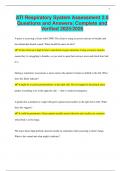
ATI Respiratory System Assessment 2.0
Questions and Answers| Complete and
Verified 2025/2026
A nurse is assessing a client with COPD. The client is using accessory muscles to breathe and
has diminished breath sounds. What should the nurse do first?
Sit the client up in high Fowler’s and check oxygen saturation. Using accessory muscles
means they’re struggling to breathe, so you want to open their airways more and check how bad
it is.
During a respiratory assessment, a nurse notices the patient’s trachea is shifted to the left. What
does this likely indicate?
It might be a tension pneumothorax on the right side. The air trapped in the pleural space
pushes everything over to the opposite side — that’s a medical emergency.
A patient has a productive cough with green sputum and crackles in the right lower lobe. What
does this suggest?
It could be pneumonia. Green sputum usually means infection and crackles are common
when fluid is in the lungs.
The nurse hears high-pitched, musical sounds on expiration when assessing a client’s lungs.
What is this sound and what might it indicate?
, 2
That’s wheezing, and it usually points to narrowed airways — think asthma or
bronchospasm.
A client suddenly becomes short of breath after surgery and has chest pain. What should the
nurse suspect?
Possibly a pulmonary embolism. That’s a post-op risk, especially if they’ve been immobile.
It’s sudden and serious.
A nurse is doing a focused respiratory assessment on a client with asthma. What findings would
show the client’s condition is worsening?
Decreased breath sounds or no wheezing — which actually means less air is moving, not
improvement.
While percussing a patient’s chest, the nurse hears dullness over the left lower lobe. What might
this mean?
There could be fluid or consolidation, like in pneumonia. Dullness usually replaces the
normal hollow sound.
A patient with a chest tube complains of increased shortness of breath. What should the nurse
check first?
Look at the chest tube for any kinks, clots, or if it’s become dislodged. That could stop it
from working right.
ATI Respiratory System Assessment 2.0
Questions and Answers| Complete and
Verified 2025/2026
A nurse is assessing a client with COPD. The client is using accessory muscles to breathe and
has diminished breath sounds. What should the nurse do first?
Sit the client up in high Fowler’s and check oxygen saturation. Using accessory muscles
means they’re struggling to breathe, so you want to open their airways more and check how bad
it is.
During a respiratory assessment, a nurse notices the patient’s trachea is shifted to the left. What
does this likely indicate?
It might be a tension pneumothorax on the right side. The air trapped in the pleural space
pushes everything over to the opposite side — that’s a medical emergency.
A patient has a productive cough with green sputum and crackles in the right lower lobe. What
does this suggest?
It could be pneumonia. Green sputum usually means infection and crackles are common
when fluid is in the lungs.
The nurse hears high-pitched, musical sounds on expiration when assessing a client’s lungs.
What is this sound and what might it indicate?
, 2
That’s wheezing, and it usually points to narrowed airways — think asthma or
bronchospasm.
A client suddenly becomes short of breath after surgery and has chest pain. What should the
nurse suspect?
Possibly a pulmonary embolism. That’s a post-op risk, especially if they’ve been immobile.
It’s sudden and serious.
A nurse is doing a focused respiratory assessment on a client with asthma. What findings would
show the client’s condition is worsening?
Decreased breath sounds or no wheezing — which actually means less air is moving, not
improvement.
While percussing a patient’s chest, the nurse hears dullness over the left lower lobe. What might
this mean?
There could be fluid or consolidation, like in pneumonia. Dullness usually replaces the
normal hollow sound.
A patient with a chest tube complains of increased shortness of breath. What should the nurse
check first?
Look at the chest tube for any kinks, clots, or if it’s become dislodged. That could stop it
from working right.