1/22/25
Rachel Jeric Clark Anatomy and Physiology
Lecture 2: Muscles
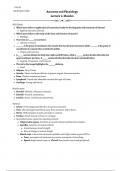
Skill Check:
Which term refers to application of anatomical study for the diagnosis and treatment of disease?
Applied Anatomy (clinical).
Which term refers to the study of the form and function of muscle?
Myology.
Your toes are _____ to your knee.
Inferior or Distal.
_______ is the point of attachment of a muscle that has the least movement while _______ is the point of
attachment of a muscle that is relatively mobile.
Origin and Insertion.
A _____ section divides the body into right and left halves, while a ______ section divides the body into
upper and lower portions. A _____ section divides the body into front and back halves.
Sagittal, Transverse, and Coronal.
The red in the image highlights the ______ skeleton.
Axial.
Adipose- Fatty Tissue.
Areolar- Elastic and more delicate (supports organs, between muscles.
Bone- Hardest connective tissue.
Lymphoid- Tonsils and adenoids contains this type of tissue.
Cartilage- Strong and elastic.
Muscle types:
Straited- Skeletal, voluntary (somatic).
Smooth- Visceral, involuntary.
Cardiac- Heart, involuntary (autonomic).
Skeletal:
Artery- Fresh oxygenated blood to structures (muscles).
Vein- takes deoxygenated blood away from structure and to heart.
Nerve- Will stimulate muscle and make it contract.
Tendon- Attach muscle to bone or cartilage.
Specialized sense organs for signaling tension:
Golgi tendon organs- Sensitive to muscle tension and found in tendons.
Spindles- Sensitive to muscle stretch.
Instantaneous muscle length.
Rate of change in muscle length.
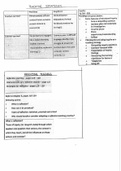
Muscle tone- Interaction of muscle spindles and Golgi tendon organs (GTOs).
Tone- perception of resistance to passive movement of stretching.
Spastic (high muscle tone) vs. Flaccid (low muscle tone/weak/paralyzed).
Rachel Jeric Clark Anatomy and Physiology
Lecture 2: Muscles
Skill Check:
Which term refers to application of anatomical study for the diagnosis and treatment of disease?
Applied Anatomy (clinical).
Which term refers to the study of the form and function of muscle?
Myology.
Your toes are _____ to your knee.
Inferior or Distal.
_______ is the point of attachment of a muscle that has the least movement while _______ is the point of
attachment of a muscle that is relatively mobile.
Origin and Insertion.
A _____ section divides the body into right and left halves, while a ______ section divides the body into
upper and lower portions. A _____ section divides the body into front and back halves.
Sagittal, Transverse, and Coronal.
The red in the image highlights the ______ skeleton.
Axial.
Adipose- Fatty Tissue.
Areolar- Elastic and more delicate (supports organs, between muscles.
Bone- Hardest connective tissue.
Lymphoid- Tonsils and adenoids contains this type of tissue.
Cartilage- Strong and elastic.
Muscle types:
Straited- Skeletal, voluntary (somatic).
Smooth- Visceral, involuntary.
Cardiac- Heart, involuntary (autonomic).
Skeletal:
Artery- Fresh oxygenated blood to structures (muscles).
Vein- takes deoxygenated blood away from structure and to heart.
Nerve- Will stimulate muscle and make it contract.
Tendon- Attach muscle to bone or cartilage.
Specialized sense organs for signaling tension:
Golgi tendon organs- Sensitive to muscle tension and found in tendons.
Spindles- Sensitive to muscle stretch.
Instantaneous muscle length.
Rate of change in muscle length.
Muscle tone- Interaction of muscle spindles and Golgi tendon organs (GTOs).
Tone- perception of resistance to passive movement of stretching.
Spastic (high muscle tone) vs. Flaccid (low muscle tone/weak/paralyzed).