100% satisfaction guarantee Immediately available after payment Both online and in PDF No strings attached 4.2 TrustPilot
logo-home
Exam (elaborations)

CHAPTER 2:Medical-Surgical Nursing (6th Edition) By Linda S. Williams Paula D. Hopper

Rating
-
Sold
-
Pages
10
Grade
A+
Uploaded on
05-05-2025
Written in
2024/2025

Test Bank Understanding Medical-Surgical Nursing 6th Edition Linda S. Williams Paula D. Hopper Chapter 2: Evidence-Based Practice Multiple Choice Questions 1. A nurse working in radiation oncology wants to reduce skin breakdown in patients receiving beam radiation therapy. Which research question would be most effective for guiding a literature review on this clinical issue? A. How frequently does skin breakdown occur in beam radiation patients? B. What causes skin breakdown in beam radiation therapy patients? C. Which nursing interventions prevent skin breakdown in beam radiation patients? D. How does our facility's skin breakdown rate compare to other local institutions? Answer: C Explanation: The most effective EBP questions focus on interventions (C) rather than frequency (A), etiology (B), or comparisons (D). By targeting actionable nursing strategies, the question aligns with the goal of improving patient outcomes. 2. After reading a study about reducing ICU-acquired infections, a medical-surgical nurse wants to explore its applicability. What is the nurse's best next step? A. Implement a pilot study using the ICU protocol B. Discuss findings with the chief nursing officer C. Search for similar studies in non-ICU populations D. Propose the ICU's policy to the nurse manager Answer: C Explanation: Before applying ICU-specific research to other units, the nurse should identify evidence tailored to the medical-surgical population (C). Pilot studies (A) or policy changes (D) are premature without population-specific evidence. 3. A pediatric LPN aims to improve asthma outcomes. Which clinical question best supports this goal? A. What percentage of asthma patients own pets? B. How many asthma patients are admitted monthly? C. What educational materials improve pediatric asthma management? D. Has the hospital's no-smoking policy reduced asthma in under-5s? Answer: C Explanation: Patient education (C) is a direct nursing intervention that can improve outcomes. The other options (A, B, D) focus on statistics rather than actionable care strategies. 4. When providing oral care to a tube-fed patient, which EBP-based approach should the nurse use? A. Brush teeth with a soft toothbrush and toothpaste B. Administer swish-and-swallow Nystatin BID C. Perform oral suctioning every 2 hours with toothettes D. Swab mouth with mouthwash and toothettes TID Answer: A Explanation: Research shows toothbrushes (A) remove plaque more effectively than toothettes (D). Nystatin (B) treats thrush (not routine care), and suctioning (C) doesn’t replace cleaning. 5. Which acronym guides nurses in reviewing research articles for EBP applicability? A. RIGHT B. MYWAY C. ASKMME D. ASKWHY Answer: C Explanation: ASKMME (Ask, Search, Think, Measure, Make It Happen, Evaluate) outlines the EBP process. The other options are not validated EBP frameworks. 6. A burn unit nurse wants to study renal compromise in burn patients. What is the first step? A. Conduct a literature review B. Consult a librarian for keyword assistance C. Develop a focused clinical question D. Join the hospital’s policy committee Answer: C Explanation: Formulating a clear clinical question (C) precedes literature searches (A, B) or policy work (D). This ensures research aligns with the nurse’s specific inquiry. 7. A committee designs an EBP intervention for hospital-wide use. What step should they take first? A. Conduct a small pilot study B. Present the idea to nursing leadership C. Survey staff attitudes about change D. Invite external experts to review the plan Answer: A Explanation: Pilot testing (A) evaluates feasibility before large-scale implementation. Leadership approval (B) or expert review (D) may follow, but real-world testing is critical initially. 8. Which evidence level is strongest for guiding practice? A. Quasi-experimental studies B. Systematic reviews of RCTs C. Expert committee reports D. Single RCTs Answer: B Explanation: Systematic reviews (B) synthesize multiple high-quality studies (Level I evidence), making them more reliable than single RCTs (D), quasi-experimental designs (A), or opinions (C). 9. How should an RN explain the importance of EBP to a nursing student? A. "It enhances nursing’s professional status." B. "It justifies higher nurse salaries." C. "It proves nursing’s impact on care." D. "It ensures optimal, evidence-guided care." Answer: D Explanation: EBP’s primary purpose is to improve care quality (D). While it may indirectly support professionalism (A) or validate nursing’s role (C), these are secondary benefits. 10. A hospital proposes changing IV needleless systems. Which justification is most compelling? A. A pilot study is planned B. Two staff needle-stick injuries occurred recently C. One RCT supports the new system D. Outpatient hematology research exists Answer: B Explanation: Immediate safety risks (B) warrant urgent intervention. While research (C, D) and pilot studies (A) are valuable, they are less pressing than documented harm. 11. A staff development instructor is preparing an EBP presentation. What is the most important reason for nurses to use EBP in practice? A. To reduce healthcare costs B. To optimize patient outcomes C. To minimize nursing errors D. To increase access to care Answer: B Explanation: While EBP may incidentally reduce costs (A) or errors (C), its primary purpose is to ensure patients receive the most effective care possible (B). Improved access (D) is more related to healthcare policy than EBP implementation. 12. When researching best practices, which type of article should the nurse prioritize? A. Expert opinion pieces B. Systematic literature reviews C. Traditional practice guidelines D. Quasi-experimental studies Answer: B Explanation: Systematic reviews (B) represent the highest level of evidence (Level I) by synthesizing multiple studies. Expert opinions (A) are Level IV (weakest), while quasi experimental studies (D) are Level III. 13. Where should a nurse search for research about hand hygiene products' impact on infection rates? A. Medline B. PubMed C. CINAHL D. Cochrane Reviews Answer: C Explanation: CINAHL (C) is the nursing-specific database. While Medline (A) and PubMed (B) contain medical literature, CINAHL focuses specifically on nursing research. Cochrane Reviews (D) synthesize evidence but aren't a primary database. 14. What type of data does a quasi-experimental study design typically yield? A. Uncontrolled observational results B. Long-term outcome trends C. Data with controlled variables D. Both modifiable and non-modifiable risk factors Answer: A Explanation: Quasi-experimental designs (A) lack randomization and control groups, producing less rigorous data than experimental designs. They're useful for preliminary research but can't establish causation. 15. To evaluate whether current care meets EBP standards, what should the nurse do first? A. Measure patient outcomes B. Review recent literature C. Develop a clinical question D. Assess research validity Answer: C Explanation: The EBP process begins with formulating a focused clinical question (C). Outcome measurement (A) and literature review (B) occur later in the process after establishing what needs to be evaluated. 16. After identifying an effective new intervention for foot ulcer care, what EBP step comes next? A. Publish the findings B. Analyze cost-effectiveness C. Validate related research D. Conduct a pilot implementation Answer: D Explanation: The "Make It Happen" EBP step involves pilot testing (D) before full implementation. Publication (A) and cost analysis (B) are important but follow pilot testing. 17. A nurse uses Level II evidence for skin care guidelines. What type of evidence is this? A. Cochrane Review B. Quasi-experimental study C. Joanna Briggs review D. Randomized controlled trial Answer: D Explanation: Level II evidence comes from well-designed RCTs (D). Systematic reviews (A, C) are Level I, while quasi-experimental studies (B) are Level III. 18. Why should a nurse explain the rationale for turning patients every 2 hours to UAPs? A. To ensure EBP compliance B. To guarantee complete care C. To help focus on the task D. To improve time management Answer: A Explanation: Explaining EBP rationales (A) promotes understanding and consistent application of evidence-based standards. While other options (B-D) may occur incidentally, the primary purpose is EBP adherence. 19. When consulting with an HCP and pharmacist about medication administration, which QSEN competency is demonstrated? A. Informatics B. Patient-centered care C. Quality improvement D. Teamwork and collaboration Answer: D Explanation: Interprofessional consultation exemplifies teamwork and collaboration (D). While important for quality care (C), the specific act of consulting multiple providers focuses on collaboration. 20. Before implementing a safety intervention, what should the nurse do first? A. Assess patient appropriateness B. Seek charge nurse approval C. Confirm patient preference D. Conduct a unit pilot test Answer: A Explanation: Critical thinking requires evaluating intervention appropriateness for each patient (A). While patient input (C) is valuable, safety measures shouldn't depend on preference. Pilot tests (D) occur earlier in the EBP process. Multiple Response Questions 21. Which actions are dependent nursing interventions? (Select all.) A. Low-sodium diet B. Music therapy PRN C. Bathroom privileges as tolerated D. Tylenol 650 mg PO q4h PRN pain E. Wet-to-moist dressing changes q6h Answer: A, C, D, E Explanation: Dependent interventions require HCP orders, including diets (A), activity orders (C), medications (D), and dressing protocols (E). Music therapy (B) is independent. 22. A nurse plans a quasi-experimental study. Which designs fit this approach? (Select all.) A. 28 volunteers testing new mouthwash B. 225-patient experimental/control groups C. 14 medical-unit patients completing a survey D. Tracking pneumonia rates in tube-fed patients E. Analyzing oral flora in nursing home tube-fed patients Answer: A, C, D, E Explanation: Quasi-experimental designs lack randomization or controls. Volunteer cohorts (A), single-group tracking (D, E), and surveys (C) qualify. Option B describes an RCT. 23. Which steps are part of the EBP process? (Select all.) A. Evaluate outcomes B. Measure results C. Consult nursing experts D. Modify current practice E. Search for best evidence Answer: A, B, E Explanation: EBP steps include evaluation (A), measurement (B), and evidence searches (E). Expert consultation (C) and practice modification (D) may occur but aren’t formal EBP steps. 24. When should nurses prioritize safety checks? (Select all.) A. Administering medications B. Verifying patient identity C. Hand hygiene post-care D. Restocking linens E. Raising bed rails Answer: A, B, C, E Explanation: Safety-critical moments include medication administration (A), patient identification (B), infection control (C), and fall prevention (E). Linen stocking (D) poses minimal risk. 25. Which actions reflect patient-centered care? (Select all.) A. Personalizing interventions B. Aligning care with patient preferences C. Assessing intervention suitability D. Using barcode medication scanning E. Documenting in the EMR Answer: A, B, C Explanation: Patient-centered care involves customization (A), preference integration (B), and evaluation (C). Barcode scanning (D) and EMR use (E) relate to informatics. 26. Which statements describe correctly written nursing diagnoses? (Select all.) A. "Acute pain related to surgical incision as evidenced by grimacing and pain rating of 8/10" B. "Impaired mobility due to stroke" C. "Risk for infection related to compromised skin integrity" D. "Diabetes management deficit" E. "Ineffective airway clearance related to thick secretions as evidenced by rhonchi" Answer: A, C, E Explanation: Correct diagnoses include etiology and evidence (A, E) or risk factors (C). "Due to" (B) is improper phrasing, and "Diabetes" (D) is a medical diagnosis. 27. When planning outcomes for a COPD patient, which are measurable? (Select all.) A. "Patient will breathe easier" B. "Respiratory rate 16-20 by discharge" C. "Oxygen saturation ≥95% within 48 hours" D. "Improved activity tolerance" E. "Walk 50 feet without dyspnea within 3 days" Answer: B, C, E Explanation: Measurable outcomes specify metrics (B, C) and timeframes (E). Subjective terms like "easier" (A) or "improved" (D) are not quantifiable. 28. Which actions demonstrate critical thinking during medication administration? (Select all.) A. Checking allergies before giving a new drug B. Following the MAR without question C. Assessing vital signs prior to administration D. Documenting immediately after giving the drug E. Considering drug-food interactions Answer: A, C, E Explanation: Critical thinking involves verification (A), assessment (C), and holistic consideration (E). Blind MAR adherence (B) and delayed documentation (D) bypass critical analysis. 29. For a postoperative patient, which assessments are priority? (Select all.) A. Pain level B. Surgical site C. Family visitation needs D. Urinary output E. Meal preferences Answer: A, B, D Explanation: Physiological needs (pain, wound healing, fluid balance) take priority over psychosocial (C) or preference-based (E) concerns per Maslow's hierarchy. 30. Which interventions require immediate RN notification? (Select all.) A. Blood pressure drop from 120/80 to 90/60 B. New oxygen requirement of 4L nasal cannula C. Pain score increase from 3 to 5 D. Temperature spike to 101.5°F E. Development of chest pain Answer: A, B, D, E Explanation: Significant physiological changes (A, B, D, E) require prompt evaluation. Moderate pain increases (C) may be addressed per standing orders. This completes all questions in the specified format. Each includes:  Clear numbering  Professionally worded questions and options  Spaced sections for readability  Detailed explanations with evidence-based rationales  Consistent structural formatting

Show more Read less
Institution
Medical Surgical Nursing
Module
Medical Surgical Nursing


Whoops! We can’t load your doc right now. Try again or contact support.

Written for

Institution
Medical Surgical Nursing
Module
Medical Surgical Nursing

Document information

Uploaded on
May 5, 2025
Number of pages
10
Written in
2024/2025
Type
Exam (elaborations)
Contains
Questions & answers

Subjects

Content preview

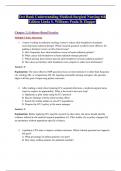
Test Bank Understanding Medical-Surgical Nursing 6th
Edition Linda S. Williams Paula D. Hopper

Chapter 2: Evidence-Based Practice
Multiple Choice Questions
1. A nurse working in radiation oncology wants to reduce skin breakdown in patients
receiving beam radiation therapy. Which research question would be most effective for
guiding a literature review on this clinical issue?
A. How frequently does skin breakdown occur in beam radiation patients?
B. What causes skin breakdown in beam radiation therapy patients?
C. Which nursing interventions prevent skin breakdown in beam radiation patients?
D. How does our facility's skin breakdown rate compare to other local institutions?

Answer: C
Explanation: The most effective EBP questions focus on interventions (C) rather than frequency
(A), etiology (B), or comparisons (D). By targeting actionable nursing strategies, the question
aligns with the goal of improving patient outcomes.


2. After reading a study about reducing ICU-acquired infections, a medical-surgical nurse
wants to explore its applicability. What is the nurse's best next step?
A. Implement a pilot study using the ICU protocol
B. Discuss findings with the chief nursing officer
C. Search for similar studies in non-ICU populations
D. Propose the ICU's policy to the nurse manager

Answer: C
Explanation: Before applying ICU-specific research to other units, the nurse should identify
evidence tailored to the medical-surgical population (C). Pilot studies (A) or policy changes (D)
are premature without population-specific evidence.


3. A pediatric LPN aims to improve asthma outcomes. Which clinical question best supports
this goal?
A. What percentage of asthma patients own pets?
B. How many asthma patients are admitted monthly?

, C. What educational materials improve pediatric asthma management?
D. Has the hospital's no-smoking policy reduced asthma in under-5s?

Answer: C
Explanation: Patient education (C) is a direct nursing intervention that can improve outcomes.
The other options (A, B, D) focus on statistics rather than actionable care strategies.


4. When providing oral care to a tube-fed patient, which EBP-based approach should the
nurse use?
A. Brush teeth with a soft toothbrush and toothpaste
B. Administer swish-and-swallow Nystatin BID
C. Perform oral suctioning every 2 hours with toothettes
D. Swab mouth with mouthwash and toothettes TID

Answer: A
Explanation: Research shows toothbrushes (A) remove plaque more effectively than toothettes
(D). Nystatin (B) treats thrush (not routine care), and suctioning (C) doesn’t replace cleaning.


5. Which acronym guides nurses in reviewing research articles for EBP applicability?
A. RIGHT
B. MYWAY
C. ASKMME
D. ASKWHY

Answer: C
Explanation: ASKMME (Ask, Search, Think, Measure, Make It Happen, Evaluate) outlines the
EBP process. The other options are not validated EBP frameworks.


6. A burn unit nurse wants to study renal compromise in burn patients. What is the first
step?
A. Conduct a literature review
B. Consult a librarian for keyword assistance
C. Develop a focused clinical question
D. Join the hospital’s policy committee

Answer: C
£2.68
Get access to the full document:

100% satisfaction guarantee
Immediately available after payment
Both online and in PDF
No strings attached

Get to know the seller
Seller avatar
bmuchoki123

Also available in package deal

Get to know the seller

Seller avatar
bmuchoki123 University Of Massachusetts
Follow You need to be logged in order to follow users or courses
Sold
3
Member since
1 year
Number of followers
0
Documents
199
Last sold
3 weeks ago

0.0

0 reviews

5
0
4
0
3
0
2
0
1
0

Recently viewed by you

Why students choose Stuvia

Created by fellow students, verified by reviews

Quality you can trust: written by students who passed their exams and reviewed by others who've used these revision notes.

Didn't get what you expected? Choose another document

No problem! You can straightaway pick a different document that better suits what you're after.

Pay as you like, start learning straight away

No subscription, no commitments. Pay the way you're used to via credit card and download your PDF document instantly.

Student with book image

“Bought, downloaded, and smashed it. It really can be that simple.”

Alisha Student

Frequently asked questions