

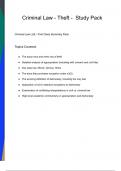
Criminal Law - Theft - Study Pack
Criminal Law LLB - First Class Summary Pack
Topics Covered:
● The actus reus and mens rea of theft
● Detailed analysis of appropriation (including with consent and civil title)
● Key case law: Morris, Gomez, Hinks
● The bona fide purchaser exception under s3(2)
● The evolving definition of dishonesty, including the Ivey test
● Application of s2(1) statutory exceptions to dishonesty
● Examination of conflicting interpretations in civil vs. criminal law
● High-level academic commentary on appropriation and dishonesty
, Theft
Introduction
Theft: D dishonestly appropriates V’s property
Theft
s1(1) Theft Act 1968 defines theft
‘A person is guilty of theft if he dishonestly appropriates property belonging to another with the
intention of permanently depriving the other of it.’
Maximum penalty: on indictment is 7 years imprisonment
Actus reus Mens rea
Conduct element Any conduct causing the Voluntary
result
Circumstance element What is appropriated is Knowledge
property
It belongs to another
Knowledge
D’s appropriation is dishonest
In the context of D’s
knowledge and belief
Result element D appropriates V’s property intention
Ulterior mens rea element Intention permanently to
deprive V of her property
1
Criminal Law LLB - First Class Summary Pack
Topics Covered:
● The actus reus and mens rea of theft
● Detailed analysis of appropriation (including with consent and civil title)
● Key case law: Morris, Gomez, Hinks
● The bona fide purchaser exception under s3(2)
● The evolving definition of dishonesty, including the Ivey test
● Application of s2(1) statutory exceptions to dishonesty
● Examination of conflicting interpretations in civil vs. criminal law
● High-level academic commentary on appropriation and dishonesty
, Theft
Introduction
Theft: D dishonestly appropriates V’s property
Theft
s1(1) Theft Act 1968 defines theft
‘A person is guilty of theft if he dishonestly appropriates property belonging to another with the
intention of permanently depriving the other of it.’
Maximum penalty: on indictment is 7 years imprisonment
Actus reus Mens rea
Conduct element Any conduct causing the Voluntary
result
Circumstance element What is appropriated is Knowledge
property
It belongs to another
Knowledge
D’s appropriation is dishonest
In the context of D’s
knowledge and belief
Result element D appropriates V’s property intention
Ulterior mens rea element Intention permanently to
deprive V of her property
1


