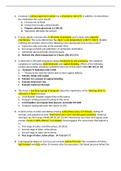
1. During an abdominal exam, what is the correct
sequence of examination to avoid altering bowel
sounds?
A. Inspect → Percuss → Auscultate → Palpate
B. Inspect → Palpate → Percuss → Auscultate
C. Inspect → Auscultate → Percuss → Palpate
D. Inspect → Palpate → Auscultate → Percuss
Answer: C. Inspect → Auscultate → Percuss → Palpate
Rationale: Auscultation must precede percussion and
palpation because palpation/percussion can introduce or
alter bowel sounds, leading to inaccurate findings
(Inspection, Auscultation, Palpation, and Percussion of the
Abdomen).
2. What is the correct order of techniques for a
respiratory assessment?
A. Inspection → Percussion → Palpation → Auscultation
B. Inspection → Palpation → Percussion → Auscultation
C. Inspection → Auscultation → Percussion → Palpation
D. Inspection → Percussion → Auscultation → Palpation
Answer: B. Inspection → Palpation → Percussion →
Auscultation
Rationale: The pulmonary exam follows inspection, then
palpation for chest expansion/tactile fremitus, then
percussion to assess resonance, and finally auscultation
to listen for breath sounds (Lung Sounds - StatPearls -
NCBI Bookshelf).
, 3. The triangle of auscultation is a useful landmark for
posterior lung sounds. Which boundaries define it?
A. Inferior trapezius, latissimus dorsi, medial border of
scapula
B. Superior trapezius, rhomboid major, lateral border of
scapula
C. Latissimus dorsi, teres major, medial border of scapula
D. Inferior trapezius, erector spinae, lateral border of
scapula
Answer: A. Inferior trapezius, latissimus dorsi, medial
border of scapula
Rationale: The triangle of auscultation is bordered
medially by trapezius (inferior portion), inferiorly by
latissimus dorsi, and laterally by the scapula’s medial
border, allowing improved posterior lung auscultation
(Triangle of auscultation - Wikipedia).
4. Why should you warm the stethoscope diaphragm
before auscultation?
A. To sterilize the instrument
B. To enhance low-frequency sound transmission
C. To prevent patient discomfort and muscle tension
artifacts
D. To improve seal against the skin
Answer: C. To prevent patient discomfort and muscle
tension artifacts
Rationale: A cold stethoscope can cause the patient to
tense muscles and shiver, producing extra sounds;
sequence of examination to avoid altering bowel
sounds?
A. Inspect → Percuss → Auscultate → Palpate
B. Inspect → Palpate → Percuss → Auscultate
C. Inspect → Auscultate → Percuss → Palpate
D. Inspect → Palpate → Auscultate → Percuss
Answer: C. Inspect → Auscultate → Percuss → Palpate
Rationale: Auscultation must precede percussion and
palpation because palpation/percussion can introduce or
alter bowel sounds, leading to inaccurate findings
(Inspection, Auscultation, Palpation, and Percussion of the
Abdomen).
2. What is the correct order of techniques for a
respiratory assessment?
A. Inspection → Percussion → Palpation → Auscultation
B. Inspection → Palpation → Percussion → Auscultation
C. Inspection → Auscultation → Percussion → Palpation
D. Inspection → Percussion → Auscultation → Palpation
Answer: B. Inspection → Palpation → Percussion →
Auscultation
Rationale: The pulmonary exam follows inspection, then
palpation for chest expansion/tactile fremitus, then
percussion to assess resonance, and finally auscultation
to listen for breath sounds (Lung Sounds - StatPearls -
NCBI Bookshelf).
, 3. The triangle of auscultation is a useful landmark for
posterior lung sounds. Which boundaries define it?
A. Inferior trapezius, latissimus dorsi, medial border of
scapula
B. Superior trapezius, rhomboid major, lateral border of
scapula
C. Latissimus dorsi, teres major, medial border of scapula
D. Inferior trapezius, erector spinae, lateral border of
scapula
Answer: A. Inferior trapezius, latissimus dorsi, medial
border of scapula
Rationale: The triangle of auscultation is bordered
medially by trapezius (inferior portion), inferiorly by
latissimus dorsi, and laterally by the scapula’s medial
border, allowing improved posterior lung auscultation
(Triangle of auscultation - Wikipedia).
4. Why should you warm the stethoscope diaphragm
before auscultation?
A. To sterilize the instrument
B. To enhance low-frequency sound transmission
C. To prevent patient discomfort and muscle tension
artifacts
D. To improve seal against the skin
Answer: C. To prevent patient discomfort and muscle
tension artifacts
Rationale: A cold stethoscope can cause the patient to
tense muscles and shiver, producing extra sounds;